
TYSM Meaning in Chat: Text & Chat Uses
TYSM means “thank you so much”. In chat, texting, and social media, people use it as a quick, casual way to show strong appreciation without typing the full phrase. If you are searching for tysm meaning in chat, the short answer is simple: it is a warm, informal thank-you used in everyday online communication.
- The term appears most often in friendly messages, quick replies, gaming chats, and comment threads.
- It is common when someone shares help, gives a compliment, sends information, or does a small favor.
- Because it is brief and expressive, it fits fast online conversations where tone matters but speed matters too.
What Does ‘tysm’ Mean?
Full form
TYSM stands for “thank you so much”. It is an abbreviation used in casual online conversations, text messages, and social media. The writer is showing more gratitude than a plain “thanks” would usually express.
Tone and feeling
Compared with a standard “thank you,” tysm feels quicker, softer, and more conversational. It often sounds enthusiastic or affectionate, especially when written in lowercase as “tysm” or with extra punctuation, such as “tysm!!” In very formal situations, though, the full phrase is usually a better choice.
You can think of tysm as stronger than “thx” and more emotional than a simple “thanks.” It signals that the speaker is not just being polite but is genuinely appreciative. In that sense, it works well in the same warm space as phrases like it means a lot when you want to show feeling, not just basic courtesy.
Common chat situations
People use tysm in everyday digital exchanges such as these:
- Someone sends notes, links, or homework help
- A friend gives advice or answers a question
- A seller, classmate, or teammate responds quickly
- Someone offers support, encouragement, or praise
- A person shares good news, a reminder, or useful information
Examples in real messages
Here are a few natural ways tysm appears in chat:
- “tysm for sending the file”
- “Tysm!! You saved me”
- “aw tysm, that’s so kind”
- “tysm for the reminder, I almost forgot”
- “omg tysm, this helps a lot”
How dictionaries support the meaning
Cambridge English Dictionary is useful here because it gives clear definitions, audio pronunciations, and examples of word usage in context. Its entries are informed by the Cambridge English Corpus, a database of over 2 billion words, which helps show how English is actually used. That is especially helpful for learners trying to understand abbreviations that appear in real online writing.
Cambridge also offers British, American, and Business English dictionaries, plus thousands of examples that show how tone changes by context. For learners across CEFR levels A1 to C2, that makes short forms like tysm easier to place: not formal writing, but normal digital conversation. If you are already familiar with everyday message phrases such as looking forward to working with you, tysm belongs on the more casual end of that politeness scale.
Origin
Where it came from
TYSM grew out of early internet and texting culture, where people shortened common phrases to save time and space. Like many abbreviations, it became popular because it was fast to type and easy to understand. Once chat rooms, texting, and social platforms became part of daily life, forms like tysm spread quickly.
Why it stayed popular
The abbreviation has lasted because it does two jobs at once: it is efficient, and it still sounds warm. A bare “k” or “thx” can seem flat, but tysm adds friendliness without much extra effort. That balance makes it especially common among younger speakers and in informal online communities.
- Its popularity also reflects a wider habit in digital English: short expressions often carry tone as much as meaning.
- The same sentence can feel more upbeat, more playful, or more personal depending on word choice.
- You can see a similar shift in everyday greetings such as how’s your day going, where the exact wording changes the social feel of the message.
How to Use ‘tysm’ in Chat
Best times to use it
- Use tysm when the conversation is informal.
- Use it when you want to sound grateful and friendly.
- Use it in quick replies, direct messages, texts, or comments.
- Use it after someone helps you, compliments you, or does something thoughtful.
When to avoid it
- Formal emails to teachers, employers, or clients
- Applications, academic writing, or official requests
- Situations where full wording sounds more respectful
Easy model sentences
- “Tysm for explaining that.”
- “tysm, I really appreciate it.”
- “Tysm for checking on me.”
- “tysm!! that was super helpful.”
How ‘tysm’ Compares
TYSM vs thank you
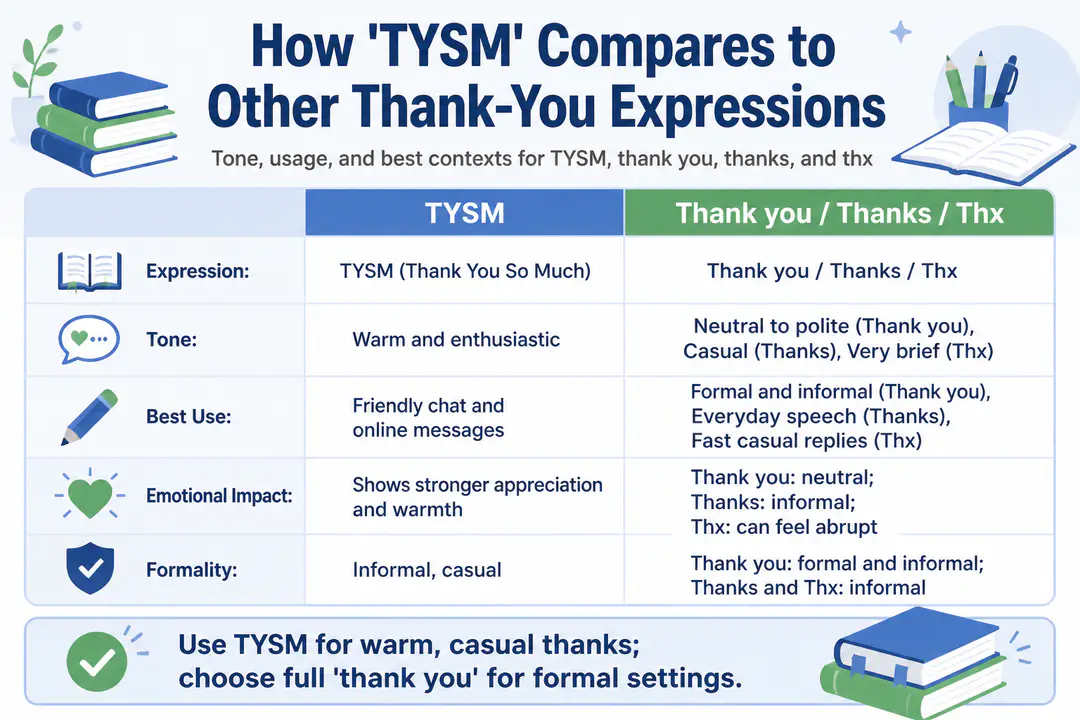
“Thank you” is neutral and works in almost any situation. “TYSM” is more casual and belongs mainly in chat, texts, and social media. If you are unsure which to choose, use the full phrase in formal settings and tysm in relaxed ones.
TYSM vs thanks
“Thanks” is common and informal, but tysm usually sounds more expressive. It adds emphasis, so it fits better when you want to show stronger gratitude. “Thanks” can be routine; tysm often feels more personal.
TYSM vs thx
“Thx” is shorter and can feel more abrupt. TYSM sounds warmer because it includes “so much,” which increases the emotional tone. If your goal is to seem appreciative rather than just efficient, tysm is usually the better choice.
| Expression | Tone | Best use |
|---|---|---|
| Thank you | Neutral to polite | Formal and informal situations |
| Thanks | Casual | Everyday speech and messages |
| Thx | Very brief | Fast, casual replies |
| TYSM | Warm and enthusiastic | Friendly chat and online messages |
FAQs
Is tysm rude?
No. TYSM is not rude in casual conversation. It is a friendly abbreviation, but it can seem too informal in professional or academic writing.
Should tysm be in capital letters?
Both “TYSM” and “tysm” are common. Full capitals can look more emphatic, while lowercase often feels softer and more natural in chat.
Can I use tysm in an email?
You can use it in a very informal email to a friend or close classmate. In work, school, or formal communication, write “thank you so much” instead.
Does tysm mean more than thanks?
Yes. It usually shows stronger appreciation than “thanks.” The phrase “so much” adds extra feeling and emphasis.
Conclusion
TYSM is best used in casual chat when you want a quick, warm way to say thank you without sounding formal.