
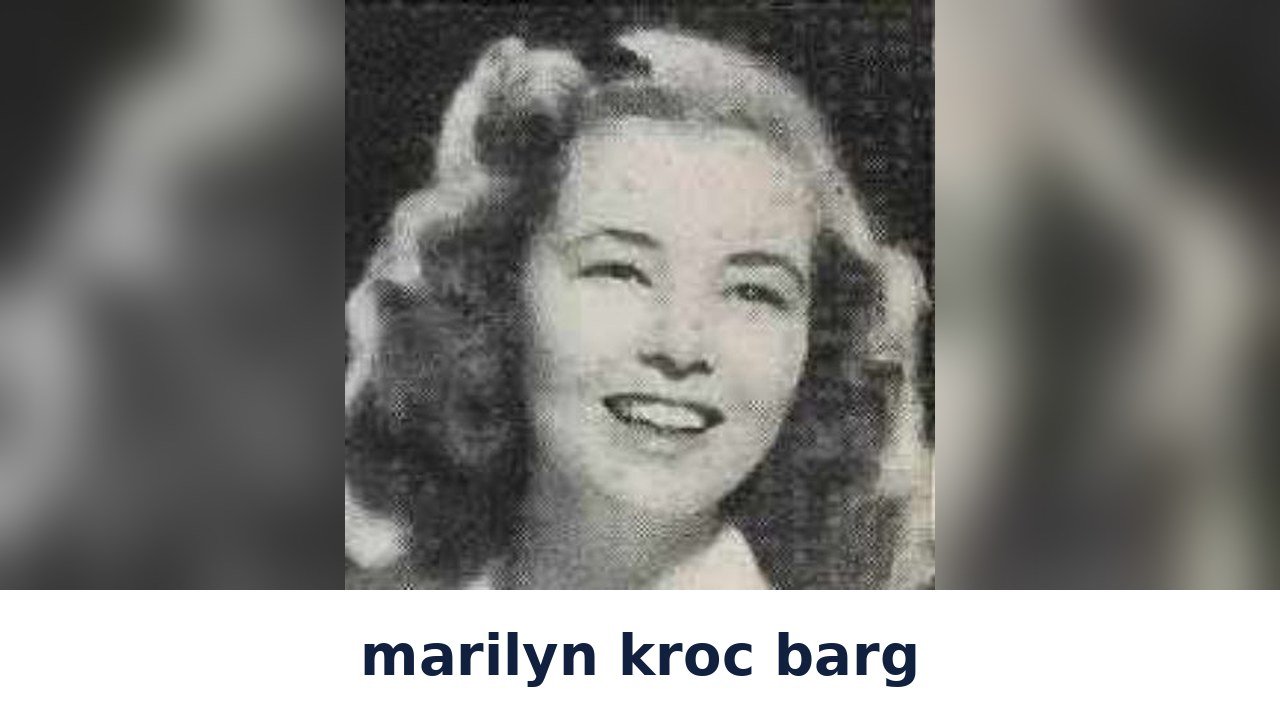
marilyn kroc barg: The Only Daughter of Ray Kroc, Her Private Life, Her Marriages and the Record She Left Behind
Introduction
Behind almost every famous business name there is a family that the cameras never quite reached, and few examples make that clearer than marilyn kroc barg. She was the only child of Ray Kroc, the travelling salesman who took a small California burger stand and built McDonald’s into the most recognisable restaurant company on earth, yet her own life was lived almost entirely away from the company, the headlines and the golden light of the arches. This article sets out what can honestly be said about marilyn kroc barg, using the records that any reader can check: genealogy databases and grave listings, her published death notice, the well-documented history of the Kroc family, and the timeline of McDonald’s itself.
The short answer is that marilyn kroc barg was born Marilyn Janet Kroc in Chicago in 1924, grew up while her father was still an unknown salesman, married twice, lived in the Chicago suburbs, and died in 1973 at the age of forty-eight, a full decade before her father. She left no public career, no memoir, no interviews and no role in the business that made her surname famous, which is precisely why so much of what circulates about her online has to be handled with care. Readers who enjoy celebrity profiles and family stories will find her an unusual subject, because the interest of her story lies in how much of an ordinary, private life can be recovered around the edges of an extraordinary one.
One honest warning belongs at the front of this article rather than at the end. The verified record of marilyn kroc barg is genuinely small, and the sections below separate what the records prove from what later writers have merely repeated, including a few popular claims that collapse the moment they are checked against dates. Where the trail runs out, and with this subject it runs out sooner than most, this article says so plainly instead of filling the quiet with invention.
Who marilyn kroc barg Was
The woman at the centre of this profile, marilyn kroc barg, was born Marilyn Janet Kroc on 15 October 1924 in Chicago, in Cook County, Illinois, and in everyday life she was known by the shorter name Lynn, which is the name her own death notice uses. She was the only child of Raymond Albert Kroc and his first wife, Ethel Janet Fleming, who had married in 1922, two years before her birth. That single fact, that Ray Kroc had exactly one child, gives marilyn kroc barg a fixed and important place in the family story, because she remains her father’s only biological descendant and the only person who grew up inside the Kroc household before the money arrived.
Almost everything firm that is known about marilyn kroc barg fits into a short list of dates, and the rest of this article is built around them. She was born in 1924, married for the first time in 1949, married for the second time in 1960, and died on 11 September 1973 in Arlington Heights, Illinois, at the age of forty-eight. She was buried at Memorial Park Cemetery in Skokie, a short distance from the city where she was born, and her grave is recorded in the public cemetery and genealogy listings under her married name.
Between those fixed points, the life of marilyn kroc barg is mostly silence, and the silence itself is informative. She gave no interviews that survive, published nothing under her name, and appears in the standard histories of McDonald’s, including her father’s own memoir, only at the edges of the frame. Understanding marilyn kroc barg therefore means understanding the family and the business that surrounded her, and then being honest about how little of her inner life any of it can reveal.
The Kroc Family Into Which marilyn kroc barg Was Born
To understand the childhood of marilyn kroc barg, it helps to remember that the Kroc family of the 1920s was not wealthy, famous or connected to restaurants at all. Her father, Ray Kroc, had been born in Oak Park, Illinois, in 1902 to Czech immigrant parents, and when his daughter arrived he was a young salesman still searching for the idea that would define him. Through her childhood he sold paper cups for the Lily-Tulip Cup Company and later travelled selling Multimixer milkshake machines, work that kept him on the road and the family in comfortable but unremarkable circumstances in the Chicago area.
The household that raised marilyn kroc barg was shaped by the Great Depression and then by the Second World War, and by all accounts it was a conventional Midwestern home in which her mother, Ethel, kept the centre. Ethel Fleming had married Ray in 1922 and remained his wife for almost four decades, through the lean years and into the first flush of McDonald’s success, and the later record suggests that mother and daughter were close. When people search for the story of marilyn kroc barg, they are often surprised to learn how ordinary the first thirty years of it were, because her father only encountered the McDonald brothers’ restaurant in 1954, when she was already a married woman of twenty-nine.
The family around marilyn kroc barg changed shape sharply in the 1960s, in ways the record does document. Her parents’ long marriage ended in divorce in 1961, the same year her father bought the McDonald’s company outright from Richard and Maurice McDonald, and her mother died in Chicago in 1965. Her father married twice more, briefly to Jane Dobbins Green and then, in 1969, to Joan Beverly Kroc, whose later fame as one of America’s great philanthropists would eventually overshadow everyone else in the family’s public story, including marilyn kroc barg herself.
Ray Kroc’s Rise, and Where marilyn kroc barg Stood in It
The rise that defines the backdrop of marilyn kroc barg began in 1954, when Ray Kroc, then fifty-two and selling milkshake machines, walked into the McDonald brothers’ busy San Bernardino restaurant and saw the future of American eating. He became their franchising agent, opened his own first restaurant in Des Plaines, Illinois, on 15 April 1955, and in 1961 bought the company outright for 2.7 million dollars. Through the decade that followed, the chain passed a thousand restaurants, went public in 1965 and spread abroad, and Ray Kroc served as its chief executive from 1967 to 1973, remaining its public face long after.
Where marilyn kroc barg stood in all of this can be stated simply: outside it. There is no record of her holding a job, a title or a seat in the company her father built, no photograph of her cutting a ribbon or standing at an opening, and no quote from her in the mountain of coverage the expansion produced. She was a married woman living in the Chicago suburbs while the arches multiplied, and readers who follow famous family histories will recognise the pattern of the founder’s child who neither joins the firm nor trades on its name, but simply gets on with a separate life.
That separation matters to the story of marilyn kroc barg because it explains both her freedom and her obscurity. The Kroc fortune, when it came, arrived in her father’s hands in her adulthood rather than surrounding her childhood, and the philanthropic chapter that later defined the family name belonged to her stepmother Joan after Ray’s death in 1984. Marilyn lived through the transformation of her family from salesman’s household to business dynasty, but she lived through it as a witness at one remove, and she died in 1973 before the company’s greatest decade had even begun.
The Marriages of marilyn kroc barg
The married life of marilyn kroc barg is one of the few parts of her story that public records document in real detail, and it is from her second marriage that her full search name comes. Genealogy records show that she married for the first time on 27 April 1949, at the age of twenty-four, to Sylvester Nordly Nelson. That marriage later ended in divorce, although the date of the divorce is not part of the commonly available record, and no children are recorded from it in the genealogy listings that trace her life.
On 28 May 1960, marilyn kroc barg married James W. Barg, whose full name appears in family records as James Walter Barg, and she remained his wife for the rest of her life. Her Chicago death notice, printed under the name Lynn J. Barg, describes her in exactly those terms, as the loving wife of James W. and the fond daughter of Raymond A. and the late Ethel J. Kroc, and announces private services in Arlington Heights. The notice is a small document, but for a woman who left so little paper behind it is the single most personal piece of the record, and it confirms the two relationships that defined the public outline of marilyn kroc barg: wife of James Barg, daughter of Ray and Ethel Kroc.
No children are recorded for marilyn kroc barg from either marriage, and that absence carries weight in the wider family story. Because she was Ray Kroc’s only child and left no descendants of her own that the records show, the Kroc line did not continue into another generation, and the family’s enormous wealth passed instead to foundations, charities and the causes her stepmother championed. Whatever her private reasons or circumstances, the result is that the name marilyn kroc barg survives in genealogy databases and in searches like the one that brought you here, rather than in a living branch of the family.
marilyn kroc barg in Checked Facts
The table below gathers what can be verified about marilyn kroc barg from genealogy records, cemetery listings, her published death notice and the documented history of her family, so that the firm ground can be seen at a glance. Anything resting only on unsourced repetition has been kept out of the table, and the sections that follow explain both the claims that fail checking and the questions no available record answers.
| Detail | Verified information |
|---|---|
| Full name | Marilyn Janet Kroc, known as Lynn |
| Born | 15 October 1924, Chicago, Cook County, Illinois |
| Father | Raymond Albert Kroc (1902–1984), builder of McDonald’s |
| Mother | Ethel Janet Fleming (married Ray Kroc 1922, divorced 1961, died 1965) |
| Siblings | None — she was Ray Kroc’s only child |
| First marriage | Sylvester Nordly Nelson, 27 April 1949; later divorced |
| Second marriage | James W. Barg, 28 May 1960; remained married until her death |
| Children | None recorded in genealogy listings |
| Died | 11 September 1973, Arlington Heights, Illinois, aged 48 |
| Burial | Memorial Park Cemetery, Skokie, Illinois |
| Role in McDonald’s | None documented |
Two entries in that table deserve a moment of attention from anyone meeting marilyn kroc barg for the first time. The first is her position as an only child, because it makes her the single bridge between the famous founder and any family line that might have followed him. The second is the entry about her role in the business, because its honest emptiness is the fact that later writers have most often tried to fill with decoration, and the decoration is where the errors begin.
A Private Life: What the Record Shows About marilyn kroc barg
Beyond dates and marriages, the record of marilyn kroc barg thins quickly into hints, and the strongest of them concerns horses. Family-history sources repeatedly describe an interest in equestrian life, in riding, breeding and showing horses, as the passion that filled her days in suburban Illinois. The detail is plausible for her time, place and circumstances, and it appears often enough to report, but it has to be labelled honestly: it rests on genealogy and family-history writing rather than on independent reporting from her lifetime, and no stable, stud book or show record under her name has been produced to confirm it.
What can be said with confidence about the texture of marilyn kroc barg’s life is mostly a matter of where she lived and what she avoided. She lived in the Chicago suburbs, in Evanston and then Arlington Heights according to her death notice, in the same corner of Illinois where she had been born and where her father had begun. She avoided, completely and apparently by choice, the publicity machinery that surrounded her father from the late 1950s onwards, and in an age when founders’ families were beginning to become celebrities in their own right, that avoidance was itself a kind of statement about the life she wanted.
It is tempting for writers to dress marilyn kroc barg in a personality assembled from adjectives, generous, graceful, quiet, humble, and many online profiles do exactly that. Those words may even be true, but they are not documented, because the people who knew her left almost nothing in print and she left nothing at all. A respectful profile has to accept the outline the records give, a daughter, a wife, a suburban life, an early death, and resist the urge to paint in features that no source can support.
The Death of marilyn kroc barg and Her Father’s Later Years
The death of marilyn kroc barg came early and quietly, on 11 September 1973 in Arlington Heights, when she was forty-eight years old. Her services were private, as her death notice states, and she was buried at Memorial Park Cemetery in Skokie under her married name. Secondary and genealogy sources widely attribute her death to complications of diabetes, a disease her father also lived with, but the notice published at the time named no cause, so that explanation is best described as widely reported rather than officially confirmed.
For the family of marilyn kroc barg, the loss sat inside a decade of endings and beginnings. Her mother had died eight years earlier, her parents’ marriage had ended twelve years before, and her father, then seventy and still the driving force of McDonald’s, would live another decade, buying the San Diego Padres baseball team in 1974 and publishing his memoir before his own death in San Diego on 14 January 1984. It is often written that grief marked his later years, and while a father’s sorrow at outliving his only child needs no documentation to be believed, the public record of Ray Kroc’s feelings about marilyn kroc barg is as restrained as everything else about her, and this article leaves it there.
The charitable empire that the Kroc name later became was built after marilyn kroc barg was gone, first through the Kroc Foundation her father had established in the 1960s, which supported medical research including work on diabetes, and then on a far larger scale through Joan Kroc, who inherited the fortune in 1984 and gave it away in billions. Marilyn’s place in that story is one of absence: the philanthropy that made her surname beloved in American cities belongs to her father’s later life and her stepmother’s long widowhood, not to any documented work of her own.
Claims About marilyn kroc barg That Do Not Hold Up
Because the real record is thin, the internet has grown a thicker, fictional one around marilyn kroc barg, and a responsible profile should name the largest errors directly. The most repeated claim is that she helped to found Ronald McDonald House Charities, and it cannot be true: she died in September 1973, and the first Ronald McDonald House opened in Philadelphia on 15 October 1974, founded by football player Fred Hill, oncologist Dr Audrey Evans and Eagles general manager Jimmy Murray, with McDonald’s support. The charity’s own history names them, not her, and the dates alone close the question.
Other decorations attached to marilyn kroc barg dissolve just as quickly under checking. She was not the first woman to own a professional baseball team and did not own the San Diego Padres; that was her stepmother Joan Kroc, a confusion that arises because the two women shared a surname and a family. Claims that she sat on the McDonald’s board of directors appear only on unsourced biography pages and in no company or contemporary record, and the round net worth figures attached to her name are guesses without a probate record, an estate report or any other checkable document behind them.
The pattern behind these errors is worth understanding for anyone researching marilyn kroc barg, because it is the pattern of the modern biography mill: a genuinely interesting name with a thin archive is padded with the achievements of relatives, the vocabulary of philanthropy and numbers invented to fill a table. Each copied page makes the next one look better sourced than it is. The defence is the one this article has tried to practise, which is to return every claim to a dated record, a named founder, a published notice or a grave listing, and to let the rest go.
What Cannot Be Verified About marilyn kroc barg
An honest account of marilyn kroc barg ends with the questions the record cannot answer, and they are not small ones. Her schooling is undocumented in any source a reader can check, her daily work and household life left no public trace, and no photograph of her has been published in a place where its identity can be confirmed, which is why this article’s picture shows her father’s era, a 1950s diner scene, rather than pretending to show her. No letters, diaries or interviews survive in public view, and even the state of her relationship with her father in his famous years is a matter of speculation that the available documents neither confirm nor deny.
The cause of her death belongs on the same list, since diabetes is reported everywhere in secondary writing but confirmed nowhere in the primary notice, and the same caution applies to her health in general, her feelings about the divorce of her parents, and her view of the company that carried her name around the world. It would be a poorer but truer summary of marilyn kroc barg to say that we know when she arrived, whom she married, where she lived and when she left, and that nearly everything a reader might most want to know sits beyond the reach of the surviving record.
None of that makes marilyn kroc barg a lesser subject. In a family defined by scale, by thousands of restaurants and billions in giving, hers is the human-sized story: one Chicago childhood in a salesman’s house, two marriages, a suburban life kept deliberately out of the light, and a death at forty-eight that came before the legend finished forming. That outline is all the record honestly offers, and it is enough to remember her by.
Conclusion
In the end, marilyn kroc barg remains what the records say she was: the only child of Ray Kroc and Ethel Fleming, a twice-married Chicago-area woman who lived her forty-eight years almost entirely outside the empire her father built. Her paper trail is thin by any measure, but it is honest, and it leaves a clear human outline of a daughter, a wife and a private life lived in the long shadow of the golden arches.

Related Posts

tina fey and pedro pizarro: A Comedian and an Energy Chief, Two Public Lives Explained

lady gaga and michel vounatsos: Two Famous Lives, No Verified Link — The Singer and the Biogen Chief Explained