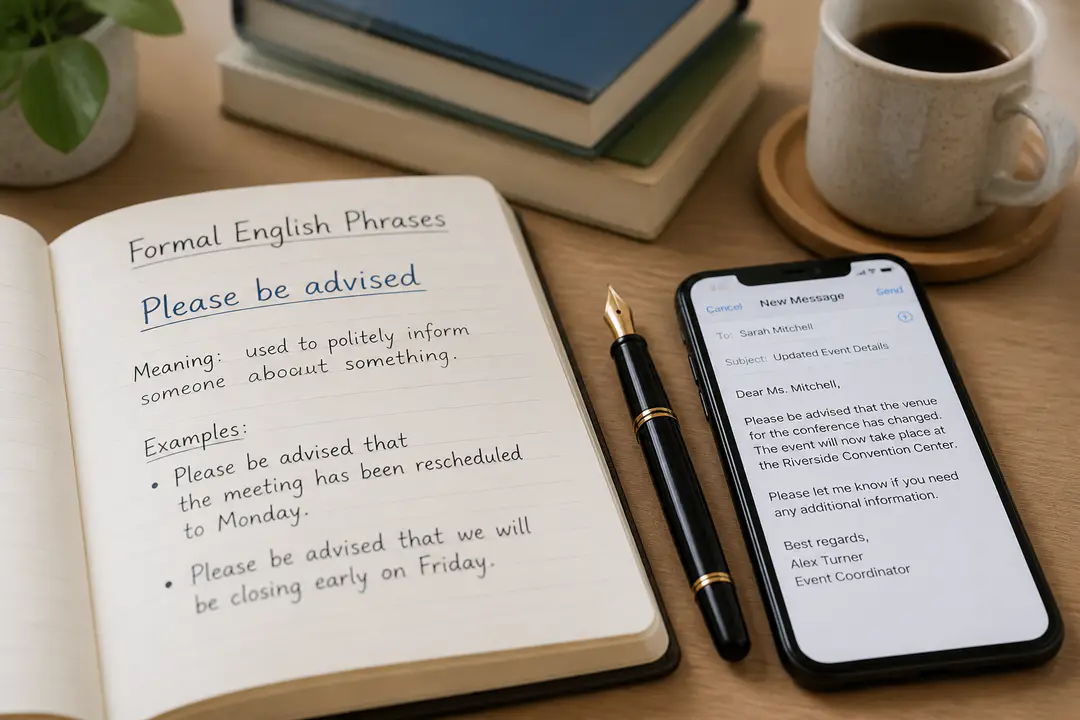
Please Be Advised Meaning: Definition & Usage
Please be advised meaning is simple: it is a formal way to say please be aware or you are being informed about something. The phrase usually appears in professional, legal, or official communication when the writer wants to give notice, share an important update, or issue a warning. It is correct English, but it can sound stiff in everyday conversation, so context matters.
If you have seen it in an email, letter, or notice, the message is usually not asking for your opinion. Instead, it is telling you to pay attention to information that follows. That is why understanding both its meaning and tone helps you use it more naturally.
What Does ‘Please Be Advised’ Mean?
Core meaning
“Please be advised” means that the reader is being formally informed of something important. In plain English, it often works like “please note,” “be aware,” or “take notice.” The phrase prepares the reader for information that matters, such as a change, deadline, rule, warning, or decision.
The word “advised” here shows that the notice has already been given. So the phrase does not mean “please give advice.” It means that advice, notice, or information is now being delivered to you.
Literal and implied meaning
Literally, the phrase means “you are advised.” In real use, though, it often carries a stronger sense: the writer wants you to pay attention because the information may affect you. For that reason, it often appears before serious or practical details.
For example, “Please be advised that your account will be closed on Friday” is not casual small talk. It signals an official notice with consequences. A similar expression appears in many fixed formal phrases, much like looking forward to working with you sounds polite but carries a specific professional tone.
How it differs from ‘please advise’
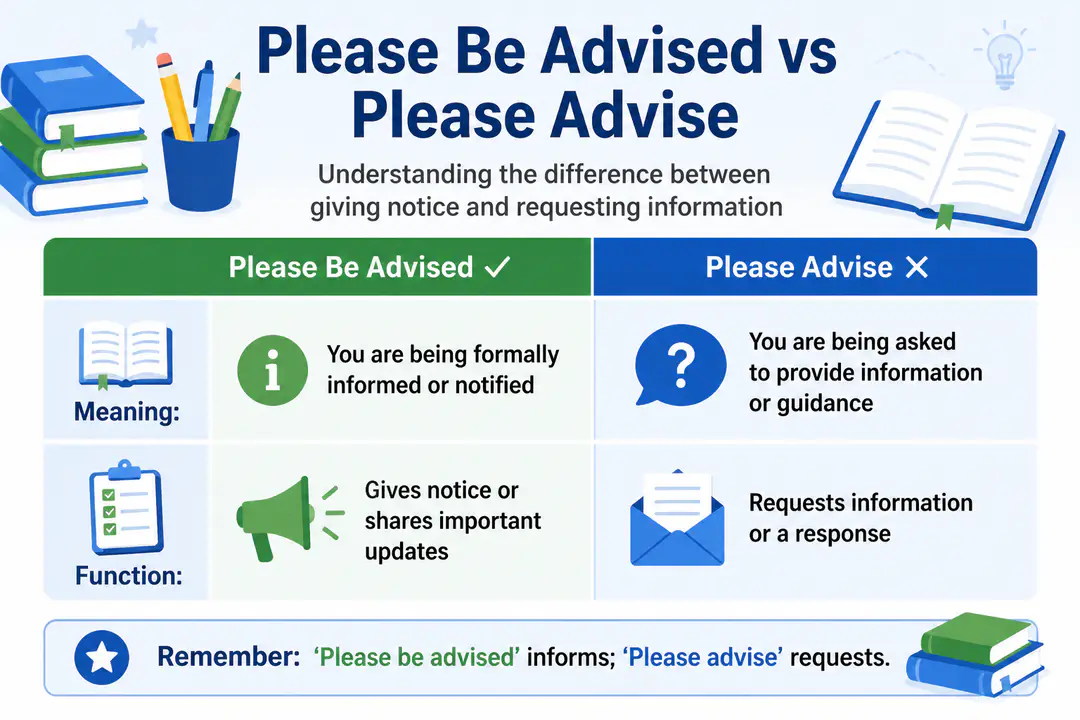
This is one of the most common points of confusion. Please be advised gives information to the reader, while please advise asks the reader to provide information or guidance. One is a notice; the other is a request.
| Phrase | Meaning | Function |
|---|---|---|
| Please be advised | Please be aware | Gives notice |
| Please advise | Please tell me what to do or what is true | Requests information |
Correct form
The correct phrase is please be advised, not “please be advise.” “Advised” is the correct form in this expression. If you write “please be advise,” it is grammatically wrong.
- Correct: Please be advised that the office will close early.
- Incorrect: Please be advise that the office will close early.
When it works best
The phrase fits situations where the writer needs a formal tone and clear notice. It is common in business emails, policy statements, legal notices, customer service messages, and official announcements. In relaxed conversation, however, it can sound distant or overly serious.
That matters because tone changes how a message feels. Compare “Please be advised that the meeting has moved” with “The meeting has moved to 3 p.m.” Both are correct, but the second sounds more natural in plain workplace English, much as everyday expressions like how’s your day going fit casual conversation better than formal notices do.
Usage
Where the phrase appears
“Please be advised” is most common in writing rather than speech. You will often see it in messages where the writer wants to document that notice was given. That is why it appears so often in formal settings.
- Business emails
- Legal or compliance notices
- Customer service updates
- School or workplace announcements
- Policy changes and deadline reminders
Best use cases
Use it when the information is important, official, or cautionary. It works best when the message concerns rules, deadlines, consequences, or required awareness. It is less suitable for friendly notes, casual team chats, or everyday personal messages.
Tone
What tone it creates
The tone of “please be advised” is formal, authoritative, and sometimes cautionary. It can make the writer sound professional and precise, especially in official communication. At the same time, it can also sound cold, distant, or rigid if the situation does not call for that level of formality.
How readers may hear it
Readers often interpret this phrase as a signal that the message is serious. Sometimes that is useful. In other cases, a simpler phrase such as “please note” feels clearer and more human, especially if you want the message to stay polite without sounding stern.
Choosing tone well is part of strong writing. The same idea shows up in other expressions too, and the wording of a phrase like means a lot to me can feel warm and personal in a way that “please be advised” never does.
Examples of ‘Please Be Advised’ in Sentences
Formal examples
- Please be advised that your appointment has been rescheduled.
- Please be advised that payment is due by the end of the month.
- Please be advised that the office will remain closed on Monday.
- Please be advised that failure to respond may result in cancellation.
- Please be advised that the policy has been updated effective immediately.
Comparison examples
- Formal: Please be advised that the report is overdue.
- Plainer: Please note that the report is overdue.
- Request: Please advise whether the report has been submitted.
Alternatives to ‘Please Be Advised’
Clearer options
- Please note
- Be aware
- Take note
- Bear in mind
- Be mindful
- Take heed
How the alternatives differ
- Please note: formal but more natural and direct
- Be aware: clear and cautionary
- Bear in mind: thoughtful and slightly softer
- Be mindful: careful and considerate in tone
- Take heed: strong and old-fashioned in many contexts
FAQs
Is ‘please be advised’ polite?
Yes, it is polite in a formal sense. However, it can sound stiff or impersonal if used in a casual or friendly message.
Is ‘please be advised’ the same as ‘please advise’?
No. “Please be advised” gives notice, while “please advise” asks for information, direction, or a response.
Is ‘please be advise’ correct?
No. The correct form is “please be advised.” The word “advised” is required in this expression.
Should I use it in everyday emails?
Usually not. In many everyday emails, simpler phrases such as “please note” or direct wording sound clearer and more natural.
Conclusion
Use “please be advised” when you need a formal way to give notice, and choose a simpler option when a more natural tone fits better.