Thank You for Letting Me Know: Meaning, Tone, and Alternatives
“Thank you for letting me know” means you appreciate someone for sharing information, updating you, or making you aware of something. People use it to acknowledge a message politely, whether the news is helpful, neutral, inconvenient, or even disappointing. It works well in both personal and professional communication because it shows respect, attention, and a calm response.
In simple terms, the phrase says two things at once: I received your message and I appreciate the update. That is why it appears so often in emails, text messages, workplace chats, and everyday conversation. Used well, it sounds thoughtful and composed rather than abrupt.
Meaning of the Phrase
Basic meaning
The phrase is a polite expression of gratitude for information someone has shared with you. It does not always mean you are happy about the news. Instead, it means you value being informed.
For example, if a coworker tells you a meeting has been moved, replying with “thank you for letting me know” shows that you noticed the update and appreciate the communication. If a friend tells you they will be late, the phrase serves the same purpose in a more casual setting.
What the phrase communicates
This expression often carries a few subtle messages beyond simple thanks. It can signal professionalism, emotional control, and basic courtesy, especially when the information affects plans or expectations.
- You received the information clearly.
- You appreciate the person taking the time to tell you.
- You are responding politely, even if the news is inconvenient.
- You are keeping the conversation smooth and respectful.
Tone and context
The tone is usually polite, neutral, and appreciative. In many situations, it sounds slightly more formal than a quick “thanks” but less stiff than very formal business language. That balance makes it useful in workplaces, customer communication, school settings, and daily life.
It also fits well when you want to avoid sounding annoyed. If someone shares a delay, correction, cancellation, or problem, this phrase helps you respond with maturity before moving to the next step. In professional writing, that can be especially valuable.
When it is appropriate
Use this phrase when someone gives you new information, corrects something, warns you about a change, or updates you on a situation. It is appropriate in emails, messaging apps, face-to-face conversations, and phone calls.
You can also make it more specific by adding context after it. For instance, “Thank you for letting me know about the schedule change” sounds warmer and clearer than a short, standalone reply. If you want similar wording for other update-based messages, a good let me know synonym list can help you vary your phrasing naturally.
Examples and close alternatives
Here are a few natural examples:
- Thank you for letting me know. I will adjust my plans.
- Thanks for letting me know about the delay.
- Thank you for letting me know that the report is ready.
- Thanks for the update.
- I appreciate you telling me.
These alternatives are close in meaning, but they differ slightly in tone. “Thanks for the update” is concise and common at work. “I appreciate you telling me” sounds a little warmer and more personal.
When and How to Use This Phrase
Professional settings
At work, this phrase is useful when a colleague shares a deadline change, a manager sends a correction, or a client provides new details. It helps you sound responsive without overexplaining. In many business messages, it is a safe and effective first sentence.
It also pairs well with a follow-up action, such as “Thank you for letting me know. I will revise the draft today.” That structure shows gratitude and progress at the same time.
Everyday conversations
In personal communication, the phrase still works, though people often shorten it to “thanks for letting me know.” That version sounds more relaxed while keeping the same meaning. It is useful when a friend updates you about plans, travel, timing, or family news.
Casual messages often depend on tone, so shorter replies can sound friendlier. A warm opener such as how’s your day going may suit a personal chat, while “thank you for letting me know” is better when you are responding to actual information or a change in plans.
Formal versus informal tone
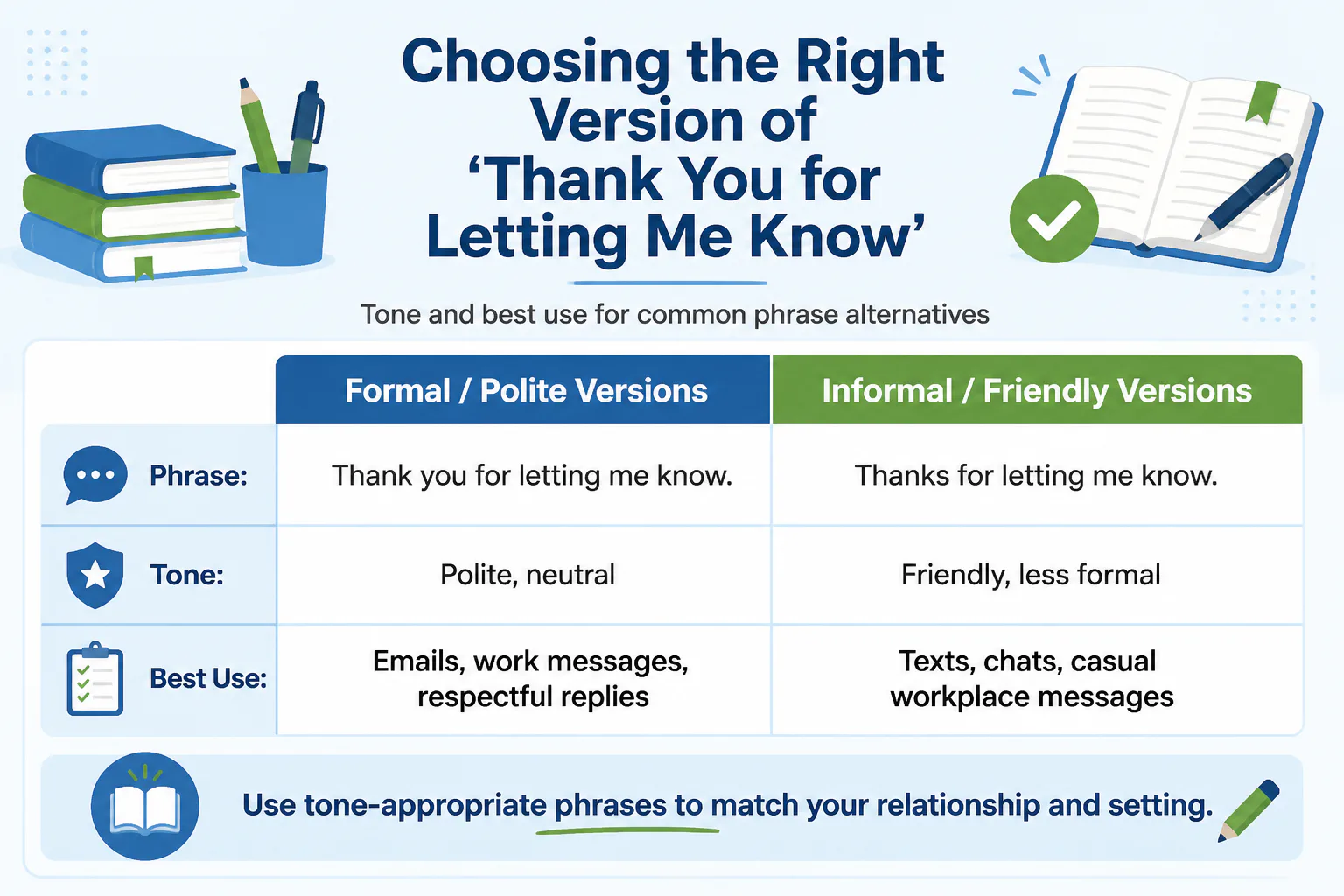
| Version | Tone | Best use |
|---|---|---|
| Thank you for letting me know. | Polite, neutral | Emails, work messages, respectful replies |
| Thanks for letting me know. | Friendly, less formal | Texts, chats, casual workplace messages |
| I appreciate you letting me know. | Warm, thoughtful | Sensitive or considerate situations |
| Thanks for the update. | Direct, efficient | Fast-moving professional communication |
Communication Examples
Email examples
- Thank you for letting me know about the revised deadline. I will send the final version by Friday.
- Thank you for letting me know that the meeting has been canceled.
- Thanks for letting me know you received the documents.
- Thank you for letting me know about the issue. I will look into it right away.
Text and chat examples
- Thanks for letting me know. I will be there a little later.
- Thank you for letting me know you made it home safely.
- Thanks for the update. See you tomorrow.
- I appreciate you telling me. That helps a lot.
Conversation examples
- “Thank you for letting me know. I had not heard about that yet.”
- “Thanks for letting me know you cannot make it tonight.”
- “I appreciate you letting me know in advance.”
- “Thank you for telling me. I will handle it from here.”
Polite Alternatives
Useful alternatives
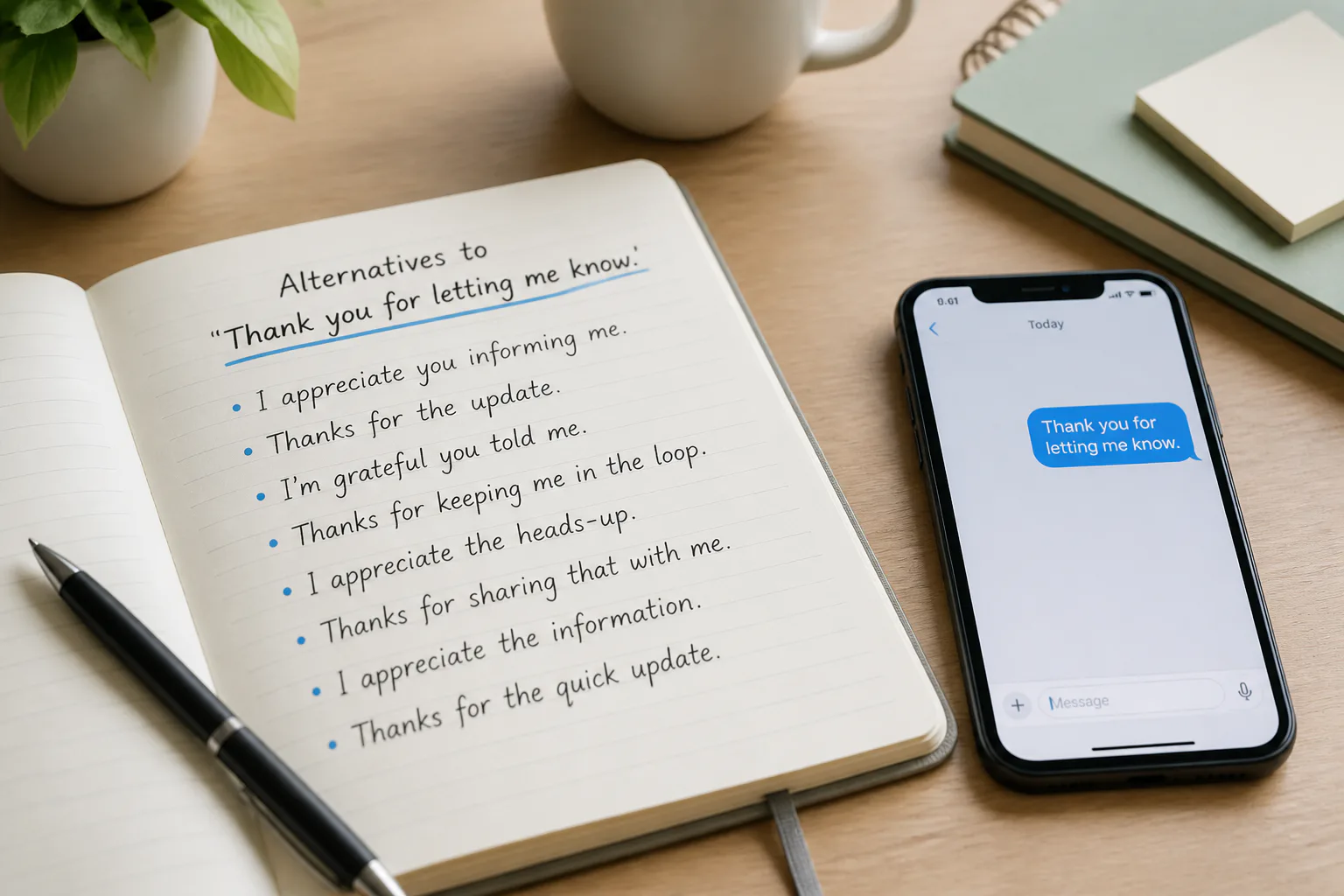
- Thanks for the update – concise and common in work messages.
- I appreciate you letting me know – warmer and more personal.
- Thank you for the heads-up – good when someone warns you in advance.
- Thanks for telling me – simple and natural in conversation.
- I am glad you told me – useful when the information matters personally.
- Thank you for informing me – more formal and less conversational.
- Noted, thank you – brief and efficient for professional settings.
Choosing the right version
The best alternative depends on your relationship with the person, the seriousness of the message, and how formal the setting is. A manager, teacher, or client may expect more polished wording than a close friend. In email writing, small phrase choices matter just as much as other standard expressions like please see attached, which can sound clearer or more natural when adjusted to the situation.
- Use “thank you for informing me” for formal business or institutional messages.
- Use “thanks for the update” for quick internal communication.
- Use “I appreciate you letting me know” when you want extra warmth.
- Use “thanks for telling me” in casual speech or text.
Common Mistakes and Tips for Effective Use
Common mistakes
One common mistake is using the phrase without any follow-up when the situation clearly calls for action. If someone tells you about a schedule change, problem, or request, a better reply often includes your next step. That makes your response useful, not just polite.
Another mistake is using an overly formal version in a very casual conversation. Saying “thank you for informing me” to a close friend can sound stiff or distant. On the other hand, replying to a client with only “thx” can seem careless.
Tips for better use
Keep your tone matched to the setting and add context when needed. If the message is important, mention the subject directly: “Thank you for letting me know about the venue change.” This reduces confusion and shows attentiveness.
It also helps to pair the phrase with one of these moves when appropriate:
- Acknowledge the update: “Thank you for letting me know about the delay.”
- State your action: “I will revise the schedule.”
- Show understanding: “I understand, and I appreciate the notice.”
- Ask a follow-up question: “Could you confirm the new time?”
Finally, be careful not to overuse the exact same phrase in every email. Repetition can make your writing feel mechanical. Rotating between a few natural alternatives keeps your communication clear and human.
FAQs
Is “thank you for letting me know” polite?
Yes. It is a polite, respectful phrase that shows appreciation for receiving information or an update.
Is it formal or informal?
It sits in the middle. It is polite enough for professional settings but still natural in everyday conversation, especially in the shorter form “thanks for letting me know.”
Can I use it when the news is bad?
Yes. The phrase does not mean you are pleased by the news. It means you appreciate being informed, even if the information is disappointing.
What is a shorter way to say it?
“Thanks for the update” and “thanks for letting me know” are the most common shorter options. Both work well in quick messages and chats.
Conclusion
“Thank you for letting me know” is a reliable way to acknowledge information with politeness and clarity. Understanding its meaning, tone, and alternatives helps you use it naturally in both everyday and professional communication.