Well Noted: Meaning, Usage and Examples
Well noted means that a message, instruction, or piece of information has been received and understood. In English communication, it is most common in emails, workplace messages, and other professional settings where someone wants to acknowledge a point briefly. Although it is correct, its tone can sound formal, distant, or even a little curt if used without warmth or context.
In simple terms, saying well noted is a way of telling someone, “I have taken note of that.” It works best when you are confirming receipt of information, a correction, a request, or an update. In casual conversation, though, people often choose friendlier phrases such as “Got it,” “Understood,” or “Thanks for letting me know.”
Meaning of ‘Well Noted’
Core definition
The phrase combines two ideas: well, meaning properly or clearly, and noted, meaning observed, recorded, or acknowledged. Together, well noted means that the information has been clearly received and mentally registered. It does not usually express agreement, gratitude, or enthusiasm on its own. It mainly signals acknowledgment.
For example, if a manager writes, “The meeting has moved to 3 p.m.,” replying “Well noted” means you have seen the update and understand it. If a client says, “Please use the revised draft,” the phrase tells them their instruction has been taken into account. In both cases, the speaker is not adding much emotion, only confirmation.
Implied meaning in real use
In practice, the phrase often carries one of these meanings:
- I have received your message.
- I understand your point.
- I will keep that in mind.
- I acknowledge the instruction or correction.
The exact meaning depends on context. In a short email, it may simply confirm receipt. In a discussion about feedback, it can mean the comment has been accepted and will be considered.
How to use it appropriately
Well noted is most appropriate when brevity is acceptable and the setting is fairly formal. It often appears in internal office emails, customer-service replies, and business communication where quick acknowledgment matters. If the situation calls for warmth, appreciation, or relationship-building, it is usually better to add a few more words.
For instance, “Well noted. I will update the document accordingly” sounds clearer and more cooperative than the phrase alone. “Well noted, thank you” also softens the tone. If you often need acknowledgment phrases, it helps to compare them with options like thank you for letting me know, which sounds more appreciative and less abrupt.
Common misunderstandings
- Assuming well noted always sounds polite can lead to awkward replies, because it may sound cold if used by itself, especially in personal or sensitive conversations.
- Treating it as a synonym for agreement is also misleading, since it only shows that something has been noticed or understood, not necessarily approved.
It is also worth remembering that some native English speakers use the phrase less often than learners expect. In many workplaces, “Noted,” “Understood,” or “Thanks, noted” sounds more natural. So while well noted is correct, it is not always the most natural choice in every variety of everyday English.
Usage Contexts
Where it appears most often
You will usually see this phrase in written communication rather than speech. It is especially common in:
- Business emails
- Team chat messages
- Customer-service communication
- Project updates
- Responses to instructions or corrections
It fits situations where the goal is to acknowledge information efficiently. If someone sends an attachment, deadline change, or procedural note, a brief acknowledgment is often enough. In that kind of exchange, the tone can be similar to phrases used in formal notices such as please be advised, though well noted is a reply rather than a warning or announcement.
Professional versus casual use
In professional writing, well noted can work if the relationship is neutral and the message is straightforward. In casual communication with friends or family, it often sounds too stiff. Most people would say “Okay,” “Got it,” or “I understand” instead.
That difference matters because good communication depends not only on correctness but also on tone. A phrase can be grammatically fine and still feel unnatural for the setting. Well noted belongs more naturally to workplace writing than to everyday social conversation.
Formality
What tone it gives
The phrase sounds formal, efficient, and controlled. That can be useful when you want to keep a message brief and professional. It avoids emotional language and focuses only on acknowledgment.
At the same time, that same efficiency can make it sound blunt. If someone shares a concern, apologizes, or gives important feedback, replying only with well noted may feel dismissive. In those moments, a warmer response creates a better impression.
When it may seem curt
It may sound curt in these situations:
- When someone expects thanks or empathy
- When the message is personal rather than administrative
- When you reply with only two words and no follow-up
- When your workplace culture is friendly and conversational
If you are unsure, expand the reply. “Well noted. Thanks for flagging this” or “Well noted. I will take care of it” sounds more natural and considerate. A similar softening happens when writers choose a direct but open phrase like let me know instead of a very clipped response.
How to make it sound better
You can improve the tone by adding gratitude, action, or reassurance. This keeps the acknowledgment clear while making the message feel human. In many cases, the best version is not the phrase alone but the phrase plus a short follow-up.
| Reply | Tone | Best use |
|---|---|---|
| Well noted. | Formal, brief, possibly cold | Very short professional acknowledgment |
| Well noted, thank you. | Formal and polite | Emails with clients or colleagues |
| Well noted. I will update it. | Professional and clear | Action-based replies |
| Got it. | Casual and friendly | Informal chats |
| Understood. | Neutral and direct | Professional or casual contexts |
Examples of ‘Well Noted’ in Sentences
Professional examples
- Well noted. I will revise the report before the deadline.
- Your feedback on the proposal is well noted, and I will make the changes today.
- Well noted, thank you. We will use the updated schedule going forward.
- The issue you raised has been well noted and forwarded to the team.
- Well noted. Please expect a follow-up by tomorrow morning.
More casual or mixed examples
- Well noted, I will remember that next time.
- Your point is well noted, but I still think we should discuss it further.
- Okay, well noted. I did not realize the plan had changed.
- Well noted, thanks for the reminder.
- The correction is well noted.
Examples to avoid
- Well noted, haha.
- Well noted!!!
- My lunch was well noted.
These sound odd because the phrase does not match the tone or purpose. It works best with information, requests, reminders, instructions, and corrections, not random personal remarks or exaggerated punctuation.
Alternatives to ‘Well Noted’
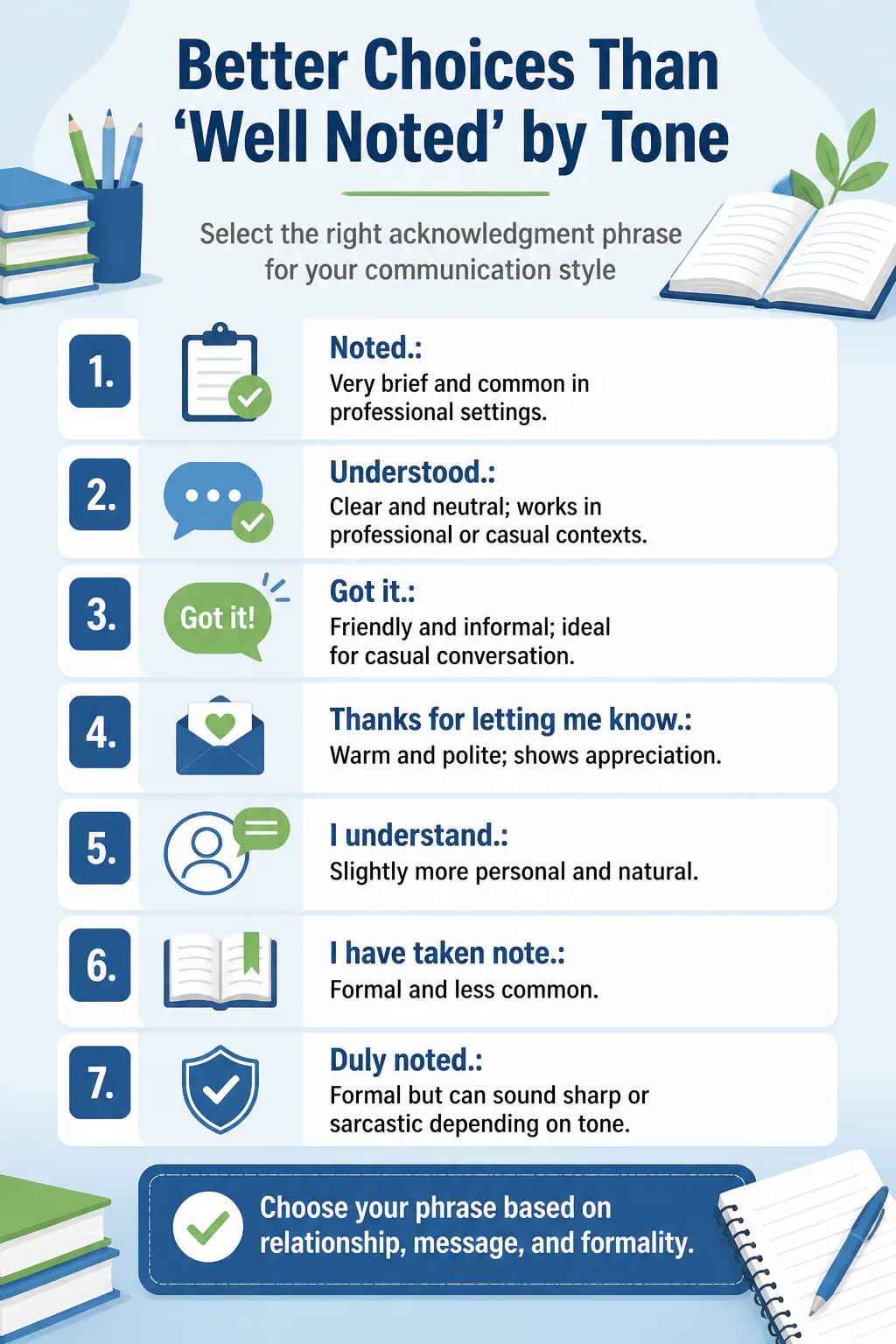
Better choices by tone
- Noted. Very brief and common in professional settings.
- Understood. Clear and neutral.
- Got it. Friendly and informal.
- Thanks for letting me know. Warm and polite.
- I understand. Slightly more personal and natural.
- I have taken note. Formal and less common.
- Duly noted. Formal, but sometimes sounds sharp or sarcastic depending on tone.
- Received. Useful when confirming delivery of a file or message.
How to choose the right one
Choose your alternative based on the relationship, the message, and the level of formality. If you are answering a client, “Understood, thank you” is often safer than well noted by itself. If you are replying to a teammate in chat, “Got it” usually sounds more natural.
For quick reference, here is a simple guide:
- Use well noted for formal acknowledgment.
- Use understood for a neutral, widely natural response.
- Use thanks for letting me know when appreciation matters.
- Use got it in casual conversation.
FAQs
Is “well noted” correct English?
Yes, it is correct English. It means that information has been received and understood, especially in formal or professional writing.
Is “well noted” polite?
It can be polite, but it is not automatically warm. Used alone, it may sound short or distant, so many people add “thank you” or a follow-up sentence.
Can I use “well noted” in an email?
Yes, especially in business emails where you are acknowledging instructions, updates, or feedback. It works best when the message is brief and formal.
What is better than “well noted”?
That depends on the tone you want. “Understood,” “Noted,” “Got it,” and “Thanks for letting me know” are often more natural choices.
Conclusion
Well noted is useful when you want a brief, formal way to acknowledge information, but it works best when the tone matches the situation.