How Is Your Day Going: Meaning, Usage, and Responses in English
“How is your day going” means “What has your day been like so far?” or “How are things going for you today?” In everyday English, it is a friendly way to start a conversation and show interest in someone’s current mood, experience, or progress through the day. In the US, people often use it as polite small talk, so the best response is usually short, natural, and matched to the situation.
This phrase is common in casual conversation and in some professional settings, especially where the tone is warm rather than very formal. It asks about both events and feelings, not just what a person has done. Because the day is still in progress, the phrase uses the present continuous tense: it focuses on what the day is like right now.
Meaning of ‘How Is Your Day Going’
Literal meaning
At the most basic level, this question asks about someone’s day up to the present moment. It does not ask only for a list of activities. It can also ask about mood, energy, stress, enjoyment, or the overall experience of the day so far.
That is why answers can describe either events or feelings. A person might say, “It’s going well,” “Pretty busy,” or “A little rough, honestly.” Each one answers the same question, but with a different focus.
Conversational meaning
In real conversation, “how is your day going” often works as a greeting. It shows friendliness and interest, but it is not always a request for a deep personal story. In American English, many people ask it as part of normal social politeness, much like “How are you?”
That social use matters. If a cashier, coworker, neighbor, or classmate asks the question, a brief answer is usually enough unless the relationship is close. If you want a natural comparison, the tone is close to how’s your day going, which is simply a more casual wording of the same idea.
Tense and grammar
The phrase uses the present continuous: “is going.” That tense fits because the day has started but has not finished. You are asking about an experience still in progress, not a completed event.
Compare these forms:
- “How is your day going?” asks about the day so far.
- “How was your day?” asks after the day is finished.
- “How has your day been?” is similar, but can sound slightly more reflective.
What tone it carries
This phrase is polite, friendly, and semi-formal. It fits easily in everyday life because it is warmer than a plain hello, but not too personal. You can use it with friends, coworkers, classmates, customers, and acquaintances.
Still, tone depends on voice and context. Said warmly, it sounds caring. Said quickly while walking past someone, it may function more like a routine greeting than a serious invitation to talk.
Example exchanges
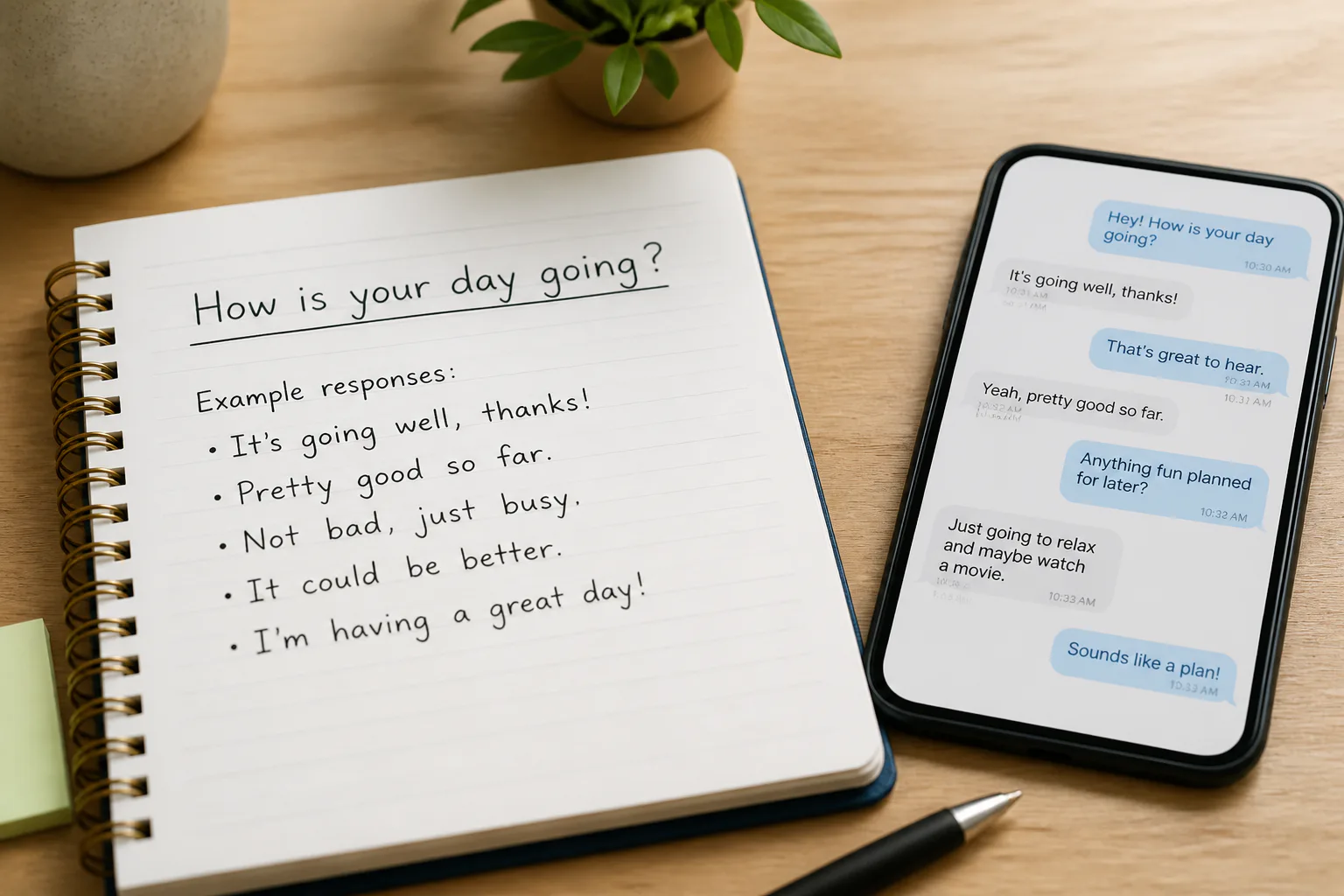
These short exchanges show how the phrase works in normal speech:
- “How is your day going?”
“Good, thanks. Busy, though.” - “Hey, how is your day going?”
“Pretty well. How about yours?” - “How is your day going so far?”
“It’s okay. I’ve had a lot of meetings.” - “How’s your day going?”
“A little tough, but I’m managing.”
What not to assume
Do not assume every speaker wants a detailed answer. In the US, this question often opens the door to conversation, but it does not force a long one. A short answer is normal, and a follow-up like “How about you?” helps keep the exchange balanced.
It also helps to vary your wording. Repeating the exact same greeting too often can sound mechanical, just as repeated workplace phrases like looking forward to working with you can lose warmth if they are overused.
When and How to Use This Phrase
Common situations
Use this phrase when you want to sound friendly and conversational. It works well at the start of an interaction, especially when you already know the person a little or when a warm tone is appropriate. In offices, schools, stores, and social settings, it can make a greeting feel more personal.
It is especially useful in these situations:
- Greeting a coworker in a friendly office
- Starting small talk before a meeting
- Talking with a classmate or neighbor
- Checking in with a friend during the day
- Speaking to a customer or client in a relaxed professional setting
When to be careful
This phrase is less suitable in very formal communication. For example, in a highly formal email, official notice, or serious discussion, it can sound too conversational. Relationship and familiarity matter, so use it where friendliness makes sense.
You can also vary the phrase to sound more natural. Common alternatives include:
- How’s your day so far?
- How are things going today?
- How’s it going today?
Common Responses
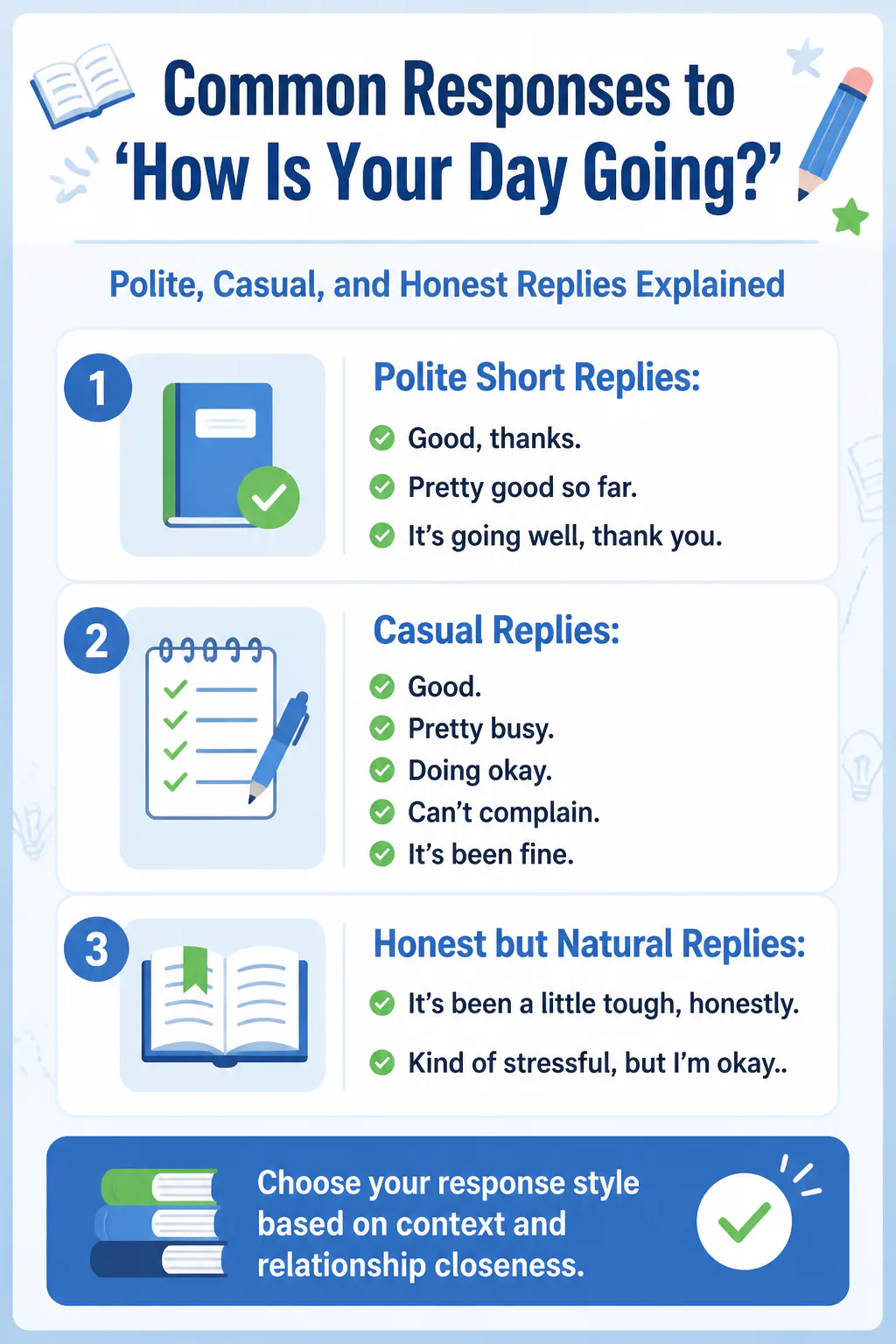
Polite short replies
- Good, thanks.
- Pretty good so far.
- It’s going well, thank you.
- Not bad. How about you?
- So far, so good.
Casual replies
- Good.
- Pretty busy.
- Doing okay.
- Can’t complain.
- It’s been fine.
Honest but natural replies
- It’s been a little tough, honestly.
- Kind of stressful, but I’m okay.
- Long day, but I’m getting through it.
- Not the best, but thanks for asking.
How to keep the conversation going
If you want to sound engaged, add a follow-up question after your answer. That keeps the exchange balanced and polite.
| Reply type | Example | Effect |
|---|---|---|
| Brief | Good, thanks. | Polite and efficient |
| Brief + return question | Pretty good. How about you? | Friendly and conversational |
| Detailed | Busy, but productive so far. | Invites more discussion |
| Honest negative | A bit rough today. | Signals you may want support |
A simple return question often works best. In work settings, this sounds as natural as other short, encouraging expressions such as keep up the good work, which are friendly without becoming too personal.
Cultural Nuances in the US
Small talk matters
In the US, “how is your day going” is often part of everyday small talk. People use it to be pleasant, build rapport, and create a comfortable social tone. The goal is often connection, not a full report on the day.
Because of that, short positive or neutral answers are common. Even if someone is having a difficult day, they may still answer briefly unless they know the other person well. This is not dishonest; it reflects a social preference for light, manageable conversation in many public or semi-professional situations.
Relationship changes the answer
The closer the relationship, the more personal the answer can be. With a friend, you might explain why your day has been stressful or exciting. With a barista, receptionist, or distant coworker, a short answer is more typical.
American speakers often judge the expected depth of response by three things:
- How well they know the other person
- Whether the setting is casual or professional
- Whether the speaker sounds rushed or genuinely open to conversation
Why variation sounds better
Using the same greeting every time can sound robotic. Native speakers often rotate between similar phrases to keep conversation natural. That variation helps the interaction feel real rather than scripted.
So instead of repeating one line all day, switch between several familiar greetings. A small change in wording can make your English sound more relaxed and socially aware.
FAQs
Is “how is your day going” grammatically correct?
Yes. It is grammatically correct and uses the present continuous tense to ask about a day that is still in progress.
Is this phrase formal or informal?
It is best described as semi-formal. It works in casual settings and in friendly professional environments, but it is less suitable for very formal communication.
Do I need to answer in detail?
No. In US English, a short and polite answer is often enough. If the relationship is closer, you can give more detail.
What is the difference between “how is your day going” and “how are you”?
“How are you” asks more generally about a person’s state. “How is your day going” focuses on today’s experience so far, including mood, events, and overall progress through the day.
Conclusion
“How is your day going” is a friendly, polite way to ask about someone’s day so far, especially in everyday US English. The phrase usually invites a brief response, but context decides how personal that response should be. Once you understand its tone and social use, it becomes an easy and natural part of conversation.