
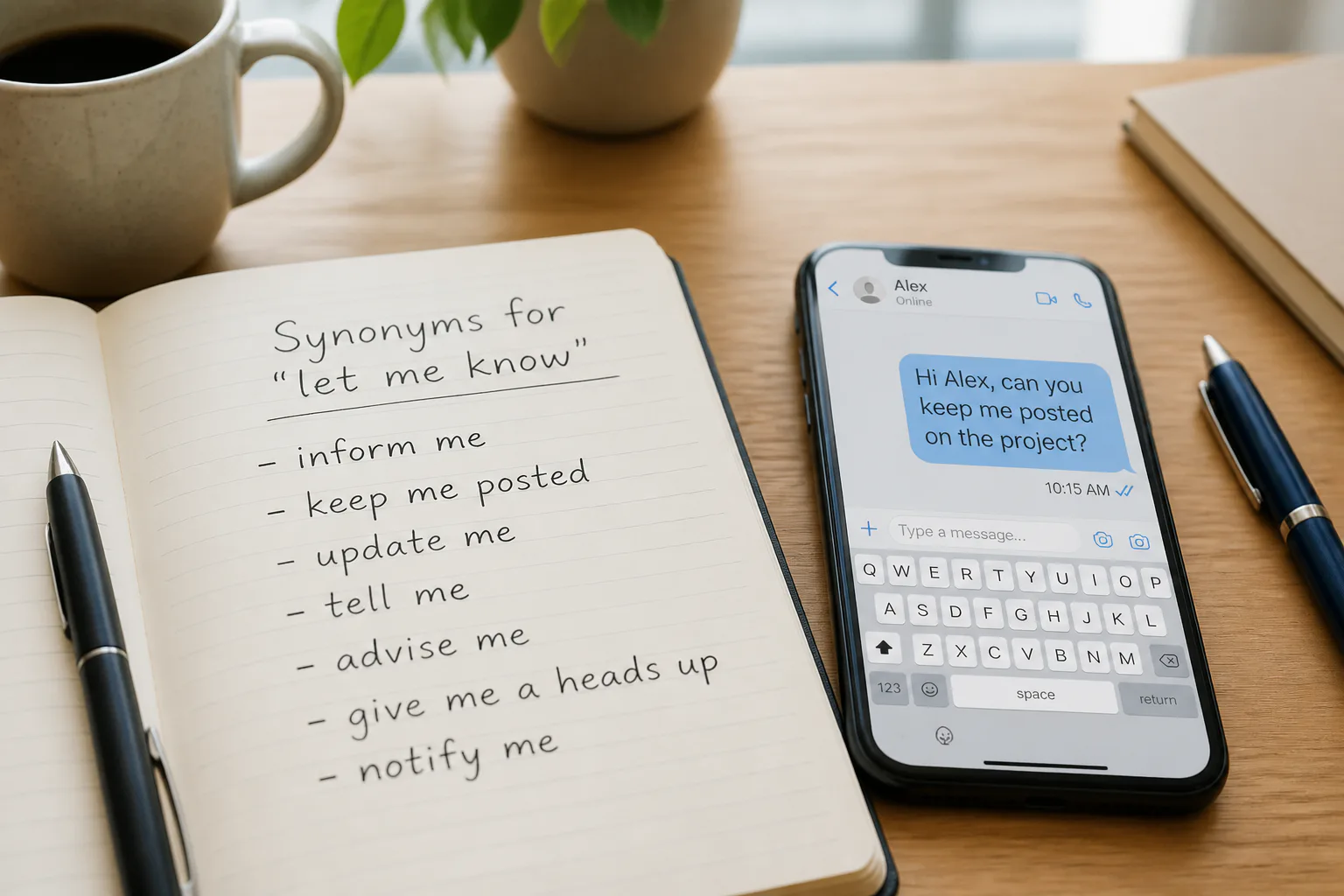
Let Me Know Synonym: Alternatives and Usage Tips
If you want a better way to say let me know, you have plenty of useful options. The best choice depends on tone, relationship, and situation: some phrases sound professional, some sound friendly, and others work best when you need a quick reply. Below is a practical let me know synonym list with examples so you can choose the right wording with confidence.
At its core, let me know means “give me the information,” “tell me your decision,” or “update me when you can.” Because it appears so often in emails, messages, and conversations, learning alternatives helps your writing sound more natural and less repetitive.
Common Synonyms for ‘Let Me Know’
Direct everyday alternatives
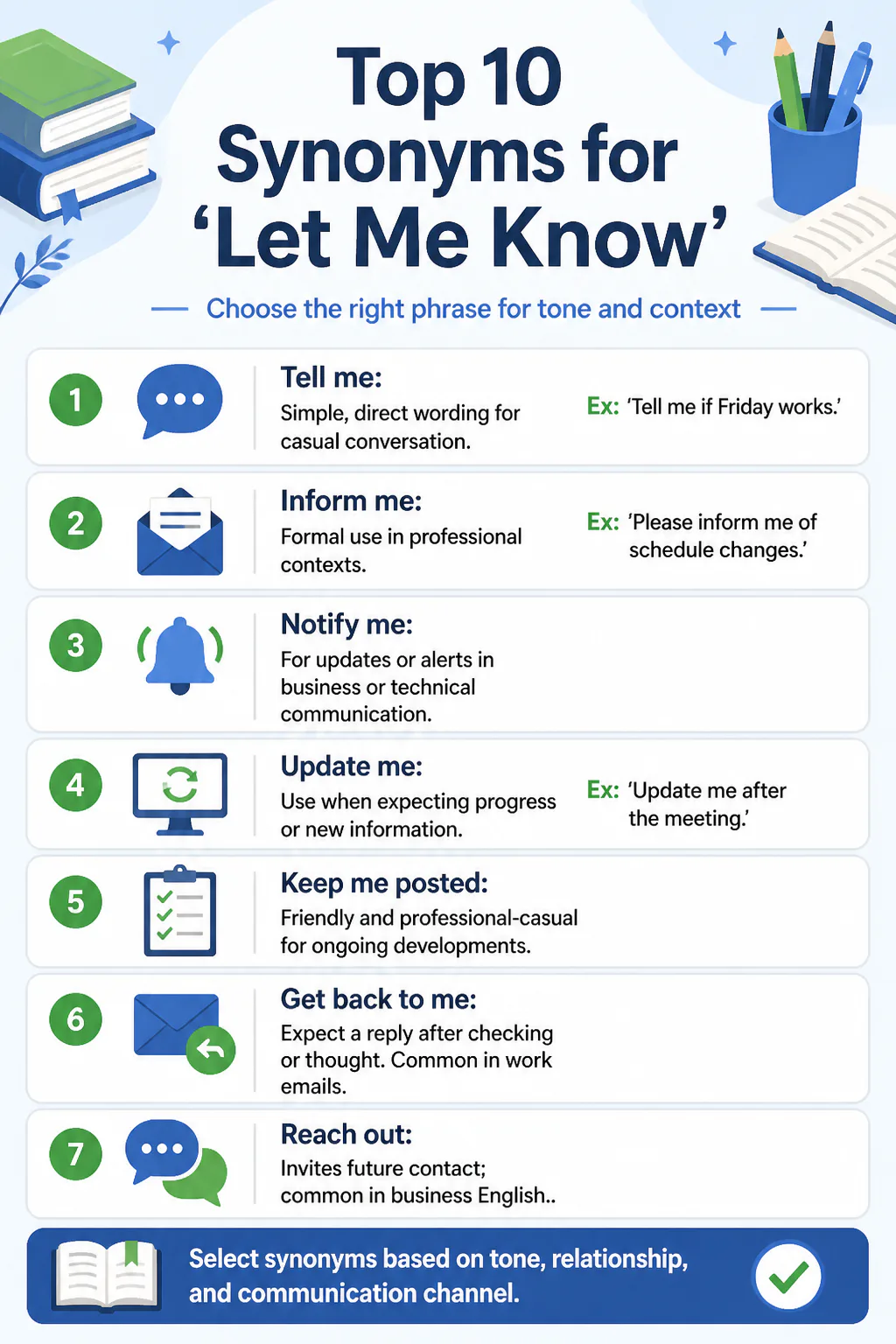
- Tell me
Use it when you want simple, direct wording.
Example: “Tell me if Friday works for you.”
Context: Clear and natural in speech and casual writing. - Inform me
Use it in more formal or official contexts.
Example: “Please inform me of any schedule changes.”
Context: Better for professional writing than friendly chat. - Notify me
Use it when you want someone to send an update or alert.
Example: “Notify me when the document is ready.”
Context: Common in business, technical, and process-based communication. - Update me
Use it when the situation may change over time.
Example: “Update me after the meeting.”
Context: Best when progress or new information is expected. - Keep me posted
Use it for ongoing developments.
Example: “Keep me posted on the client response.”
Context: Friendly and professional-casual, but not highly formal. - Get back to me
Use it when you expect a reply after some thought or checking.
Example: “Get back to me once you confirm the dates.”
Context: Very common in work emails and everyday messages. - Reach out
Use it when inviting future contact.
Example: “Reach out if you have any questions.”
Context: Common in business English, though sometimes overused. - Send me a message
Use it when the communication channel is informal or digital.
Example: “Send me a message when you arrive.”
Context: Best for texting, chat, or social communication. - Fill me in
Use it when you want details or background information.
Example: “Fill me in after the call.”
Context: Informal and conversational. - Share the details
Use it when the missing information is specific.
Example: “Share the details once the plan is finalized.”
Context: Good for semi-formal writing.
How each phrase changes the tone
| Phrase | Tone | Best use |
|---|---|---|
| Tell me | Direct | Casual conversation, quick requests |
| Inform me | Formal | Professional emails, official notices |
| Notify me | Structured | Status changes, alerts, processes |
| Update me | Neutral | Progress reports, ongoing situations |
| Keep me posted | Friendly | Work chat, team communication |
| Get back to me | Neutral | Replies after checking information |
| Reach out | Open-ended | Invitations for follow-up contact |
| Fill me in | Informal | Background details, casual updates |
Best example rewrites
Here are a few simple rewrites to show how a let me know synonym can shift tone without changing meaning. “Let me know if you need help” can become “Tell me if you need help” in casual speech, “Please inform me if you require assistance” in a formal message, or “Reach out if you need help” when you want a warmer tone.
That same flexibility appears in workplace phrases. Instead of writing “Let me know your thoughts,” you could say “Get back to me with your thoughts,” “Share the details of your feedback,” or “Update me after you review it.” If you are working on email wording generally, phrases such as please see attached also benefit from the same kind of tone adjustment.
- Need a yes or no answer: use tell me or get back to me.
- Need an official response: use inform me or notify me.
- Need progress updates: use update me or keep me posted.
- Need full context: use fill me in or share the details.
Formal Alternatives
Professional phrases
- Please inform me
Example: “Please inform me if the policy changes.” - Please advise
Example: “Please advise whether you approve the proposal.” - Please notify me
Example: “Please notify me when the shipment arrives.” - I would appreciate an update
Example: “I would appreciate an update by Thursday.” - Please keep me informed
Example: “Please keep me informed of any new developments.”
When formal wording works best
Formal alternatives fit business emails, academic settings, client communication, and any message where distance or professionalism matters. “Please advise” is especially common when you need a decision or instruction, while “please notify me” sounds more process-driven.
Be careful with phrases that sound stiff. “Please advise” is standard in many workplaces, but in very friendly teams it can feel colder than necessary. If you want formal wording without sounding severe, “please keep me informed” often works well. Similar care with tone matters in other set phrases such as please be advised, which can sound either polished or overly rigid depending on context.
Informal Alternatives
Friendly everyday options
- Tell me
Example: “Tell me what you decide.” - Text me
Example: “Text me when you’re free.” - Hit me up
Example: “Hit me up when you get to town.” - Keep me in the loop
Example: “Keep me in the loop about the party plans.” - Fill me in
Example: “Fill me in later on what happened.” - Drop me a line
Example: “Drop me a line when you have the dates.”
What to avoid in casual phrasing
Casual alternatives work best with friends, close coworkers, and informal team chats. Still, not every casual phrase fits every relationship. “Hit me up” is natural with friends, but it can sound too relaxed in a client email or a message to a teacher.
Also watch for generational and platform-based language. “Text me” is specific to phone messaging, while “drop me a line” sounds a little older and softer. In online conversation, shortened expressions change tone quickly, just as chat abbreviations like TYSM in chat feel much more casual than full written thanks.
Contextual Usage Tips
Match the relationship
The relationship between speaker and listener matters first. With a manager, professor, or client, use phrases like “please inform me,” “please notify me,” or “I would appreciate an update.” With friends or close teammates, “tell me,” “text me,” or “keep me posted” sounds more natural.
Match the type of response
Choose your phrase based on what kind of information you want. If you need a simple answer, use “tell me” or “get back to me.” If you need a continuing report, use “update me” or “keep me posted.” If you need formal confirmation, use “inform me” or “notify me.”
Match the communication channel
Email often calls for neutral or formal wording, while text messages allow shorter and warmer phrasing. “Send me a message” and “text me” fit chat well, but they can look too casual in official writing. “Reach out” works across channels, though it is less precise than phrases that ask for a clear reply.
Avoid repetition
Using “let me know” in every email can make your writing sound automatic. Rotating among a few natural alternatives improves tone and clarity. A simple pattern helps: use “please inform me” for formal notes, “update me” for ongoing work, and “tell me” for everyday conversation.
FAQs
What is the best synonym for “let me know”?
The best synonym depends on context. “Tell me” is the simplest general option, while “please inform me” works better in formal writing and “keep me posted” works well for ongoing updates.
Is “please advise” the same as “let me know”?
It is similar, but not always identical. “Please advise” often asks for guidance, a decision, or professional input, while “let me know” can ask for any kind of information.
Is “keep me posted” formal?
No. It is professional-casual rather than formal. It fits team communication and friendly workplace emails, but it is less suitable for highly official messages.
Can I use “reach out” instead of “let me know”?
Yes, but the meaning shifts slightly. “Reach out” invites contact, while “let me know” more directly asks for information or a response.
Conclusion
A strong let me know synonym depends on tone, setting, and the kind of reply you need. Use formal options such as “please inform me” in professional writing, casual phrases such as “text me” with friends, and neutral choices such as “update me” when you want flexibility.

Related Posts

Best Fast Learner Synonyms for Resumes and Reviews

30 Ways to Say Bro: Casual Slang and Nicknames