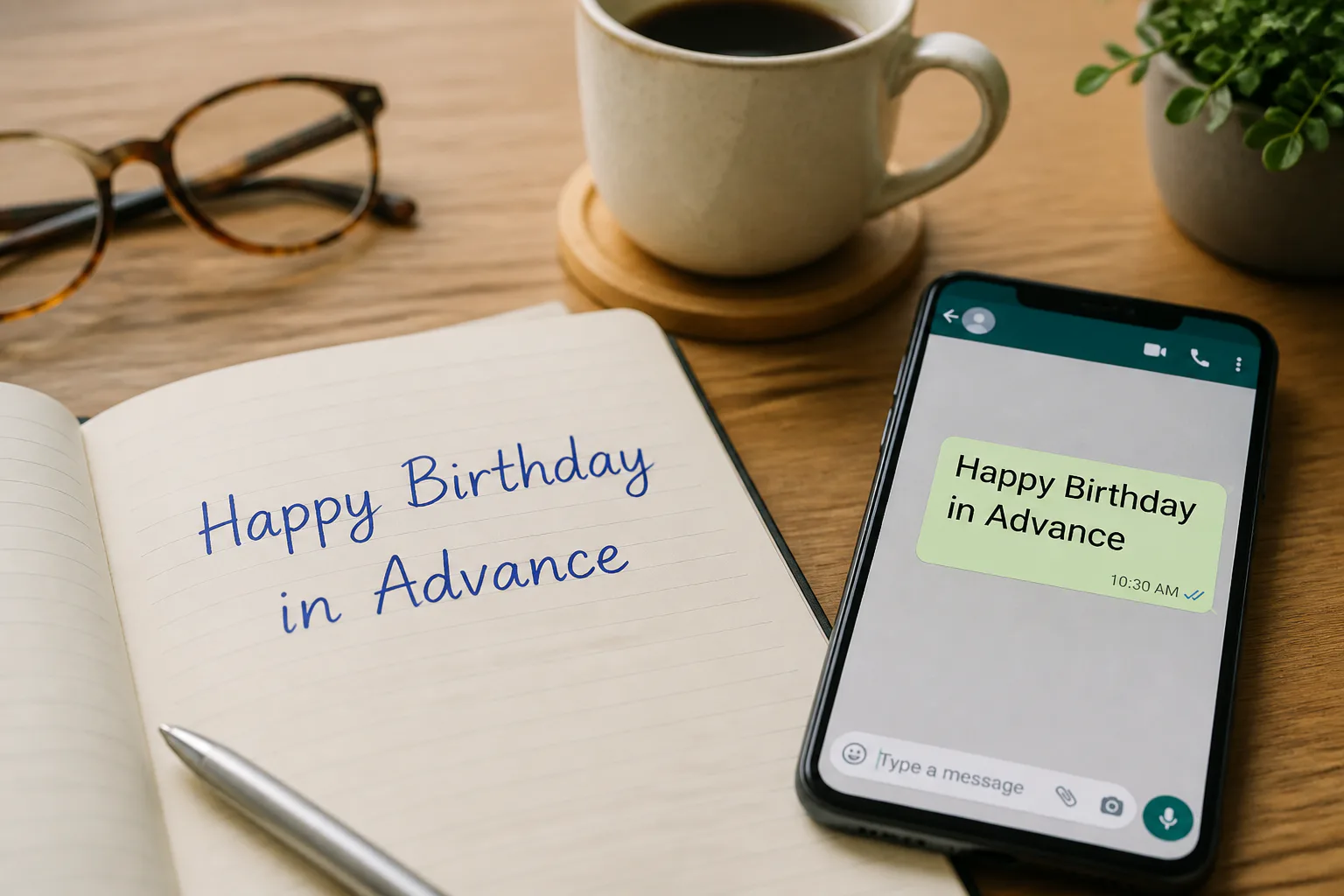
Happy Birthday in Advance Meaning: Definition & Usage
Happy birthday in advance means you are wishing someone a happy birthday before their actual birthday arrives. People use it when they know they may not get a chance to speak to the person on the day itself, or when they want to make sure their good wishes are not missed. In everyday English, it is a friendly and widely understood phrase, but it sounds best when used close to the birthday rather than far too early.
- In advance means before the time.
- The phrase is an early birthday wish.
- It is common in speech, texts, cards, emails, and social media messages.
What Does ‘Happy Birthday in Advance’ Mean?
Basic meaning
The phrase combines two parts: happy birthday, which is the standard birthday greeting, and in advance, which means before something happens. Together, they mean, “I know your birthday is coming, so I am giving you my birthday wishes now.”
For example, if your friend’s birthday is on Saturday and you will be traveling on Friday, you might say, “Happy birthday in advance!” This tells your friend that you are not confused about the date. You are simply offering the greeting early.
How people usually use it
This phrase is usually used shortly before the birthday, often one or two days earlier. It appears in casual and polite communication, especially when the speaker expects to be busy, offline, or unavailable on the birthday itself. You will hear it in workplaces, families, friendships, and online chats.
It can be used as a full message by itself, but it often sounds warmer with a short extra line. If you want more natural wording, you can pair it with one of these ideas:
- Happy birthday in advance! I hope you have a wonderful day.
- Wishing you a very happy birthday in advance because I may not see you tomorrow.
- Happy birthday in advance. Enjoy your special day.
- Just saying happy birthday in advance in case I miss the date.
What tone it carries
The tone is friendly, thoughtful, and practical. It shows that you remembered the birthday and wanted to acknowledge it early. In many situations, that feels considerate rather than careless.
Still, timing matters. Saying it too early can feel odd or impersonal, especially if the birthday is weeks away. If you want your message to sound natural, keep it reasonably close to the date.
Etiquette to remember
In most English-speaking settings, saying it is polite. The main question is not whether the phrase is correct, but whether it fits the relationship and timing. Some people love early wishes because they feel remembered, while others prefer greetings on the exact day.
A safe approach is to use it when there is a clear reason for wishing early. For instance, you may be traveling, taking leave, attending an event, or expecting to be busy. If you want your wording to sound more personal, the same principle applies when choosing how to say happy birthday in a way that matches the relationship.
Common mistakes
The most common mistake is using the phrase too far ahead of time. Another is sending only an early message and then forgetting the person completely on the day, especially if they are close to you. For a close friend, partner, or family member, an early wish is good, but a birthday message on the actual day is often even better.
It also helps to avoid making the phrase sound mechanical. Instead of writing only “HBD in advance,” use a complete sentence if the situation is even slightly formal. Clear, warm wording usually sounds better than shorthand.
| Phrase | Meaning | Best use |
|---|---|---|
| Happy birthday | Birthday wish on the day | Exact birthday date |
| Happy birthday in advance | Birthday wish before the day | Shortly before the birthday |
| Belated happy birthday | Birthday wish after the day | After missing the date |
When and Why People Say It
Common situations
People say it early when they know they may not be able to contact the person on the actual birthday. This happens often in busy schedules, travel plans, time-zone differences, or office settings where a person will be absent.
It is also used when someone is about to leave a conversation and wants to include the birthday wish before parting. In that sense, it works like other advance good wishes, such as saying goodbye before an event or holiday.
Typical reasons
- You will not see the person on their birthday.
- You may forget on the exact date and want to be thoughtful.
- You are sending a card, gift, or message early.
- You are speaking to them just before the birthday and the moment feels natural.
Some people prefer to make the message more personal rather than repeating the exact same birthday phrase each time. If that is your goal, these other ways to say happy birthday can help you sound warmer or more specific.
Is Saying It Polite?
Short answer
Yes, it is polite in most situations. English speakers generally understand it as a kind and practical gesture. It is not rude simply because it comes early.
When it works best
It works best when the birthday is near and there is a reason for saying it ahead of time. For coworkers, classmates, neighbors, and casual friends, an early birthday wish is often completely fine. In these settings, the phrase sounds considerate and normal.
For very close relationships, it can still be polite, but many people appreciate a second message on the actual day. The early greeting shows thoughtfulness, while the day-of greeting shows extra care.
When to be careful
A few people are superstitious about celebrating or wishing birthdays before the date. This belief is cultural or personal rather than a rule of English usage. If you know someone feels that way, wait until the birthday arrives.
Formality matters too. In a workplace email, “Wishing you a happy birthday in advance” sounds smoother than a very casual text-style message. The same attention to tone matters in other set phrases, including expressions like please be advised meaning, where politeness depends on context as much as wording.
Examples of Using ‘Happy Birthday in Advance’
Everyday examples
- Happy birthday in advance, Sarah! I hope you have a fantastic day on Monday.
- I won’t see you tomorrow, so happy birthday in advance.
- Wishing you a happy birthday in advance and a great year ahead.
- Just wanted to say happy birthday in advance in case we do not talk this weekend.
More formal examples
- Wishing you a very happy birthday in advance. I hope you enjoy your special day.
- Please accept my happy birthday wishes in advance, as I will be away tomorrow.
- Many happy returns in advance. Have a wonderful celebration.
Best-practice tips
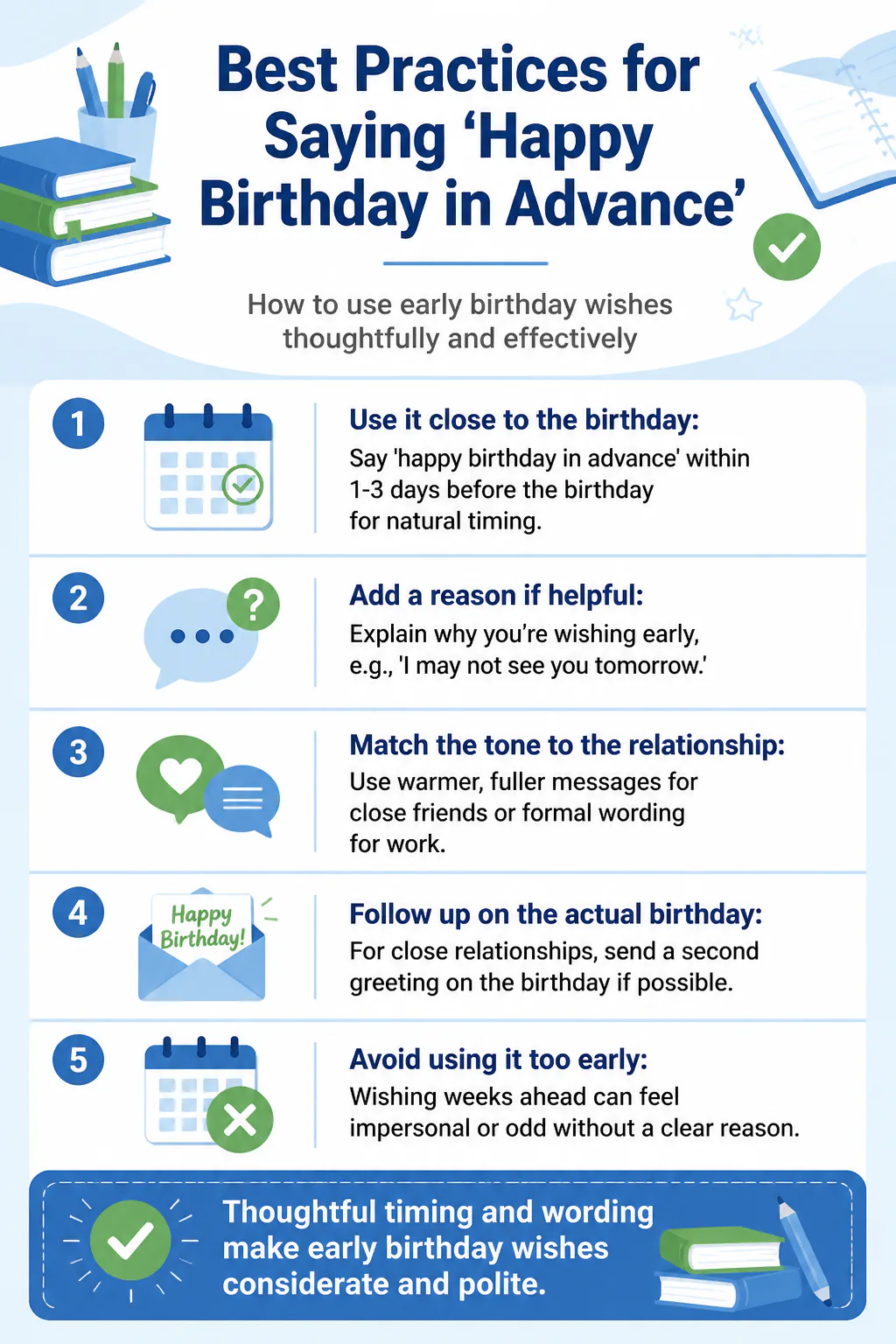
- Use it close to the birthday.
- Add a reason if helpful: “I may not see you tomorrow.”
- Match the tone to the relationship.
- For close relationships, follow up on the actual birthday if possible.
FAQs
Is ‘happy birthday in advance’ grammatically correct?
Yes. It is a correct and natural English phrase. The words clearly show that the birthday greeting is being given before the birthday itself.
How many days before a birthday can I say it?
One to three days before is the most natural range in everyday use. A longer gap can still be acceptable, but it sounds less personal unless there is a clear reason.
Can I write it in a card or email?
Yes. It works well in cards, emails, texts, and spoken conversation. In formal writing, a full sentence such as “Wishing you a happy birthday in advance” sounds polished.
Is it better to say it early or late?
If you cannot say it on the day, early is often better than forgetting completely. Still, if you miss the birthday, a sincere belated message is also polite.
Conclusion
Happy birthday in advance is a polite early birthday wish when you use it close to the date and in the right situation.