
IT Means a Lot to Me: Meaning and Emotional Use
“It means a lot to me” means something has deep personal or emotional importance. People say it when they want to show that a word, action, gift, or gesture is not just nice, but truly meaningful. In everyday communication, this phrase matters because it turns simple thanks into something warmer, more personal, and more honest.
Meaning of the Phrase
At its core, the phrase uses the verb “mean” in the sense of having importance or value. In English, “mean” can refer to intention, as in “She means to win,” or to signifying something, as in “a red sky means rain.” In “it means a lot to me,” the idea is different: it shows that something carries strong personal value.
Literal meaning
Literally, the sentence says that “it” has a large amount of meaning for the speaker. The word “lot” does not refer to a number here. It emphasizes degree, showing that the feeling is strong rather than small or casual.
Emotional meaning
Emotionally, the phrase often expresses gratitude, affection, relief, or comfort. If someone supports you during a hard time, remembers something important, or gives thoughtful help, saying “it means a lot to me” tells them their action touched you deeply. That emotional layer is what makes the phrase more powerful than a plain “thanks.”
How “mean” works here
The word “mean” has several uses in English, but context makes this one clear. It can describe purpose, significance, or value, and this phrase belongs to the value side. It is not related to “mean” as an adjective meaning unkind, and it is not the same as “mean” in math, where it refers to an average.
Why people respond to it
People often want to know whether their actions mattered. This phrase answers that directly. It tells the other person that what they did was seen, felt, and appreciated, which can strengthen trust and closeness in both personal and professional relationships.
Because the phrase is sincere and direct, it fits many kinds of conversations. You might say it after a kind message, a thoughtful gift, an apology, or emotional support. In the same way that polite wording can shape tone, phrases such as looking forward to working with you show how a few simple words can carry warmth beyond their literal meaning.
- “Your advice means a lot to me.”
- “You came when I needed help, and it means a lot to me.”
- “This card means a lot to me because you wrote it yourself.”
- “It means a lot to me that you remembered.”
Notice that the phrase is often attached to a reason. That reason explains the emotional value: the support was timely, the gift was thoughtful, or the effort felt personal. When speakers add that small detail, the sentence sounds even more genuine.
When and Why People Use This Phrase
People use this phrase when they want to express more than ordinary appreciation. It appears in moments where feelings matter, especially when someone has shown care, respect, loyalty, or understanding. The phrase is common because it helps speakers say, clearly and simply, that something mattered on a personal level.
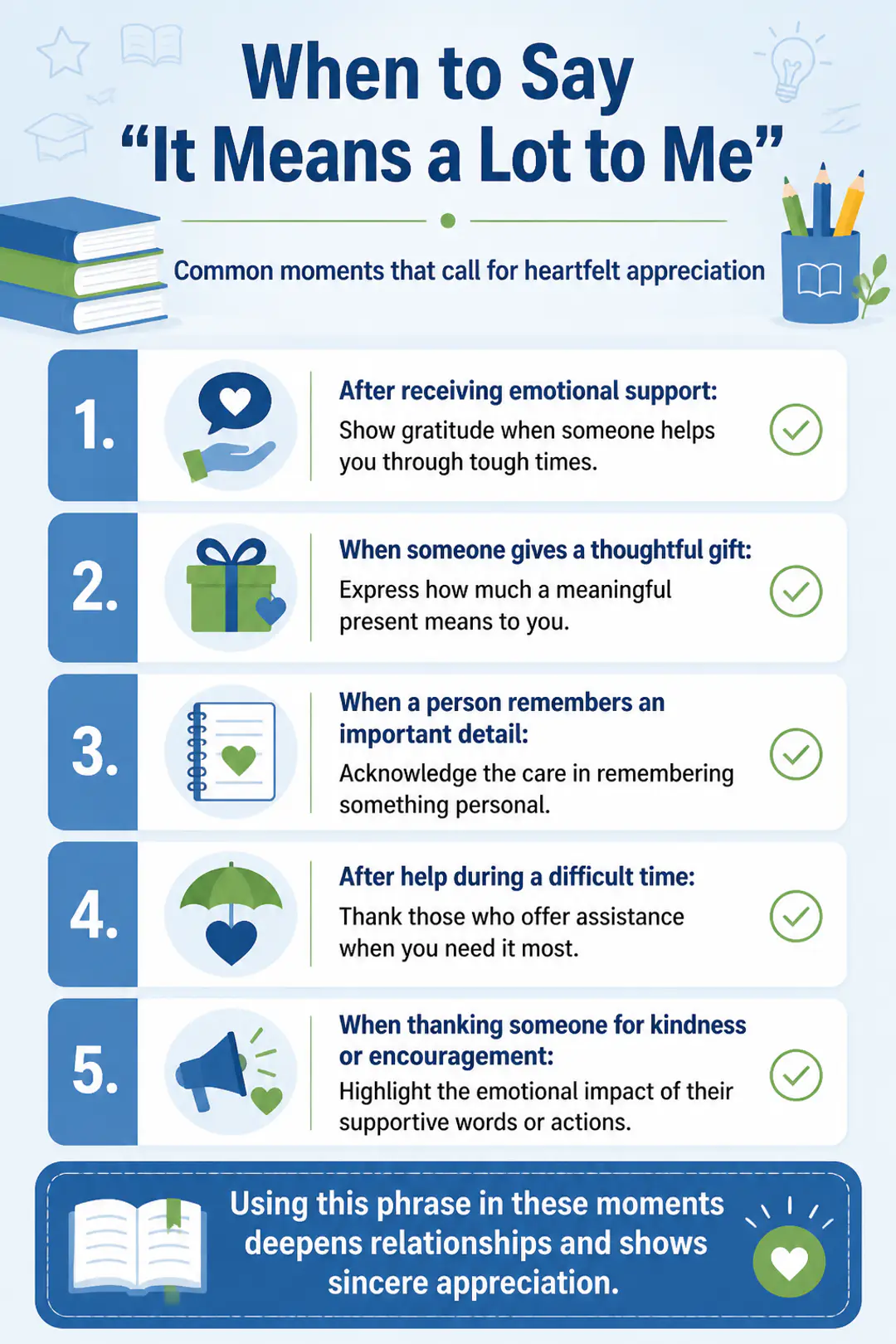
Common situations
- After receiving emotional support
- When someone gives a thoughtful gift
- When a person remembers an important detail
- After help during a difficult time
- When thanking someone for kindness or encouragement
Social effect
Saying “it means a lot to me” can deepen a conversation because it names the impact of another person’s action. Instead of just acknowledging what happened, it reveals how it felt. That honesty often makes the other person feel valued too.
The phrase can also soften formal situations by adding human feeling. For example, in work settings, it can turn a standard thank-you into a more memorable response. Tone matters in everyday expressions, just as it does in friendly check-ins like how’s your day going, where wording shapes how warm or distant a message feels.
Conversation Examples
Everyday examples
- Friendship: “Thanks for calling me last night. It means a lot to me.”
- Family: “You being here today means a lot to me.”
- Work: “I appreciate your feedback. It means a lot to me coming from you.”
- Support: “Your encouragement means a lot to me right now.”
- Gift: “This present means a lot to me because you chose it so carefully.”
- Apology: “It means a lot to me that you said that.”
Natural variations
- “That means a lot to me.”
- “It really means a lot to me.”
- “This means so much to me.”
- “Your support means everything to me.”
Grammar note
If the subject is singular, use “means,” not “mean.” So the correct sentence is “This means a lot to me,” not “This mean a lot to me.” The verb agrees with “this” or “it,” which is singular.
These examples work best when the feeling matches the moment. If the situation is very casual, a shorter version may sound more natural. If the moment is serious or emotional, the full phrase can communicate deeper appreciation, much like choosing more thoughtful wording in sensitive expressions such as ways to say rest in peace.
Alternative Ways to Express Similar Sentiments
Close alternatives
- I really appreciate it.
- That truly means a lot.
- I’m so grateful.
- I truly appreciate it.
- I’m very grateful.
- I deeply appreciate it.
- That means so much to me.
- I cannot thank you enough.
- This truly matters to me.
How the tone changes
- Warm and direct: “I really appreciate it.”
- More emotional: “That means so much to me.”
- More formal: “I truly appreciate it.”
- Very strong gratitude: “I cannot thank you enough.”
These alternatives all share the same basic purpose: they show that something had value beyond the surface. The best choice depends on tone, closeness, and setting. In a heartfelt conversation, stronger phrases often sound more natural than plain, routine thanks.
FAQs
Is “it means a lot to me” romantic?
It can be, but it is not automatically romantic. The phrase simply shows deep personal importance, so it works in friendships, family conversations, work settings, and romantic relationships.
Is it stronger than saying “thank you”?
Yes. “Thank you” shows appreciation, while “it means a lot to me” explains that the action had real emotional impact.
Can I use it in professional settings?
Yes, if the tone fits the situation. It works well when someone has offered meaningful help, support, trust, or recognition.
What is the difference between “mean” here and other uses of “mean”?
Here, “mean” refers to importance or value. In other contexts, “mean” can describe intention, show what something signifies, refer to an average, or describe someone as unkind.
Conclusion
“It means a lot to me” is a simple phrase with real emotional weight. It tells people that their words or actions had genuine value, and that kind of clear appreciation can make relationships stronger, kinder, and more sincere.