

Other Ways to Say Rest in Peace: Respectful Phrases for Sympathy and Memorials
If you want other ways to say Rest in Peace, the best alternative depends on where you are writing, how close you were to the person, and whether the message is public, private, secular, or religious. In a sympathy card, obituary, memorial post, funeral program, or engraving, the right phrase should feel respectful, personal, and appropriate for the grieving family.
Rest in Peace, often shortened to RIP, remains widely accepted and clear. Still, many people want wording that feels warmer, more personal, or better suited to a specific tribute. Below are meaningful alternatives, when to use them, and how to choose one with care.
Best alternatives
- In loving memory
- Gone but never forgotten
- Forever in our hearts
- Rest easy
- May you find eternal peace
- May your soul rest in peace
- At peace now
- Until we meet again
- Your memory will live on
- With deepest sympathy
- Always loved, always remembered
- In peaceful rest
- Eternal rest
- Rest with the angels
- Rest in God’s care
- Sleep in heavenly peace
- Safe journey
- At rest in eternal light
- Peace be upon you
- Rest in power
How to choose the right phrase
The most respectful condolence message matches the setting. A public tribute on social media often calls for short, simple wording, while a sympathy card or personal message can be more intimate and specific.
Belief also matters. Spiritual condolence language such as rest in God’s care or sleep in heavenly peace fits only when you know the family welcomes a religious message. If their beliefs are unknown, neutral remembrance language is safer and often more comforting.
Use formal wording for public settings
For an obituary, memorial service program, funeral program, or tribute page, choose wording that is dignified and broadly understood. These phrases work well in formal condolence and public tribute contexts:
- In loving memory
- Forever in our hearts
- Your memory will live on
- May your soul rest in peace
- With deepest sympathy
Use warmer wording for personal loss
If you were close to the person, a more personal tribute often feels better than standard RIP. The goal is not to sound original for its own sake, but to sound sincere.
- Gone but never forgotten
- Until we meet again
- Always loved, always remembered
- Rest easy
- At peace now
Use short wording for engravings
Space is limited on an engraving, urn engraving, memorial jewelry piece, keepsake, or plaque. In those cases, short phrases usually read better than full sentences.
- In loving memory
- Forever in our hearts
- Always loved
- Always remembered
- At peace now
- Rest easy
Phrase guide
| Phrase | Best use | Tone | Notes |
|---|---|---|---|
| Rest in Peace | General condolence message, obituary, memorial post | Traditional, formal | Universally recognized and respectful |
| In loving memory | Obituary, tribute page, engraving | Warm, timeless | One of the best all-purpose alternatives |
| Gone but never forgotten | Sympathy card, memorial speech, social media tribute | Emotional, personal | Focuses on remembrance and legacy |
| Forever in our hearts | Keepsake, funeral program, public tribute | Tender, affectionate | Works well for family-centered remembrance |
| Rest easy | Personal message, memorial post | Gentle, informal | Best when the relationship was close |
| May you find eternal peace | Formal condolence, spiritual remembrance | Calm, reverent | Appropriate when spiritual language fits |
| May your soul rest in peace | Obituary, sympathy card, religious message | Traditional, spiritual | Suitable when reference to the soul is welcome |
| At peace now | Private condolence, tribute | Comforting, reflective | Use carefully if the family would not want the loss framed around relief |
| Until we meet again | Personal tribute, memorial jewelry | Hopeful, intimate | Common in close-family remembrance |
| Your memory will live on | Public tribute, obituary, memorial speech | Respectful, legacy-focused | Strong choice when highlighting impact |
| With deepest sympathy | Sympathy card, formal condolence note | Supportive, formal | Better for comforting the grieving family than addressing the deceased directly |
| Rest in power | Activist, leader, public figure tribute | Bold, legacy-driven | Best for someone known for service, advocacy, or cultural impact |
30 meaningful alternatives
Traditional and widely appropriate
- Rest in Peace
- May your soul rest in peace
- May you find eternal peace
- Eternal rest
- In peaceful rest
- At peace now
- Rest in eternal light
- Safe journey
Warm and personal
- In loving memory
- Gone but never forgotten
- Forever in our hearts
- Your memory will live on
- Always loved, always remembered
- Until we meet again
- Rest easy
- You will be deeply missed
Spiritual and religious
- Rest with the angels
- Rest in God’s care
- Sleep in heavenly peace
- Heavenly peace be yours
- Peace be upon you
- May you be held in God’s care
- May the angels watch over you
Legacy-focused tributes
- Your legacy lives on
- Your memory will live on
- Always remembered
- Forever remembered
- Rest in power
- Gone too soon
- Never forgotten
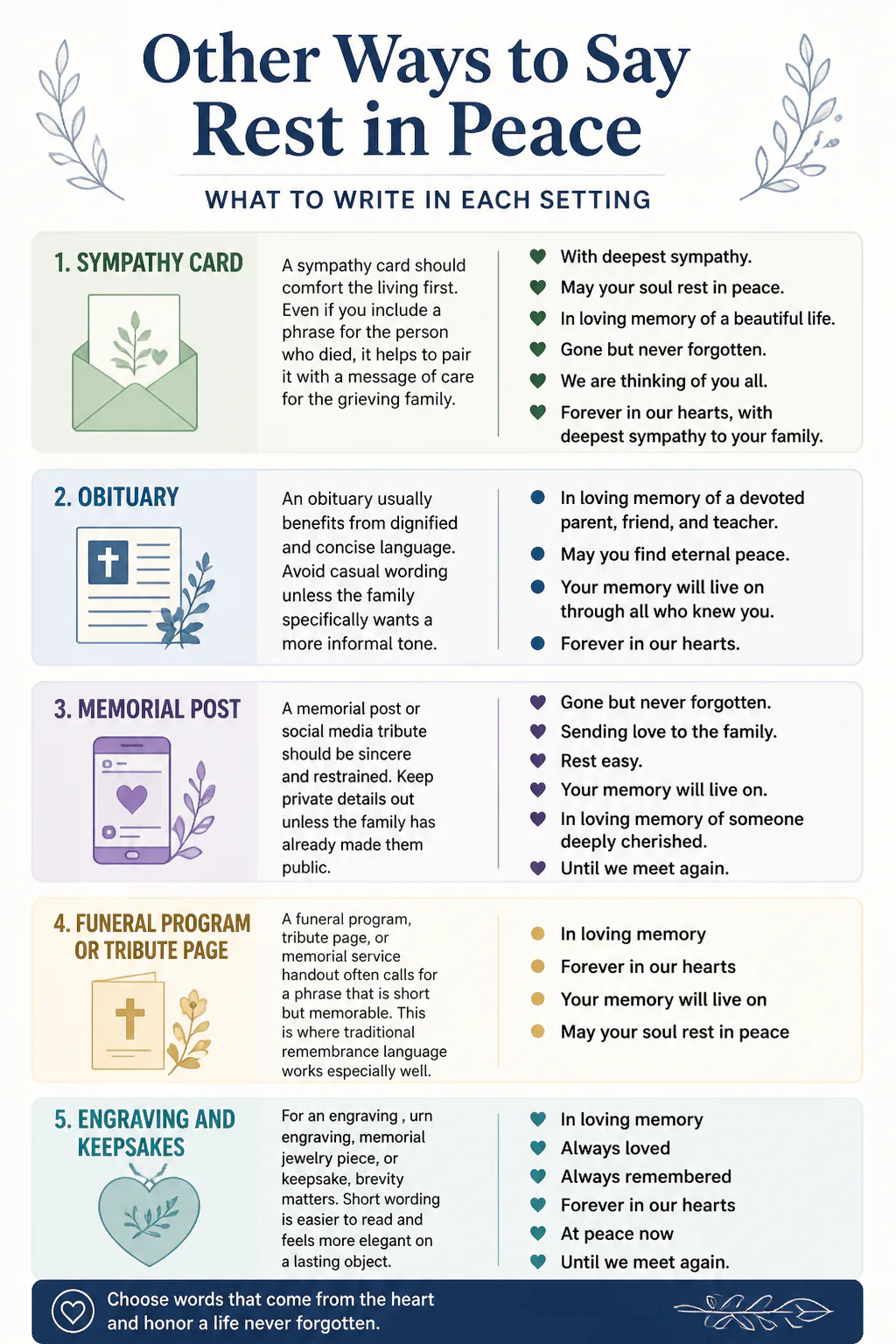
What to write in each setting
Sympathy card
A sympathy card should comfort the living first. Even if you include a phrase for the person who died, it helps to pair it with a message of care for the grieving family.
- With deepest sympathy. May your soul rest in peace.
- In loving memory of a beautiful life.
- Gone but never forgotten. We are thinking of you all.
- Forever in our hearts, with deepest sympathy to your family.
Obituary
An obituary usually benefits from dignified and concise language. Avoid casual wording unless the family specifically wants a more informal tone.
- In loving memory of a devoted parent, friend, and teacher.
- May you find eternal peace.
- Your memory will live on through all who knew you.
- Forever in our hearts.
Memorial post
A memorial post or social media tribute should be sincere and restrained. Keep private details out unless the family has already made them public.
- Gone but never forgotten. Sending love to the family.
- Rest easy. Your memory will live on.
- In loving memory of someone deeply cherished.
- Until we meet again.
Funeral program or tribute page
A funeral program, tribute page, or memorial service handout often calls for a phrase that is short but memorable. This is where traditional remembrance language works especially well.
- In loving memory
- Forever in our hearts
- Your memory will live on
- May your soul rest in peace
Engraving and keepsakes
For an engraving, urn engraving, memorial jewelry piece, or keepsake, brevity matters. Short wording is easier to read and feels more elegant on a lasting object.
- In loving memory
- Always loved
- Always remembered
- Forever in our hearts
- At peace now
- Until we meet again
When to avoid certain phrases
Not every phrase fits every loss. A respectful remembrance message should reflect the person and avoid assumptions about belief, suffering, or family preferences.
- Avoid religious wording if the family’s beliefs are unknown.
- Use “At peace now” carefully if the family would not want the death framed as relief after illness or suffering.
- Use “Gone too soon” carefully because it strongly emphasizes sudden or early loss.
- Use “Rest in power” selectively for activists, public figures, or people whose legacy is tied to advocacy or social impact.
- Avoid overly casual slang in an obituary, formal condolence, or memorial service setting.
Examples you can use
Short messages
- In loving memory.
- Forever in our hearts.
- Gone but never forgotten.
- Rest easy.
- At peace now.
- Until we meet again.
Longer condolence lines
- With deepest sympathy as you honor a life so dearly loved.
- May you find eternal peace, and may your family find comfort in remembrance.
- Your memory will live on in every life you touched.
- Gone but never forgotten, always loved and always remembered.
- May your soul rest in peace and your legacy continue through those who loved you.
Public tribute examples
- In loving memory of a remarkable person whose kindness will not be forgotten.
- Rest in power. Your legacy and voice will live on.
- Forever in our hearts. Sending love and prayers to the grieving family.
- Gone but never forgotten. Thank you for the light you brought to others.
FAQs
Is Rest in Peace still appropriate?
Yes. Rest in Peace is still appropriate in a condolence message, obituary, funeral program, or public tribute. It remains one of the most accepted and widely understood expressions of mourning.
What is the most personal alternative?
Gone but never forgotten, Forever in our hearts, and Until we meet again often feel more personal than plain RIP. They work especially well when you knew the person closely.
What is best for a sympathy card?
For a sympathy card, combine remembrance with support for the family. With deepest sympathy, In loving memory, and Your memory will live on are strong choices.
What is best for an engraving?
For an engraving, choose a short phrase with clear emotional meaning. Good options include In loving memory, Forever in our hearts, Always remembered, and Rest easy.
Is Rest in power the same as Rest in Peace?
No. Rest in power carries a different tone. It is most appropriate for someone remembered for activism, leadership, public service, or a strong cultural legacy, while Rest in Peace is broader and more traditional.
Should I use religious phrases?
Use a religious message only if it fits the person or family. Phrases such as rest in God’s care, rest with the angels, and sleep in heavenly peace can be comforting, but only when that spiritual remembrance aligns with their beliefs.
Final advice
If you are unsure, choose simple and respectful wording: In loving memory, Forever in our hearts, or Your memory will live on. These phrases work well in a sympathy card, obituary, memorial post, tribute page, or keepsake without making assumptions the family may not share.
The best alternative to Rest in Peace is the one that sounds sincere, honors the person’s legacy, and brings comfort rather than attention to the wording itself.

Related Posts

30 Other Ways to Say “Thank You” (With Examples)
ONG Meaning in Text: What Does ONG Stand For?