
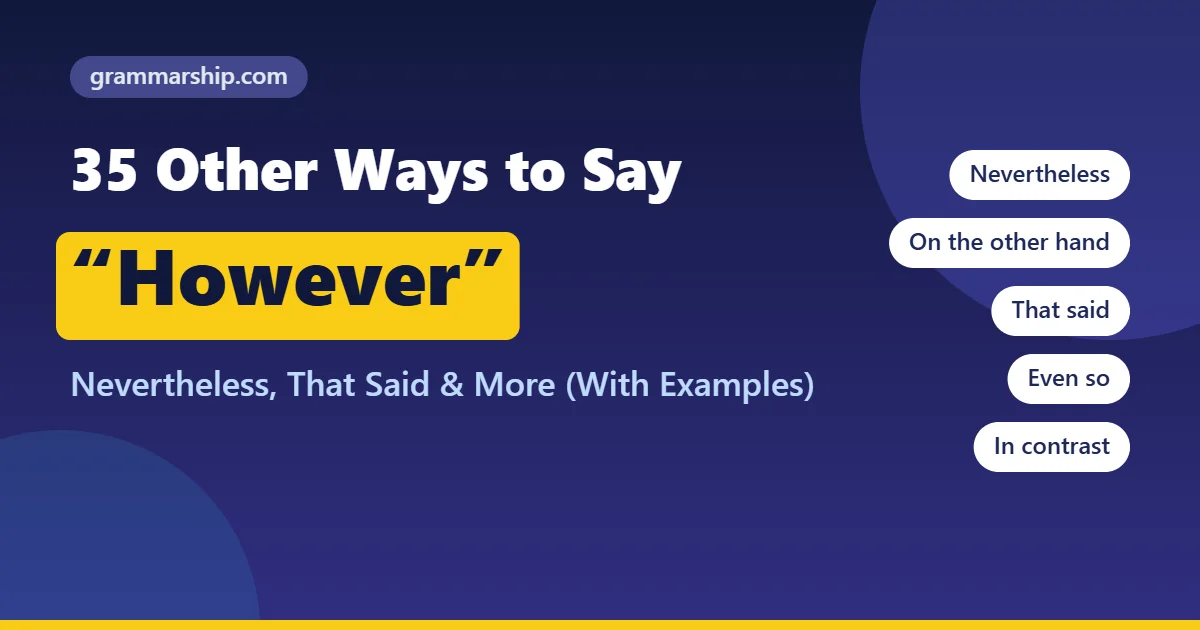
35 Other Ways to Say “However” (With Examples)
“However” is the go-to word for showing contrast in English. It helps you introduce a different idea, a surprising fact, or an exception. But when it shows up in every other paragraph, your writing starts to feel predictable. That is why it pays to know some other ways to say however.
This guide gives you 35 alternatives for essays, business writing, and everyday speech. Each one comes with its tone, a short explanation, and an example sentence. You will also learn the punctuation rules for “however,” which is one of the most commonly mispunctuated words in English.
Quick Answer: Best Alternatives to “However”
Short on time? These six options work in most situations:
- Nevertheless – formal and strong
- On the other hand – perfect for comparing two sides
- That said – natural in modern writing
- Even so – shows something is still true
- In contrast – great for clear differences
- But – simple and always clear
Why Use Other Ways to Say However?
Contrast is what makes an argument interesting. It shows that you have considered more than one side and can handle complex ideas. But if “however” carries every contrast, your writing begins to sound mechanical.
Different words also show different kinds of contrast. “Nevertheless” means something is true despite a problem, “in contrast” compares two separate things, and “on the contrary” corrects a wrong idea. Choosing the right one makes your logic easier to follow.
Formal Other Ways to Say However
These transitions work well in essays, research papers, and reports. Most of them follow the same punctuation as “however.”
1. Nevertheless
Tone: Formal. “Nevertheless” shows that something is still true despite what you just said. It is one of the strongest and most common replacements in academic writing.
Example: The project was expensive. Nevertheless, it delivered excellent results.
2. Nonetheless
Tone: Formal. “Nonetheless” means almost exactly the same as “nevertheless.” Use them interchangeably to keep your writing varied.
Example: The weather was terrible; nonetheless, the race went ahead.
3. On the Other Hand
Tone: Neutral. Use this phrase to present the second side of an argument. It works best when you have already introduced the first side.
Example: City life is exciting. On the other hand, it can be very expensive.
4. In Contrast
Tone: Formal. “In contrast” highlights a clear difference between two things. It is ideal for comparison essays and data analysis.
Example: Sales rose in Europe. In contrast, they fell sharply in Asia.
5. By Contrast
Tone: Formal. “By contrast” works just like “in contrast.” Some writers prefer it when comparing two specific examples.
Example: The first novel is dark and serious. By contrast, the sequel is light and funny.
6. Conversely
Tone: Formal, precise. “Conversely” introduces the opposite or reverse situation. It is common in science, economics, and logic.
Example: Higher prices reduce demand. Conversely, lower prices increase it.
7. On the Contrary
Tone: Formal, emphatic. Use “on the contrary” to reject a false idea and replace it with the truth. Do not use it for simple comparisons.
Example: The test was not easy. On the contrary, it was the hardest of the year.
8. Notwithstanding
Tone: Very formal. “Notwithstanding” means “despite” and is common in legal and official writing. It can come before or after the noun it refers to.
Example: Notwithstanding the delays, the bridge opened on schedule.
9. Despite This
Tone: Neutral to formal. “Despite this” points back to a problem and shows it did not stop the result. It is clear and easy to use.
Example: The team lost its best player. Despite this, they won the league.
10. In Spite of This
Tone: Neutral to formal. This phrase means the same as “despite this.” Use both to add variety to longer essays.
Example: Funding was cut. In spite of this, the program kept growing.
11. Be That as It May
Tone: Formal, slightly old-fashioned. This phrase accepts a point but moves on to a stronger one. It works well in debates and formal speeches.
Example: The plan has risks. Be that as it may, we cannot afford to wait.
12. Admittedly
Tone: Formal, balanced. “Admittedly” concedes a point against your own argument. It shows fairness before you continue your case.
Example: Admittedly, the new system takes time to learn, but it saves hours later.
13. Whereas
Tone: Formal. “Whereas” joins two contrasting clauses in one sentence. Unlike “however,” it is a conjunction, so use a comma before it.
Example: My brother loves the mountains, whereas I prefer the beach.
14. Although
Tone: Neutral. “Although” introduces a contrast inside the same sentence. It often starts a sentence, followed by a comma.
Example: Although the hotel was small, it was very comfortable.
15. Even Though
Tone: Neutral, emphatic. “Even though” is a stronger version of “although.” It stresses that the contrast is surprising.
Example: Even though she was tired, she finished the report.
16. While
Tone: Neutral. “While” can show contrast as well as time. Make sure your sentence is clear about which meaning you intend.
Example: While some students prefer online classes, others learn better in person.
Neutral and Modern Other Ways to Say However
These phrases are common in blogs, journalism, and business writing. They sound natural and less stiff than formal transitions.
17. That Said
Tone: Modern, conversational. “That said” accepts what came before but adds an important point. It is very popular in professional emails and articles.
Example: The budget is tight. That said, we can still afford one new hire.
18. Having Said That
Tone: Conversational. This is a slightly longer version of “that said.” It is common in speech and informal writing.
Example: I love my job. Having said that, I need a vacation.
19. Even So
Tone: Neutral. “Even so” means “despite that.” It is short, natural, and works in both writing and speech.
Example: The tickets were expensive. Even so, the concert sold out.
20. Still
Tone: Neutral. “Still” at the start of a sentence means “even so.” It is simple but effective.
Example: The movie got bad reviews. Still, I wanted to see it.
21. All the Same
Tone: Neutral, slightly British. “All the same” shows that something remains true despite a fact. It sounds friendly and natural.
Example: You don’t have to bring anything. All the same, a dessert would be nice.
22. At the Same Time
Tone: Neutral, balanced. This phrase introduces a second, contrasting point that is also true. It is useful in balanced discussions.
Example: Social media keeps us connected. At the same time, it can increase stress.
23. Then Again
Tone: Conversational. “Then again” introduces a thought that weakens what you just said. It sounds like you are thinking out loud.
Example: The car is cheap. Then again, it uses a lot of fuel.
24. Instead
Tone: Neutral. “Instead” shows that one thing replaced another. Use it when your contrast is about a different choice or result.
Example: We planned to fly. Instead, we took the train.
25. Rather
Tone: Formal. “Rather” corrects or refines a statement. It is often used after a negative sentence.
Example: The problem wasn’t the price. Rather, it was the poor service.
26. Regardless
Tone: Neutral. “Regardless” means “without being affected by” something. Use it when a fact does not change the outcome.
Example: It may rain tomorrow. Regardless, the game will go on.
27. Unlike
Tone: Neutral. “Unlike” compares two things inside one sentence. It is followed by a noun, not a clause.
Example: Unlike her sister, Maria enjoys public speaking.
28. Yet
Tone: Neutral, elegant. “Yet” works like “but” but adds a sense of surprise. It can join two clauses or start a sentence.
Example: The plan was simple, yet it worked perfectly.
Casual Other Ways to Say However
In conversation, texts, and relaxed writing, these options sound natural and easy.
29. But
Tone: Simple, universal. “But” is the most common contrast word in English. You can start a sentence with it, despite what some teachers say.
Example: I wanted to go out. But it was too late.
30. Though
Tone: Casual. “Though” at the end of a sentence is a natural way to add contrast in speech. It softens the point.
Example: The food was great. The service was slow, though.
31. Mind You
Tone: Casual, British. “Mind you” adds a small but important point that changes the picture. It is common in conversation.
Example: He’s a great cook. Mind you, he leaves the kitchen a mess.
32. Anyway
Tone: Casual. “Anyway” shows that something happens despite a reason not to. It also moves a conversation forward.
Example: I knew it was a bad idea. I tried it anyway.
33. Still and All
Tone: Informal, American. This is a casual way of saying “even so.” It sounds folksy and relaxed.
Example: The trip was long. Still and all, we had a great time.
34. Except
Tone: Casual. “Except” introduces an exception to what you just said. It is common in spoken English.
Example: I’d love to join you, except I have to work.
35. Only
Tone: Informal. “Only” can mean “but” in casual speech. It often introduces a problem with an otherwise good idea.
Example: It’s a lovely dress, only it’s too expensive.
How to Punctuate “However” Correctly
“However” is a conjunctive adverb, not a conjunction like “but.” This means it cannot join two complete sentences with just a comma. Here are the rules that keep your punctuation correct.
- At the start of a sentence: Add a comma after it. However, the results were mixed.
- Between two complete clauses: Use a semicolon before and a comma after. The test was hard; however, everyone passed.
- In the middle of a clause: Put commas on both sides. The test, however, was easy.
- Meaning “in whatever way”: Use no comma. However you decide, I will support you.
The most common error is the comma splice: “The test was hard, however everyone passed.” This is incorrect. Use a semicolon or a period before “however.” For a full definition, see the Merriam-Webster entry for however.
Transition Words vs. Conjunctions
Knowing which group a word belongs to tells you how to punctuate it. This table makes it simple.
| Type | Words | Punctuation |
|---|---|---|
| Conjunctive adverbs | however, nevertheless, nonetheless, conversely | Semicolon or period before, comma after |
| Coordinating conjunctions | but, yet | Comma before when joining two clauses |
| Subordinating conjunctions | although, even though, whereas, while | Comma after the clause when it comes first |
| Prepositions | despite, in spite of, unlike, notwithstanding | Followed by a noun, not a clause |
Which Alternative Should You Use?
Use this table to match the right word to your situation.
| Situation | Best Choices | Avoid |
|---|---|---|
| Academic essay | Nevertheless, in contrast, conversely | Mind you, anyway |
| Comparing two things | Whereas, on the other hand, unlike | On the contrary |
| Business email | That said, even so, at the same time | Still and all |
| Legal writing | Notwithstanding, nonetheless | Though (end position) |
| Casual chat | But, though, mind you, anyway | Notwithstanding |
Common Mistakes to Avoid
- Comma splices. Never join two sentences with only a comma before “however.”
- Using “on the contrary” for comparisons. It means “the opposite is true,” not “in comparison.”
- Putting a clause after “despite.” Write “despite the rain,” not “despite it rained.”
- Overusing transitions. Not every sentence needs one; sometimes a simple “but” is best.
- Mixing “although” and “but.” “Although it was late, but we stayed” is wrong. Use only one.
Practice: Choose the Best Word
Test yourself with these sentences. The answers are below.
- The movie was long. ___, I enjoyed every minute.
- Cats are independent, ___ dogs need lots of attention.
- He isn’t lazy. ___, he works harder than anyone.
- The weather was bad; ___, the flight left on time.
Answers: 1. Nevertheless / Even so · 2. whereas · 3. On the contrary · 4. however / nonetheless
Frequently Asked Questions
What is another word for “however”?
Common alternatives include nevertheless, nonetheless, but, yet, and still. Phrases like on the other hand and that said also work well.
What can I use instead of “however” in an essay?
Try nevertheless, in contrast, conversely, or despite this. These sound academic and help you avoid repetition.
Can I start a sentence with “however”?
Yes. When “however” starts a sentence to show contrast, follow it with a comma.
Is “but” less formal than “however”?
Yes, slightly. “But” is acceptable in formal writing, but “however” and “nevertheless” sound more academic.
What is the difference between “however” and “nevertheless”?
“However” introduces any contrast. “Nevertheless” specifically means that something is true despite what was just said.
Do you need a semicolon before “however”?
You need a semicolon (or a period) when “however” joins two complete sentences. A comma alone creates a comma splice.
Final Thoughts
“However” is a powerful word, but variety makes your arguments more engaging. In formal writing, rotate between nevertheless, in contrast, and conversely. In everyday writing, that said, even so, and but sound natural and clear.
Remember to match the word to the type of contrast and to punctuate it correctly. Those two habits will make your writing clearer and more professional.
Keep improving your writing with our guides to other ways to say “because” and other ways to say “for example”.
More Guides to Improve Your Writing

Related Posts
35 Other Ways to Say “You’re Welcome” (With Examples)
35 Other Ways to Say “Because” (With Examples)
One thought on “35 Other Ways to Say “However” (With Examples)”