
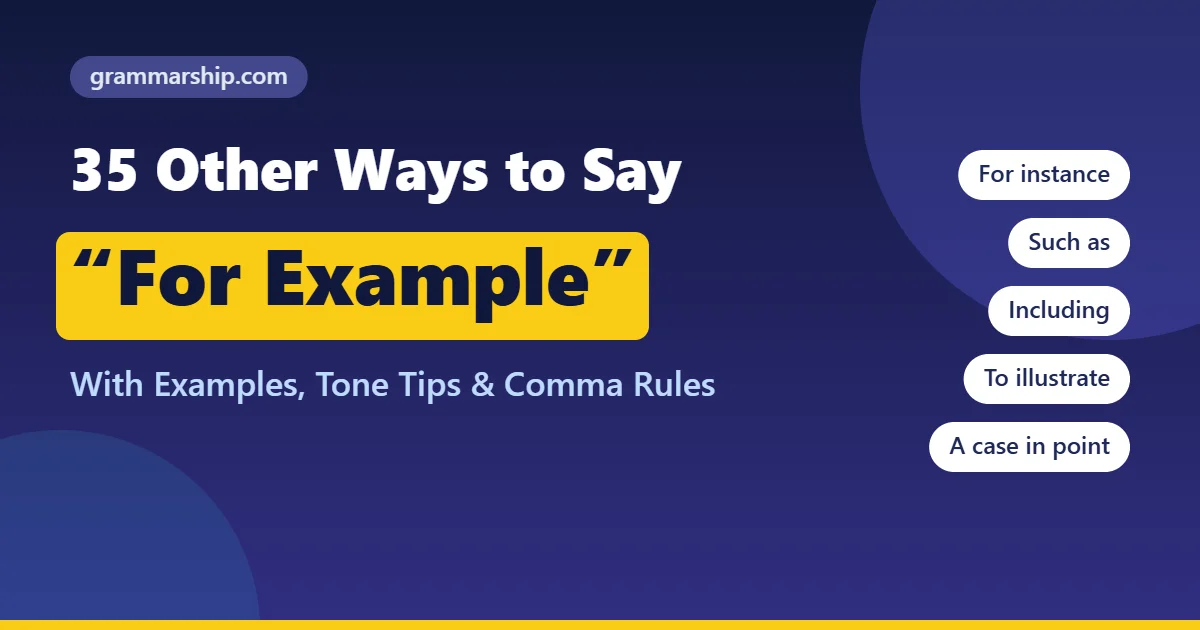
35 Other Ways to Say “For Example” (With Examples)
“For example” is one of the most useful phrases in English, but it gets old fast. If you use it three times in one essay, your writing starts to sound repetitive. The good news is that there are many other ways to say for example that sound fresher and more precise.
This guide gives you 35 alternatives, from formal phrases for essays to casual ones for everyday conversation. Each phrase comes with its tone, a short explanation, and an example sentence. You will also learn how to punctuate them correctly, which is where many writers slip up.
Quick Answer: Best Alternatives to “For Example”
Short on time? These six options cover most situations and are easy to use correctly:
- For instance – the closest match, works everywhere
- Such as – perfect for short lists inside a sentence
- Including – shows your list is not complete
- To illustrate – great for longer examples in essays
- Like – natural in speech and casual writing
- A case in point – strong for one powerful example
Why Use Other Ways to Say For Example?
Examples are the backbone of clear writing. They turn abstract ideas into something readers can picture and remember. But when every example starts with the same two words, readers begin to skim.
Using a variety of phrases also helps you say exactly what you mean. “Such as” introduces a quick list, “to illustrate” sets up a detailed story, and “a case in point” highlights one perfect example. Choosing the right one makes your writing sharper, not just less repetitive.
Formal Other Ways to Say For Example
These phrases work well in essays, research papers, reports, and professional emails. They sound clear and confident without being stiff.
1. For Instance
Tone: Neutral. This is the closest synonym for “for example,” and you can swap them in almost any sentence. It works at the start, in the middle, or at the end of a sentence.
Example: Some animals hibernate in winter. Bears, for instance, can sleep for months.
2. Such As
Tone: Neutral to formal. Use “such as” to introduce one or more examples inside a sentence. It is ideal for short lists and is one of the most common choices in academic writing.
Example: Citrus fruits such as oranges and lemons are rich in vitamin C.
3. E.g.
Tone: Formal, written only. “E.g.” is short for the Latin exempli gratia, meaning “for the sake of example.” Use it inside parentheses or in notes, tables, and technical writing, but never say it out loud in a speech.
Example: Bring something warm to wear (e.g., a jacket or sweater).
4. Including
Tone: Neutral. “Including” tells readers that your list is only part of a bigger group. It is perfect when you cannot or do not want to name everything.
Example: The museum has works by many artists, including Monet and Van Gogh.
5. To Illustrate
Tone: Formal. Use “to illustrate” when your example needs a full sentence or more. It prepares the reader for a detailed case that brings your point to life.
Example: Small habits add up. To illustrate, saving $5 a day gives you over $1,800 a year.
6. As an Illustration
Tone: Formal. This phrase works like “to illustrate” but sounds slightly more academic. It fits nicely at the start of a new paragraph.
Example: As an illustration, consider how smartphones changed the way we shop.
7. To Demonstrate
Tone: Formal. “To demonstrate” suggests your example proves something, not just describes it. It is useful in scientific and persuasive writing.
Example: To demonstrate, the team ran the same test on 200 devices.
8. A Case in Point
Tone: Formal, emphatic. Use this when one example perfectly supports your argument. It tells the reader, “Here is the best proof I have.”
Example: Public transport can transform a city. Copenhagen is a case in point.
9. By Way of Example
Tone: Very formal. This phrase sounds polished and a little old-fashioned. It works well in formal reports, speeches, and legal or academic writing.
Example: By way of example, the company cut its energy use by 30% in one year.
10. In Particular
Tone: Neutral. “In particular” points to one specific example that stands out from the rest. It adds focus and emphasis to your point.
Example: Students enjoyed the trip, and the science museum in particular was a hit.
11. Particularly
Tone: Neutral. This one-word version highlights the most important example in a group. It often comes right before the example it emphasizes.
Example: Fresh vegetables, particularly leafy greens, are packed with nutrients.
12. Specifically
Tone: Formal. “Specifically” narrows a general idea down to an exact example. It is great when you need precision in work emails or reports.
Example: We need to improve customer service, specifically our response times.
13. Notably
Tone: Formal. Use “notably” to point out an example that is especially important or impressive. It is common in news writing and academic papers.
Example: Several leaders attended the summit, notably the prime ministers of Japan and Canada.
14. As Evidenced By
Tone: Formal. This phrase links a claim directly to proof. It works best when your example is a fact, statistic, or event.
Example: Interest in electric cars is growing, as evidenced by record sales this year.
15. As Seen In
Tone: Neutral. “As seen in” connects your point to a real case that readers may recognize. It is useful in essays about books, films, or history.
Example: Courage often comes from ordinary people, as seen in many wartime stories.
16. One Example Is
Tone: Neutral. Sometimes the simplest phrase is the clearest. “One example is” introduces a single example as a complete sentence.
Example: Many words come from French. One example is “restaurant.”
17. Examples Include
Tone: Neutral to formal. Use this to start a list of examples as its own sentence. It is very common in textbooks and reports.
Example: Renewable energy sources are growing fast. Examples include solar, wind, and hydropower.
18. Consider
Tone: Engaging. “Consider” invites the reader to think about an example with you. It is a great way to open a paragraph in persuasive writing.
Example: Consider how much time the average person spends on their phone each day.
Casual Other Ways to Say For Example
In conversation, texts, and friendly writing, these phrases sound natural and relaxed. Avoid most of them in formal essays.
19. Like
Tone: Casual. “Like” is the most common way to give examples in everyday speech. In formal writing, “such as” is usually the safer choice.
Example: I love outdoor sports, like hiking and kayaking.
20. Say
Tone: Casual. “Say” introduces a quick, often hypothetical example. It is usually set off by commas in the middle of a sentence.
Example: If you moved to a big city, say, Chicago, what would you miss most?
21. Let’s Say
Tone: Casual, conversational. Use “let’s say” to set up an imaginary situation. Teachers and trainers use it often to explain ideas step by step.
Example: Let’s say you earn $3,000 a month. How much should you save?
22. Take
Tone: Conversational. “Take” points the listener to a specific example. It often appears as “take ___, for example,” but it works on its own too.
Example: Some jobs are hard to automate. Take nursing: it needs both skill and empathy.
23. Think Of
Tone: Friendly. “Think of” asks the reader to picture something familiar. It makes your example feel personal and easy to understand.
Example: Think of your favorite teacher. What made them so memorable?
24. Picture This
Tone: Casual, storytelling. This phrase sets up a vivid scene. It is popular in blogs, presentations, and marketing.
Example: Picture this: you wake up, and your coffee is already made.
25. Imagine
Tone: Friendly, persuasive. “Imagine” draws the reader into a possible situation. It is powerful for showing benefits or consequences.
Example: Imagine finishing all your work by noon every Friday.
26. Suppose
Tone: Neutral. “Suppose” introduces a hypothetical example, much like “let’s say.” It is common in math, logic, and classroom explanations.
Example: Suppose a train leaves the station at 9 a.m. When will it arrive?
27. To Name a Few
Tone: Casual. Place this at the end of a short list to show there are many more. It sounds natural in both speech and blogs.
Example: She speaks Spanish, Arabic, and Japanese, to name a few.
28. Among Others
Tone: Neutral. Like “to name a few,” this phrase shows your list is incomplete. It is slightly more formal and works in reports too.
Example: The festival featured jazz, blues, and folk musicians, among others.
29. Things Like
Tone: Very casual. “Things like” is relaxed and conversational. Keep it for speech and informal messages.
Example: I need to buy things like milk, bread, and eggs.
30. For One
Tone: Conversational. “For one” gives a single example, often the first of several reasons. It usually sits right after the subject.
Example: Not everyone liked the movie. My brother, for one, fell asleep.
More Ways to Introduce an Example
These flexible phrases work in both formal and informal writing. They are especially useful when you want your example to stand out.
31. A Good Example Is
Tone: Neutral. This phrase signals that the example is a strong, clear one. It is easy to use and suits almost any audience.
Example: A good example is the way bees communicate through dance.
32. To Give an Example
Tone: Neutral. This is a simple, direct way to introduce an example. It works well in speeches, interviews, and presentations.
Example: To give an example, our sales doubled after we added free delivery.
33. To Show What I Mean
Tone: Conversational. Use this when an idea might be hard to understand without a real case. It feels friendly and helpful.
Example: To show what I mean, here is the email that started the problem.
34. This Is Shown By
Tone: Formal. This phrase connects your point to supporting evidence. It fits naturally in essays and research summaries.
Example: The policy worked. This is shown by the drop in waiting times.
35. Especially
Tone: Neutral. “Especially” highlights the strongest example in a group. It adds emphasis without needing a full phrase.
Example: Kids love the park, especially the new water play area.
Phrases That Look Similar but Mean Something Different
Some phrases are often confused with “for example,” but they do a different job. Using them correctly will make your writing much more precise.
| Phrase | Meaning | Use It When |
|---|---|---|
| i.e. | “That is” (Latin id est) | You explain or restate, not give examples |
| Namely | “Specifically, and only” | You name the complete list |
| That is | “In other words” | You clarify what you just said |
| In other words | “To say it differently” | You rephrase an idea more simply |
Quick test: If your list could go on, use “for example” or “e.g.” If your list is complete or you are explaining, use “i.e.” or “namely.”
E.g. vs. I.e.: The Most Common Mistake
Many writers mix up these two abbreviations. “E.g.” introduces some examples, while “i.e.” introduces the exact thing you mean. A simple memory trick is “e.g. = example given” and “i.e. = in essence.”
- Correct: I love citrus fruits (e.g., oranges and limes).
- Correct: I love the best citrus fruit (i.e., oranges).
In American English, put periods in both abbreviations and add a comma after them. British writers often drop the periods (eg, ie), so follow the style your school or publication prefers. You can check the full definition in the Merriam-Webster entry for e.g.
How to Punctuate “For Example” and Its Alternatives
Punctuation trips up many writers, so here are the main rules to remember. Getting these right makes your writing look polished and professional.
- At the start of a sentence: Put a comma after the phrase. For instance, many birds migrate south.
- In the middle of a sentence: Put commas on both sides. Many birds, for instance, migrate south.
- After a semicolon: Use a semicolon before and a comma after. Some birds migrate; for example, geese fly south.
- With “such as”: No comma is needed after it. Birds such as geese migrate.
Which Alternative Should You Use?
Still not sure which phrase fits your sentence? This table matches common situations with the best choices.
| Situation | Best Choices | Avoid |
|---|---|---|
| Academic essay | For instance, such as, to illustrate | Like, things like |
| Research paper | E.g., as evidenced by, notably | Picture this, let’s say |
| Business email | Specifically, including, for instance | Things like |
| Speech or presentation | To give an example, consider, imagine | E.g. (don’t say it aloud) |
| Casual conversation | Like, say, let’s say, take | By way of example |
Common Mistakes to Avoid
- Using “e.g.” and “etc.” together. “E.g.” already shows the list is incomplete, so “etc.” is unnecessary.
- Repeating the same phrase. Rotate between “for instance,” “such as,” and “including” to keep readers engaged.
- Using “like” in formal essays. Many teachers prefer “such as” for listing examples.
- Confusing “namely” with “for example.” “Namely” gives the complete list, not a sample.
- Forgetting commas. Most introductory phrases need a comma after them.
Practice: Choose the Best Phrase
Test yourself with these quick sentences. The answers are below.
- Pack a few snacks (___, nuts or fruit).
- Many artists, ___ Picasso and Dalí, lived in Paris.
- ___ you lost your passport abroad. What should you do?
- Remote work has benefits. My team, ___, saves two hours a day.
Answers: 1. e.g. · 2. such as / including · 3. Let’s say / Suppose · 4. for one / for instance
Frequently Asked Questions
What is another way to say “for example”?
The most common alternatives are for instance, such as, including, and e.g. In casual speech, like and let’s say sound more natural.
What can I use instead of “for example” in an essay?
Try for instance, to illustrate, such as, or a case in point. These sound academic and help you avoid repeating the same phrase.
Is “for instance” the same as “for example”?
Yes, they mean the same thing and can usually be swapped. “For instance” is sometimes used for a single, specific case, but the difference is very small.
Is “such as” formal?
Yes, “such as” is suitable for formal writing. It is generally preferred over “like” when listing examples in essays and reports.
What is the difference between e.g. and i.e.?
“E.g.” means “for example” and introduces some possible examples. “I.e.” means “that is” and introduces an explanation or the exact thing you mean.
Do you put a comma after “for example”?
Yes. When “for example” starts a sentence, follow it with a comma. In the middle of a sentence, put commas on both sides.
Final Thoughts
“For example” is a great phrase, but it should not carry your whole essay. For formal writing, rotate between for instance, such as, and to illustrate. In conversation, like, say, and let’s say sound natural and friendly.
Most importantly, pick the phrase that matches what your example is doing. Whether you are listing, proving, or imagining, the right phrase makes your point clearer and your writing more enjoyable to read.
Keep improving your writing with our guides to other ways to say “in conclusion” and then vs than.
More Guides to Improve Your Writing

Related Posts
35 Other Ways to Say “However” (With Examples)

35 Other Ways to Say “You’re Welcome” (With Examples)
2 thoughts on “35 Other Ways to Say “For Example” (With Examples)”