

30 Ways to Say Bro: Casual Slang and Nicknames
If you use “bro” a lot, you’re not alone. One of the easiest ways to make your speech feel more natural, funny, or specific is to learn a few other ways to say bro that fit different moods, regions, and friend groups. From buddy and mate to bruh, brah, and even playful picks like Broseph, the right word can change the vibe of a conversation fast.
At its core, bro is a casual term for a close friend, and it usually signals friendship, camaraderie, trust, and easygoing familiarity. But not every situation calls for the same word. Some alternatives sound warmer, some sound funnier, and some come from specific scenes like surfer slang, skate lingo, urban culture, or regional English.
What “bro” really means in everyday speech
“Bro” is more than a nickname. In everyday informal conversations, it often works as a shortcut for solidarity, loyalty, and group identity. You might use it as a greeting, a reaction, or a label for someone you trust.
It also has a flexible tone. Depending on how you say it, bro can sound affectionate, playful, teasing, supportive, or mildly dramatic. That flexibility is why so many people look for other ways to say bro without losing the same relaxed energy.
- Friendly: “Thanks, bro.”
- Surprised: “Bro, what was that?”
- Supportive: “You got this, bro.”
- Teasing: “Bro, be serious for one second.”
That said, “bro” is usually best kept to casual settings. In professional or formal situations, it can feel too familiar unless the culture clearly allows it.
Common ways to say bro in casual conversation
If you want practical substitutes, start with the terms that work across the most situations. These are easy, familiar, and generally understood by most English speakers.
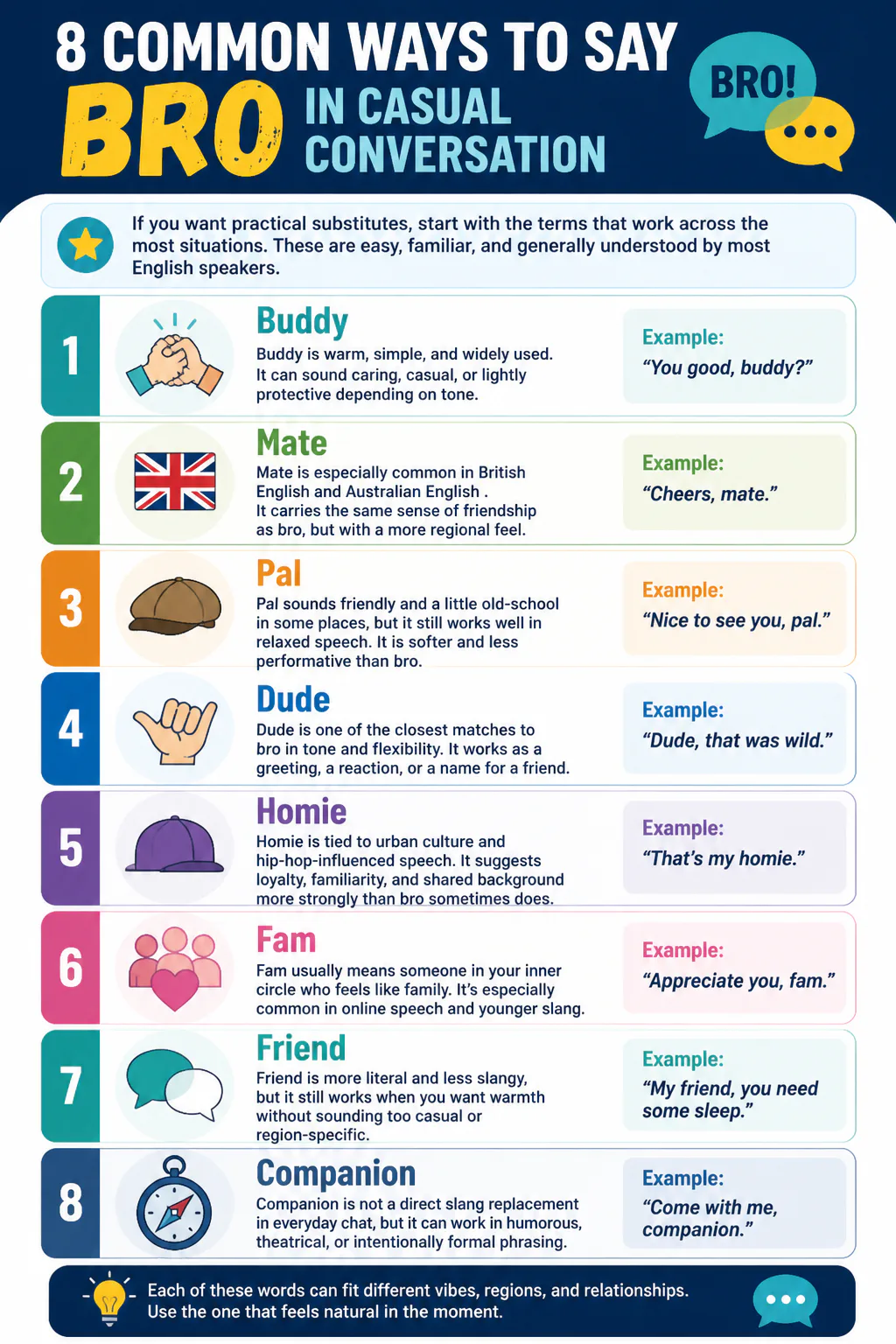
1. Buddy
Buddy is warm, simple, and widely used. It can sound caring, casual, or lightly protective depending on tone.
Example: “You good, buddy?”
2. Mate
Mate is especially common in British English and Australian English. It carries the same sense of friendship as bro, but with a more regional feel.
Example: “Cheers, mate.”
3. Pal
Pal sounds friendly and a little old-school in some places, but it still works well in relaxed speech. It is softer and less performative than bro.
Example: “Nice to see you, pal.”
4. Dude
Dude is one of the closest matches to bro in tone and flexibility. It works as a greeting, a reaction, or a name for a friend.
Example: “Dude, that was wild.”
5. Homie
Homie is tied to urban culture and hip-hop-influenced speech. It suggests loyalty, familiarity, and shared background more strongly than bro sometimes does.
Example: “That’s my homie.”
6. Fam
Fam usually means someone in your inner circle who feels like family. It’s especially common in online speech and younger slang.
Example: “Appreciate you, fam.”
7. Friend
Friend is more literal and less slangy, but it still works when you want warmth without sounding too casual or region-specific.
Example: “My friend, you need some sleep.”
8. Companion
Companion is not a direct slang replacement in everyday chat, but it can work in humorous, theatrical, or intentionally formal phrasing.
Example: “Come with me, companion.”
Slang-heavy alternatives with a different vibe
Not every replacement for bro sounds neutral. Some words carry a stronger cultural flavor, a different age vibe, or a more playful edge.
Bruh
Bruh is one of the most common modern alternatives. It often expresses surprise, frustration, disbelief, humor, or camaraderie all at once.
Example: “Bruh, you really said that?”
Unlike bro, bruh is often more reaction-based. It can name a person, but it also functions like an emotional soundbite.
Brah
Brah is widely recognized as a Hawaiian version of bro. It also overlaps with beach and board-sport speech, which is why it shows up so often in surfer slang.
Example: “How’s it going, brah?”
Dawg
Dawg brings a distinct casual energy and is often linked to sports talk, hip-hop influence, and laid-back banter.
Example: “What’s up, dawg?”
Chief
Chief can be playful, ironic, or sincere depending on delivery. Some people use it affectionately, while others use it for light sarcasm.
Example: “That’s not how this works, chief.”
Ace
Ace sounds upbeat and approving. It can suggest that someone is dependable, skilled, or just a solid person to have around.
Example: “Thanks, ace.”
Partner
Partner has a friendly, cooperative feel. It can sound rustic, Southern, old-school, or simply supportive depending on context.
Example: “We got this, partner.”
Amigo and hombre
Amigo is a familiar, friendly choice that many English speakers use casually. Hombre can also appear in informal speech, though it tends to be more stylized and should be used with awareness of tone and context.
Example: “Good looking out, amigo.”
Regional and cultural alternatives to bro
One important rule with slang: not every term fits every region equally. A word that sounds natural in one place can sound forced somewhere else.
British English
- Mate
- Pal
- Lad
- Chum
In British English, mate is the standout. Lad can also work, especially in group settings, though it has its own social and regional shades.
Australian English
- Mate
- Buddy
- Chief
In Australian English, mate is deeply embedded in everyday casual talk. It often carries the same blend of familiarity, ease, and social bonding that bro does elsewhere.
Hawaiian and surf-influenced speech
- Brah
- Abroha
Brah is the best-known Hawaiian version of bro. In more playful beachy slang, abroha blends “aloha” and “bro” into a joking greeting.
Urban and hip-hop-influenced casual speech
- Homie
- Fam
- Homeboy
- Dawg
These terms often emphasize loyalty, roots, and inner-circle belonging. They can overlap with bro, but they carry their own history and style, so they work best when they’re part of your natural voice.
Funny and playful bro variations
If you are not just looking for substitutes but for humor, the broader brocabulary is full of exaggerated nicknames and joke words. This is where bro-ism and bronacular really come alive.
A bro-ism is a slangy expression shaped by bro culture, especially the kind linked to surfer slang and skate lingo. The larger brocabulary includes dozens of bro-based inventions, and some lists run well past 50 entries, with others reaching 100.
Popular humorous bro words
- Broseph — a playful, exaggerated version of bro
- Broseidon — a mythic bro figure, often styled as ruler of the Brocean
- Brocean — a joking “bro kingdom” or bro republic
- Brofessor — a bro with advanced expertise, often in surf or skate contexts
- Brobot — an emotionless bro, or someone who says bro constantly
- Brohemian — a bohemian-flavored bro persona
- Brotastic — extremely bro-ish in a funny or approving way
- Brolicious — over-the-top bro energy
- Yobro — a greeting between bros
- Brotherman — a stylized, rhythmic alternative to brother or bro
Examples:
- “What up, Broseph?”
- “Ask the brofessor if your board setup is right.”
- “This cookout turned into a full bro-b-q.”
- “He’s such a brobot in group chats.”
These are fun, but they are not universal everyday replacements. Use them when the tone is clearly playful and everyone is in on the joke.
Relationship-based words that can replace bro
Sometimes the best alternative depends less on slang and more on the relationship itself. If you want to stress closeness, these words can work better than bro.
- Brother — deeper and more affectionate than bro
- Bestie — more common in affectionate or ironic speech
- BFF — playful and often text-friendly
- Sidekick — funny and loyal
- Wingman — social, supportive, and situational
- Soulmate — exaggerated or sincere depending on context
- Comrade — ironic, political, or jokingly formal
- Blood — intense loyalty in some dialects and communities
- Boss — approving, respectful, and casual
These are not all direct synonyms, but they can fill the same social role as bro: signaling closeness, confidence, or shared identity.
How to choose the right alternative
The smartest way to use different ways to say bro is to match the term to the context. Think about region, age group, tone, and how close you are to the person.
- Match the setting. Use slang in casual speech, texts, gaming chats, and social media more than in formal environments.
- Match the relationship. A close friend might get “bro,” “fam,” or “homie,” while a newer acquaintance might fit “buddy” or “mate.”
- Match the culture. Terms from surfer slang, skate lingo, or hip-hop-influenced speech sound best when they’re authentic to the speaker and situation.
- Match the emotion. “Bruh” is great for disbelief, “dude” for reaction, and “brother” for warmth.
- Don’t force it. If a word feels unnatural in your mouth, people can hear that instantly.
Quick list: 30 alternatives and variations for “bro”
Here is a mix of practical, regional, and humorous options:
- bruh
- brah
- buddy
- mate
- pal
- homie
- dude
- friend
- companion
- fam
- ace
- chief
- partner
- homeboy
- brother
- amigo
- hombre
- dawg
- chum
- lad
- bestie
- sidekick
- wingman
- comrade
- blood
- boss
- Broseph
- brotherman
- yobro
- brah
If you want the safest all-purpose choices, start with buddy, mate, dude, pal, and friend.
Bro culture, bro-isms, and why these words keep evolving
The reason there are so many ways to say bro is that slang grows through subcultures, not rulebooks. The broader bronacular around bro has been shaped heavily by surfing culture, skateboarding culture, online humor, meme language, and Gen Z slang.
That is why the family of bro words ranges from practical terms like buddy and mate to niche joke formations like Broseidon and brocean. The core meaning stays familiar: friendship, trust, loyalty, and camaraderie. The surface style changes with the crowd.
You can also see this in related expressions:
- Bro hug — a hug between two friends or bros
- Bromance — a close affectionate bond between two bros
- Bro-b-q — a joking term for a barbecue for bros
These phrases show that bro is not just a label. It is a whole mini language tied to social connection and in-group humor.
When not to say bro
Even a good slang term can miss the mark. “Bro” and its alternatives are usually a poor fit when the moment needs distance, professionalism, or extra care.
- Job interviews
- Formal emails
- Academic writing
- Customer service situations
- Conversations where you do not know the other person well
Also, be careful with culturally marked terms. A word like homie, brah, or blood carries more context than a neutral option like buddy or mate. If it is not part of your natural speech, using it can sound performative.
Examples of ways to say bro by tone
Warm and supportive
- buddy
- brother
- friend
- fam
Laid-back and everyday
- dude
- mate
- pal
- bro
Funny and exaggerated
- Broseph
- brofessor
- brobot
- Broseidon
Reaction-heavy and expressive
- bruh
- dude
- chief
Loyalty and inner-circle energy
- homie
- homeboy
- fam
- dawg
FAQ
What are the most common ways to say bro?
The most common alternatives are buddy, mate, pal, dude, homie, fam, and friend. These cover most casual situations without sounding too niche.
Is “bruh” the same as “bro”?
Not exactly. Bruh can refer to a person, but it is often more of a reaction word used for surprise, frustration, humor, or disbelief. Bro is more consistently used as a direct name for a friend.
What is the difference between “bro” and “brah”?
Brah is commonly recognized as the Hawaiian version of bro and is strongly associated with surfer slang. Bro is the broader mainstream form used across many kinds of casual English.
Which word is most like “bro” in British English?
In British English, the closest everyday equivalent is usually mate. Depending on tone and region, pal or lad may also fit.
Which word is most like “bro” in Australian English?
In Australian English, mate is the strongest match. It covers much of the same social ground: friendliness, familiarity, and everyday rapport.
Is “homie” the same as “friend”?
Not quite. Homie usually implies a stronger bond, more shared identity, and more cultural style than the neutral word friend. It tends to sound more intimate and more rooted in casual group speech.
What is a bro-ism?
A bro-ism is a bro-related slang expression, often shaped by surfer slang or skate lingo. It can be a catchphrase, nickname, joke term, or part of the larger brocabulary.
What does “Broseph” mean?
Broseph is a humorous, affectionate spin on bro. People use it when they want to sound extra playful or over-the-top with a friend.
Can you say “bro” at work?
Usually, it is better to avoid it unless your workplace culture is very casual and the relationship clearly supports it. In most professional settings, bro feels too informal.
What are funny bro words people use online?
Popular playful forms include Broseph, Broseidon, brocean, brofessor, brobot, brohemian, and brotastic. These belong more to joke slang than daily direct address.
Conclusion
The best ways to say bro depend on what you want to sound like: relaxed, supportive, regional, ironic, or just funny. For everyday use, safe picks like buddy, mate, pal, dude, and friend go a long way. If you want more style, terms like bruh, brah, homie, and fam add personality, while joke words like Broseph and brofessor tap into the wider brocabulary.
The real key is fit. Choose the word that matches your relationship, your setting, and your natural voice. If you want, you can keep exploring related slang, regional expressions, and modern bronacular to build a more flexible everyday vocabulary.

Related Posts

30 Other Ways to Say “Thank You” (With Examples)

ONG Meaning in Text: What Does ONG Stand For?