
What “Please Confirm Receipt of This Email” Means
You send an important message, attach the file, hit send, and then wait. If the email contains a signed contract, HR paperwork, an invoice, or other time-sensitive information, silence can become a real problem. That is exactly why people use the phrase please confirm receipt of this email.
In business communication, this phrase is a request for receipt confirmation or email acknowledgment. It asks the recipient to verify that the message and any attachment arrived successfully. It does not mean they agree with the contents, approve the request, or accept legal terms. It simply creates a clear record, reduces miscommunication, and supports accountability.
In this guide, you will learn what “please confirm receipt of this email” means, when to use it, when to avoid it, how to reply, and which alternatives sound more natural in modern professional correspondence.
What does “please confirm receipt of this email” mean?
At its core, please confirm receipt of this email means: please acknowledge that you received my message. In a professional email, the sender is asking for a short reply that confirms delivery was successful.
This kind of confirmation of receipt is common when the message includes important information, deadlines, legal documents, or financial information. It helps create a paper trail and supports record-keeping if questions come up later.
- Confirm receipt means verify that the email or item arrived.
- Acknowledge receipt means formally state that you received it.
- Written confirmation means the acknowledgment is documented, usually by email.
- Formal confirmation is often used in legal, financial, or compliance-focused settings.
In simple terms, the sender wants proof that the message reached the right person.
Why receipt confirmation matters in business communication
In everyday email etiquette, not every message needs a reply. But some messages absolutely do. When stakes are higher, a quick acknowledgment of delivery helps avoid delays, confusion, and disputes.
A request to confirm receipt is especially useful because it creates clarity around who has the information and when they received it. That matters for accountability, compliance requirements, and smooth next steps.
Key reasons professionals ask for confirmation of receipt
- To reduce miscommunication about whether the email was received.
- To create a documented paper trail for audits or disputes.
- To support compliance and record-keeping in regulated industries.
- To confirm that an attachment, file, or document was delivered.
- To prevent project delays when a message is time-sensitive.
- To establish accountability before the recipient must review and respond.
In many workplaces, this is less about formality and more about practical risk management.
When to use “please confirm receipt of this email”
This phrase works best when the message contains something important enough that silence would create a problem. It is most appropriate in professional correspondence where you need a record that delivery was successful.
Common situations where it makes sense
- Signed contract delivery
- Legal documents or legal notice
- Invoice submission
- Payment confirmation
- Financial document exchange
- HR paperwork or onboarding forms
- Job application materials
- NDA transmission
- Proposal submission before a deadline
- Shipment or package acknowledgment
- Any time-sensitive email where delay could affect outcomes
For example, if you send a signed contract for execution, a simple acknowledgment confirms the recipient has the correct version. If you send payment details, a reply can confirm that the funds or supporting documents were received and logged properly.
Contexts where confirmation is especially important
Some industries rely heavily on documented communications. In finance, healthcare, legal services, and other regulated fields, a formal email reply may be part of standard procedure.
That is because the issue is not just convenience. It is also about compliance requirements, audit readiness, and preserving a reliable business record.
When not to use it
Although the phrase is correct and professional, it can sound stiff if used for every routine message. Good email etiquette means matching the wording to the situation.
You probably do not need to request confirmation for casual internal updates, low-priority FYI notes, or simple check-ins. Overusing it can make normal communication feel heavier than necessary.
Skip it when:
- The message is routine and low risk.
- The recipient is already actively responding in a live thread.
- There is no attachment, deadline, or action item.
- A chat message or project tool is the better channel.
- You are asking for approval, not simple acknowledgment.
If your real goal is feedback or a decision, ask for that directly instead of only asking someone to confirm receipt.
Does confirming receipt mean acceptance?
No. This point matters a lot. A confirmation of receipt only shows that the recipient received the email, file, payment record, or shipment. It does not constitute acceptance, approval, agreement, or legal consent.
That distinction is especially important in legal and contractual settings. Someone can acknowledge receipt of a signed contract, legal notice, or proposal without agreeing to the terms. In formal situations, parties may even state this explicitly in writing.
Confirmation of receipt does not constitute acceptance, approval, or agreement with the contents.
This wording is useful when you need a clear record of delivery without implying that the recipient has accepted obligations or approved official agreements.
How to ask someone to confirm receipt professionally
If you need a reply, keep the request short, direct, and polite. Most of the time, one sentence is enough. The best wording depends on the context, relationship, and level of formality.
Standard phrasing
Please confirm receipt of this email.
This is correct, widely understood, and suitable for formal confirmation. Still, many professionals now prefer softer or more natural alternatives.
Better alternatives for modern professional email
- Please confirm receipt at your earliest convenience.
- Please acknowledge receipt of this message and attachment.
- Kindly confirm that you received this email.
- Please let me know once the documents have been received.
- Please send a brief email confirmation upon receipt.
- Could you confirm safe receipt of the attached file?
- Please confirm that delivery was successful.
- When you have a moment, please acknowledge receipt.
- Please confirm receipt of the signed contract.
- Please confirm receipt of the invoice and advise on next steps.
These options still support accountability while sounding more natural in current business communication.
How to ask without sounding overly formal
If the tone is less formal, your request can be simpler:
- Just confirming you received this.
- Can you let me know when this comes through?
- Please let me know once you have the attachment.
- A quick acknowledgment would be appreciated.
Use these only when the relationship and context allow a lighter tone.
Email examples: how to use “please confirm receipt of this email”
Example for a signed contract
Dear Ms. Patel,

Attached is the signed contract for your records.

Please confirm receipt of this email and the attached signed contract. If any pages are missing, let me know and I will resend them immediately.

Best regards,
Daniel Reed
Example for HR paperwork
Hello Jordan,

I have attached the completed HR paperwork for onboarding.

Please acknowledge receipt of this email and confirm whether any additional forms are required.

Thank you,
Avery Chen
Example for an invoice
Dear Accounts Payable,

Please find attached Invoice 10487 dated August 7, 2026.

Please confirm receipt of this email and the invoice. For clarity, the invoice number is 10487 and the amount due is listed in the attachment.

Kind regards,
Mina Lopez
When dealing with an invoice, it helps to include the invoice number, date, and amount. That makes the audit trail clearer and reduces ambiguity.
Example for payment processed
Hello Sam,

This is to confirm that the payment processed today relates to Invoice 10487.

Please acknowledge receipt of this email and confirm receipt of the payment confirmation for your records.

Regards,
Finance Team
Example for a legal notice
Dear Counsel,

Please find attached the notice referenced in our prior correspondence.

Kindly provide written confirmation of receipt. For the avoidance of doubt, acknowledgment of delivery does not constitute acceptance, approval, or agreement with the contents.

Sincerely,
Elena Brooks
How to reply when someone asks you to confirm receipt
If someone requests acknowledgment, keep your response brief and clear. A formal email reply does not need to be long. In most cases, one or two sentences are enough.
Simple professional replies
- I confirm receipt of your email.
- This is to acknowledge receipt of your message and attachment.
- Received with thanks. I will review and respond shortly.
- I acknowledge receipt of the signed contract.
- Confirmed received. I will follow up on next steps at my earliest convenience.
Formal reply examples by situation
General email acknowledgment
Dear Alex,

I confirm receipt of your email and attachment.

Best regards,
Priya
Reply for a proposal or report
Hello Marcus,

Thank you. I acknowledge receipt of the proposal. I will review and respond by Tuesday.

Regards,
Nina
Reply for legal or contractual documents
Dear Team,

This email confirms receipt of the documents transmitted today. Please note that confirmation of receipt does not constitute acceptance or approval of the contents.

Sincerely,
Jonathan Lee
Reply for shipment received
Hello Warehouse Team,

We confirm the shipment received today. Inspection will be completed within the standard review window, and we will advise if any issue is identified.

Thank you,
Operations
For shipment matters, timing can be important. If damage is discovered after the inspection window closes, filing a claim may become harder.
Read receipt vs written confirmation: what is the difference?
Many people assume a read receipt solves the same problem. It usually does not. A read receipt only attempts to show that an email was opened. It does not prove that the message was read carefully, that attachments were downloaded, or that the recipient understood the content.
On top of that, read receipts are often blocked, ignored, or disabled. That makes them unreliable for formal confirmation.
Why written confirmation is stronger
- It creates a direct written confirmation from the recipient.
- It can mention the exact file, contract, or invoice number received.
- It supports record-keeping and a clearer audit trail.
- It avoids disputes about whether delivery was successful.
- It is better for legal documents, financial information, and official agreements.
If the matter is important, ask for an actual reply rather than relying on system-generated signals.
Best practices for asking for receipt confirmation
If you want a response, make it easy for the other person to reply quickly. Clear structure improves email etiquette and increases the odds of a prompt acknowledgment.
- State the purpose clearly. Say what you need them to confirm.
- Name the attachment. Mention the signed contract, invoice, NDA, or report directly.
- Include key identifiers. For financial information, add the invoice number, amount, and date.
- Mention urgency only when real. If the message is time-sensitive, say so plainly.
- Separate receipt from approval. If needed, state that receipt does not constitute acceptance.
- Make the next step obvious. Say whether they only need to acknowledge receipt or also review and respond.
A strong structure for important emails
- What is attached
- Why it matters
- What confirmation you need
- Whether there is a deadline
- What happens next
This keeps your professional correspondence efficient and easy to act on.
Phrases to use instead of “please confirm receipt of this email”
If the original phrase feels too formal, you have plenty of alternatives. The right choice depends on tone, urgency, and the nature of the relationship.
Formal alternatives
- Please provide confirmation of receipt.
- Kindly acknowledge receipt of this email and attachment.
- Please send written confirmation upon receipt.
- Please confirm acknowledgment of delivery.
- Please confirm that the documents were received successfully.
Neutral business alternatives
- Please let me know once you receive this.
- Please confirm you have received the attached file.
- A quick email confirmation would be appreciated.
- Please acknowledge receipt when convenient.
- Please let me know if the attachment came through correctly.
Time-sensitive alternatives
- This is time-sensitive, so please confirm receipt as soon as possible.
- Please confirm receipt today if possible.
- Kindly acknowledge receipt at your earliest convenience.
- Please confirm receipt so we can proceed with the next steps.
These alternatives let you sound human without losing clarity.
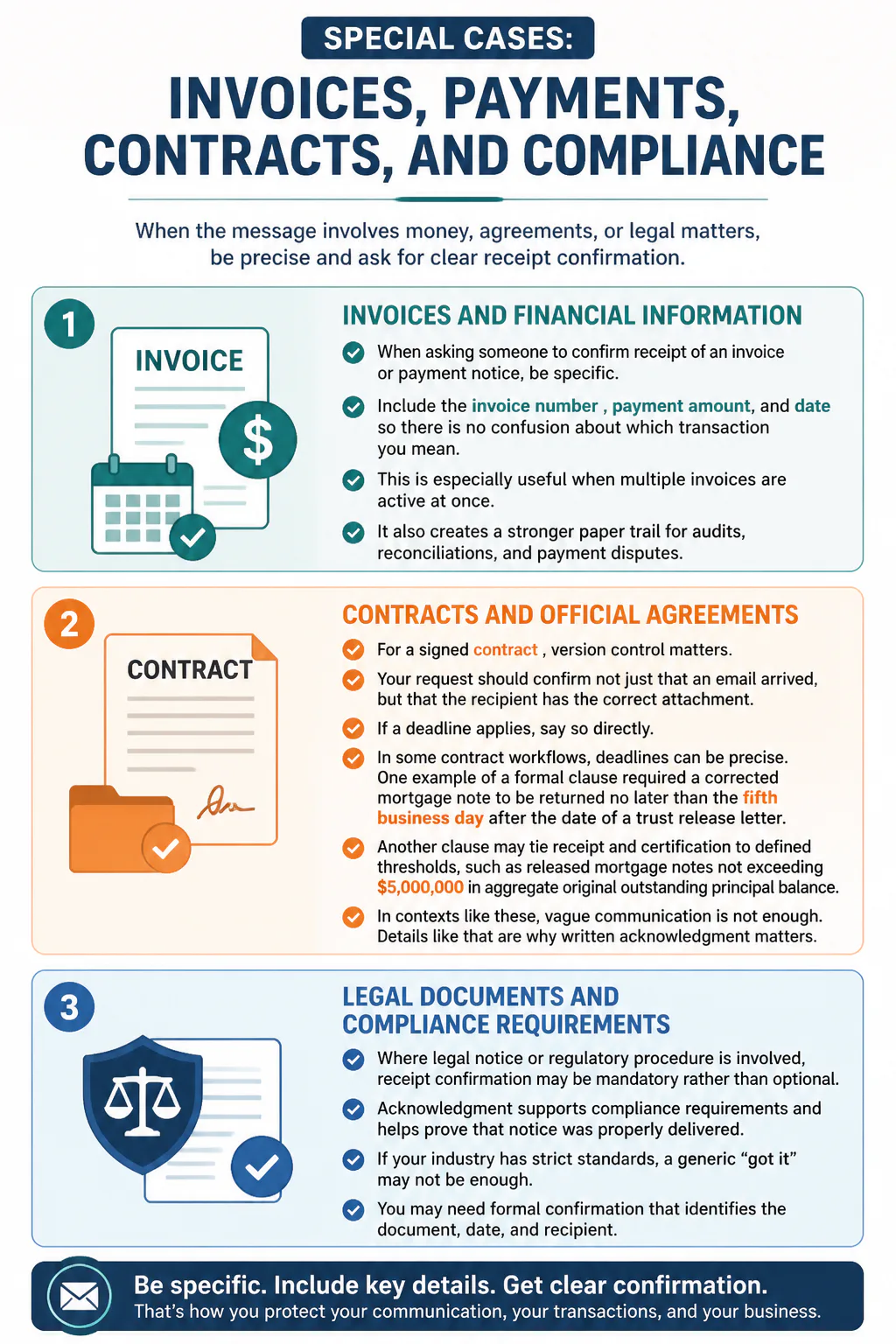
Special cases: invoices, payments, contracts, and compliance
Invoices and financial information
When asking someone to confirm receipt of an invoice or payment notice, be specific. Include the invoice number, payment amount, and date so there is no confusion about which transaction you mean.
This is especially useful when multiple invoices are active at once. It also creates a stronger paper trail for audits, reconciliations, and payment disputes.
Contracts and official agreements
For a signed contract, version control matters. Your request should confirm not just that an email arrived, but that the recipient has the correct attachment. If a deadline applies, say so directly.
In some contract workflows, deadlines can be precise. One example of a formal clause required a corrected mortgage note to be returned no later than the fifth business day after the date of a trust release letter. Details like that are why written acknowledgment matters.
Another clause may tie receipt and certification to defined thresholds, such as released mortgage notes not exceeding $5,000,000 in aggregate original outstanding principal balance. In contexts like these, vague communication is not enough.
Legal documents and compliance requirements
Where legal notice or regulatory procedure is involved, receipt confirmation may be mandatory rather than optional. Acknowledgment supports compliance requirements and helps prove that notice was properly delivered.
If your industry has strict standards, a generic “got it” may not be enough. You may need formal confirmation that identifies the document, date, and recipient.
Common mistakes to avoid
- Using the phrase for every email. Reserve it for messages that actually need acknowledgment.
- Assuming receipt means approval. It does not.
- Relying only on a read receipt. That is not reliable evidence of review.
- Forgetting to mention the attachment. Say what needs to be confirmed.
- Leaving out key details. For payments and invoices, include identifiers.
- Making urgency vague. If it is time-sensitive, state the deadline clearly.
- Asking for receipt when you really want a decision. Be direct about the action required.
Quick templates you can copy
General template
Please confirm receipt of this email and the attached document at your earliest convenience.
Attachment template
Please acknowledge receipt of the attachment and let me know if you are unable to open the file.
Invoice template
Please confirm receipt of Invoice 10487, dated August 7, 2026, and advise on next steps for processing.
Payment template
Please confirm receipt of the payment confirmation for Invoice 10487 in the amount listed below.
Contract template
Please confirm receipt of the signed contract. This confirmation of receipt does not require approval at this stage.
Legal-style template
Kindly provide written confirmation of receipt. For clarity, acknowledgment of delivery does not constitute acceptance, approval, or agreement with the contents.
FAQ: please confirm receipt of this email
Is “please confirm receipt of this email” polite?
Yes. It is polite, professional, and widely accepted in business communication. However, it can sound a little formal or rigid in casual workplace settings, so alternatives may feel more natural depending on the audience.
What is the difference between confirm receipt and acknowledge receipt?
In most professional correspondence, they are very similar. Confirm receipt emphasizes verification that something arrived, while acknowledge receipt emphasizes the act of formally recognizing delivery.
Does a read receipt count as confirmation of receipt?
Not really. A read receipt may show that an email was opened, but it does not confirm that attachments were reviewed or that the message was understood. For important matters, written confirmation is better.
How do I respond to “please confirm receipt of this email”?
A short reply is enough. For example: “I confirm receipt of your email and attachment” or “Received with thanks. I will review and respond shortly.”
Can I use this phrase for invoices or payment confirmation?
Yes. It is very common for invoices, payment processed notices, and other financial information. Include the invoice number, amount, and date to create a stronger audit trail.
Does confirmation of receipt mean agreement?
No. Receipt confirmation only means the email, file, shipment, or document was received. It does not constitute acceptance unless the reply specifically says so.
When should I avoid asking for receipt confirmation?
Avoid it for low-stakes routine emails that do not need a documented acknowledgment. If there is no deadline, no attachment, and no compliance concern, the request may be unnecessary.
What is a more natural alternative to “please confirm receipt of this email”?
Try “Please let me know once you receive this,” “Please confirm you received the attachment,” or “A quick acknowledgment would be appreciated.” These often sound more natural while preserving the same meaning.
Conclusion
The phrase please confirm receipt of this email is still useful, especially when you are handling contracts, invoices, legal documents, HR paperwork, or any other time-sensitive communication. It supports accountability, reduces miscommunication, and creates a clear paper trail for professional correspondence.
The key is to use it intentionally. Ask for receipt confirmation when delivery really matters, keep the request clear, and remember that acknowledgment does not equal acceptance. If you want to improve your business communication further, the next step is to build a small set of email templates for confirmations, follow-ups, and formal replies so you can respond quickly and consistently.

Related Posts
35 Other Ways to Say “However” (With Examples)

35 Other Ways to Say “You’re Welcome” (With Examples)