No Soliciting Meaning: What Does It Really Mean?
A knock at the door can be harmless—or it can turn into an unwanted sales pitch. That’s why you’ll often see “No Soliciting” signs on homes, apartments, and businesses. But what does no soliciting mean, exactly, and does putting up a sign actually stop people from knocking?
The short answer is that a no soliciting notice generally asks people not to approach, visit, or contact a property for the purpose of selling something, requesting donations, or promoting a product, service, or cause. However, the exact meaning and legal effect can vary depending on local rules and circumstances.
What Does No Soliciting Mean?
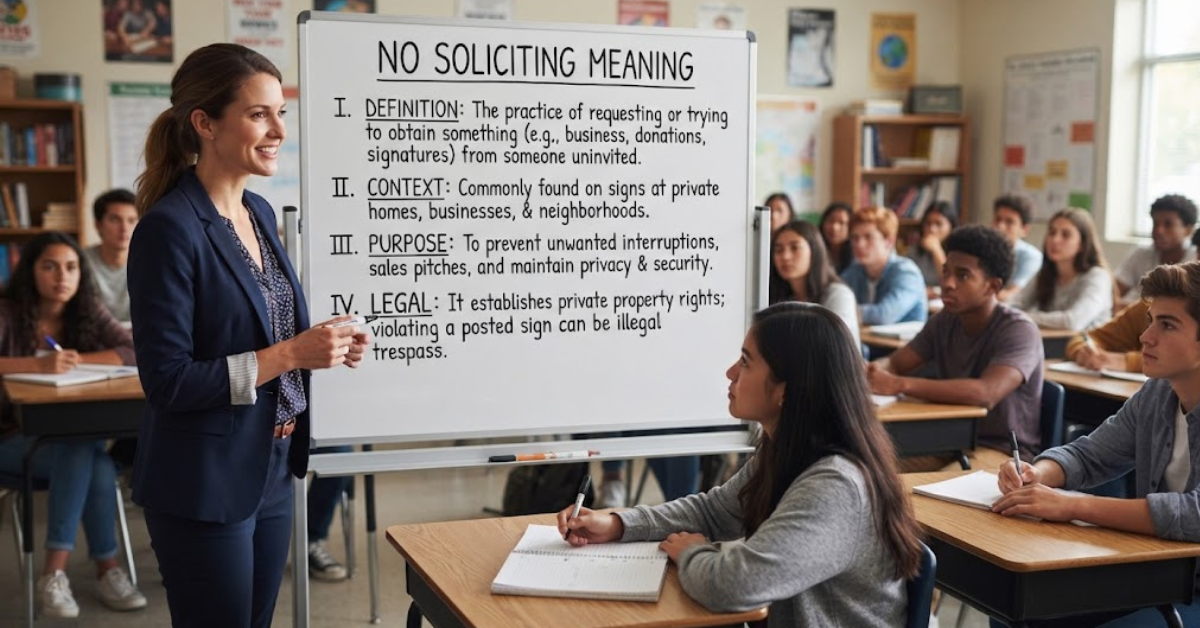
The no soliciting meaning is essentially a request that people do not engage in solicitation at a particular property.
Solicitation commonly involves approaching someone to:
- Sell goods or services
- Ask for donations
- Promote a business
- Request money
- Distribute promotional material
- Recruit customers
- Sometimes advocate for a cause
For example, a homeowner may place a “No Soliciting” sign near the front door because they don’t want salespeople or other solicitors knocking.
It’s important to understand that the phrase is generally directed at solicitation, not every possible reason someone might come to the door.
What Is Soliciting?
To understand no soliciting, it helps to understand the word soliciting.
In everyday use, soliciting means approaching someone to ask for something, particularly money, business, support, or a purchase.
Common examples include:
Door-to-door sales
A salesperson knocks on your door and offers:
- Internet service
- Security systems
- Roofing services
- Landscaping
- Home improvements
Fundraising
Someone visits a neighborhood asking residents to donate money to a charity, organization, or cause.
Business promotion
A representative approaches residents to promote a product or service.
The precise legal definition of solicitation can differ by jurisdiction, so a sign doesn’t necessarily create one universal rule everywhere.
No Soliciting Signs Meaning
The no soliciting signs meaning is generally straightforward: the property owner does not want solicitors approaching the property.
You might see signs such as:
NO SOLICITING
or:
NO SOLICITORS
or:
PLEASE DO NOT SOLICIT
Some signs make the request more specific:
NO SALESPEOPLE OR SOLICITORS
Others may say:
NO SOLICITING — THANK YOU
The wording can communicate the same basic message: please don’t come here to solicit business, money, or support.
What Is the Difference Between “No Soliciting” and “No Trespassing”?
These signs are related, but they don’t mean the same thing.
No Soliciting
This generally tells people:
Don’t approach this property for solicitation purposes.
No Trespassing
This is a broader property-access warning indicating that people generally do not have permission to enter the property or designated areas.
A no soliciting sign isn’t necessarily the same as a legal no trespassing notice.
That’s an important distinction because property and trespass laws vary by location.
Does “No Soliciting” Mean Nobody Can Knock?
Not necessarily.
A no soliciting sign generally targets solicitation rather than every person who might come to your door.
For example, depending on the circumstances, someone might still approach your property for reasons unrelated to selling or soliciting.
Potential examples could include:
- A friend
- A neighbor
- A delivery worker
- An invited guest
- Someone responding to a specific request
- Certain government or emergency personnel
Exactly who may lawfully approach a property can depend on local law and the circumstances.
Do No Soliciting Signs Work?
A common question is “do no soliciting signs work?”
Yes, they can be effective as a clear communication tool, but they aren’t a guaranteed barrier against every visitor.
A visible sign tells potential solicitors:
This property does not welcome solicitation.
Many legitimate salespeople and organizations may respect such requests and move on.
However, a sign doesn’t guarantee that every person will follow the request. Some people may ignore it, misunderstand it, or argue that their activity doesn’t qualify as solicitation.
Why a Sign Can Help
A well-placed sign can:
- Clearly communicate your preference
- Discourage door-to-door sales
- Reduce unwanted interruptions
- Give visitors an easy-to-understand warning
- Make your expectations clear before someone approaches
Are No Soliciting Signs Legally Enforceable?
This is where things become more complicated.
Whether a no soliciting sign has legal force depends on the applicable local laws and the circumstances involved. Different cities, states, municipalities, and jurisdictions can have different definitions and rules governing solicitation.
Some communities regulate door-to-door solicitation through permits, restricted hours, registration requirements, or other rules.
Therefore, you shouldn’t automatically assume that every no soliciting sign has the same legal effect everywhere.
If you’re dealing with a specific legal dispute, it’s best to check your local ordinances or consult a qualified attorney.
What About Political Campaigns and Religious Groups?
This is one of the most important nuances.
People sometimes use “no soliciting” broadly to mean “don’t knock on my door.” But legally, different types of speech and activity may be treated differently.
Political canvassing, religious outreach, petitioning, and charitable activity can involve constitutional or statutory protections depending on the jurisdiction.
So a homeowner shouldn’t automatically assume that a no soliciting sign legally prohibits every political, religious, or charitable visitor.
The rules can be especially complicated because local solicitation ordinances may define the term differently.
Can You Ignore a No Soliciting Sign?
If you’re the visitor, the respectful approach is simple: follow the homeowner’s request.
If a property clearly displays a no soliciting sign, continuing to knock or repeatedly attempting to sell something can create an unnecessary confrontation.
For businesses and organizations, it’s also important to train representatives to recognize and respect property-specific requests.
How to Make a No Soliciting Sign More Effective
If your goal is to reduce unwanted door-to-door visits, a sign should be easy to notice.
Consider these practical tips:
- Place it near the main entrance.
- Use large, readable text.
- Keep the wording simple.
- Make sure it’s visible from the approach to the door.
- Consider specifying what you don’t want.
For example:
NO SOLICITING — NO SALES OR FUNDRAISING
This is more specific than simply saying “No Soliciting.”
However, adding more wording doesn’t necessarily make a sign legally stronger. Its main benefit is making your wishes clearer.
No Soliciting vs. No Flyers
These aren’t necessarily the same request.
A no soliciting sign focuses on solicitation, while a sign saying:
NO FLYERS
specifically addresses the distribution of printed promotional material.
If you want to discourage both activities, a property owner might choose wording such as:
NO SOLICITING — NO FLYERS
Again, the legal treatment of these notices depends on local rules.
Common Situations Involving No Soliciting Signs
A salesperson knocks anyway
You can politely point to the sign and tell them you’re not interested.
A fundraiser approaches
Whether the activity legally counts as solicitation depends on the circumstances and local law, but you can still clearly communicate that you don’t want visitors at your door.
A political canvasser arrives
Political canvassing can involve different legal protections, so the effect of a no-soliciting sign may depend on local law.
A neighbor comes over
A no-soliciting sign generally isn’t intended to prevent ordinary social visits.
Frequently Asked Questions
What does no soliciting mean?
No soliciting generally means the property owner does not want people approaching the property to sell products, services, request donations, or conduct similar solicitation.
What is the no soliciting signs meaning?
A no soliciting sign communicates that the property owner does not want solicitors approaching the property. The exact legal effect can vary by jurisdiction.
Do no soliciting signs work?
Yes, they can discourage unwanted solicitation and clearly communicate the owner’s wishes. However, they don’t guarantee that every visitor will obey the sign, and their legal effect varies by location.
Does no soliciting mean no one can knock?
No. It generally refers to solicitation rather than every person who approaches the property. Friends, invited guests, delivery workers, and others may have different reasons for visiting.
Does no soliciting include political canvassing?
Not necessarily. Political canvassing may receive specific legal protections depending on local and national law. Check the applicable rules in your jurisdiction.
Does no soliciting include religious visitors?
Not necessarily. Religious outreach can involve legal protections that differ from ordinary commercial solicitation.
What’s the difference between no soliciting and no trespassing?
No soliciting generally addresses solicitation, while no trespassing concerns unauthorized entry onto property. They communicate different restrictions.
Can a business have a no soliciting sign?
Yes. Businesses commonly use signs to discourage unsolicited sales visits, fundraising, or promotional activity.
Where should you put a no soliciting sign?
The best location is usually near the main entrance where visitors can easily see it before approaching the door.
Conclusion: No Soliciting Meaning Explained
The basic no soliciting meaning is simple: the property owner is asking people not to approach the property for solicitation purposes. This commonly includes door-to-door sales, fundraising, and promotional activity.
No soliciting signs can be useful because they make a homeowner’s wishes clear and may discourage unwanted visits. However, they aren’t automatically a universal legal prohibition, and rules can vary considerably depending on local law.
If you’re using one, keep the message clear, place it somewhere visible, and check your local regulations if you’re concerned about its legal effect.