
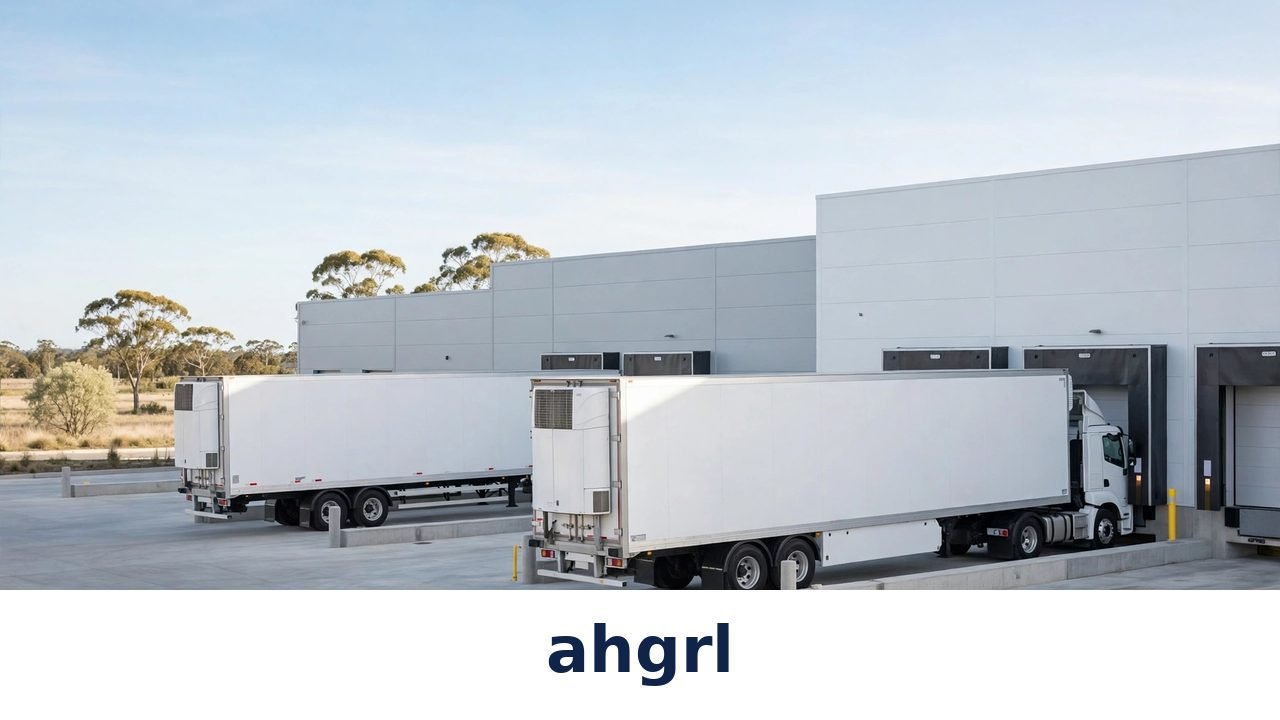
ahgrl: The Cold-Chain Giant Behind the Letters, Its Sale, Its ScottsRL Rebrand and Its Collapse
Introduction
People who type ahgrl into a search box usually expect a single clear answer, because five short letters ought to point at one thing. Instead, the trail splits in two, and following it honestly means walking down both branches. In the real world of trucks, warehouses and supermarket shelves, ahgrl was the short name of AHG Refrigerated Logistics, once described as Australia’s biggest integrated refrigerated logistics business, while in a very different corner of the internet the same letters label a proposed method for teaching robots to handle soft objects with human help. This article explains both meanings of ahgrl using only sources that any reader can open and check, which are official market announcements, established trade reporting and the public registration record for the domain name itself.
The short answer is that ahgrl most often refers to AHG Refrigerated Logistics, the cold-chain transport and warehousing division built inside Automotive Holdings Group and later held by AP Eagers. That business carried chilled and frozen food for producers and supermarket chains across Australia before it was sold to a private equity firm in 2020, renamed Scott’s Refrigerated Logistics, and then, only a few years later, placed into administration and wound up. Readers who follow business profiles and company explainers will find the story a complete one, with a beginning, a peak and an end that can all be dated from public records.
A second honest point belongs near the front of this article rather than buried at the end of it. The address ahgrl.com itself is not registered at all, a fact confirmed in the public registry for dot com names, and the company that carried the name traded from an Australian address ending in dot com dot au instead. Everything that follows therefore rests on announcements and reporting rather than on any official website for the term, and where the public record runs out, this article says so plainly instead of filling the gaps with confident guesses.
What ahgrl Stood For
The name ahgrl was the compressed form of AHG Refrigerated Logistics, and understanding it starts with the two businesses folded inside those letters. AHG was Automotive Holdings Group, a large Australian automotive business, and its refrigerated logistics division gathered together several long-running transport names under one roof. The operations that made up ahgrl were Scott’s Refrigerated Freightways, Rand Transport, Harris and JAT Road Transport, each of them a working carrier with its own trucks, depots and customers, presented to the market as a single combined cold-chain service.
The work of ahgrl was the unglamorous but essential business of moving food that cannot be allowed to warm up. Refrigerated trucks and rail containers carried frozen, chilled and ambient goods between producers, cold storage warehouses and the distribution systems of the major supermarket chains, so that what a shopper lifted from a freezer cabinet in Perth or Brisbane had stayed at a controlled temperature for the whole journey. It was, in other words, a business measured in kilometres, pallets and degrees rather than in headlines, and most Australians who benefited from it never knew its name.
Ownership of ahgrl changed around it as the years passed, and that movement is part of its identity rather than a footnote to it. The division sat inside Automotive Holdings Group until that group was absorbed by the larger automotive retailer AP Eagers in a deal reported at around two billion dollars, after which ahgrl became a non-core asset inside a car-selling company that openly wanted to sell it. A logistics business of national scale therefore spent its final years under its original name as an item on a parent company’s disposal list, which is a fair part of why its story ends the way it does.
The Business Behind ahgrl
The scale behind ahgrl was considerable, and it is the reason the short name kept appearing in transport reporting for years. Trade coverage at the time of its sale described the business as Australia’s biggest integrated refrigerated logistics operation and the market leader in temperature-controlled road and rail transport, serving a diversified base of food and beverage producers and supermarket chains. Its network rested on twenty-four cold storage facilities spread across all Australian mainland states, together with a transport fleet of about five hundred trucks and some four hundred and fifty rail containers, and its workforce was put at around fifteen hundred people.
The customers of ahgrl explain its importance better than any fleet figure can. The business moved goods for suppliers to the major grocery retailers and acted as a distributor for some of those retailers, alongside independent supermarkets, food manufacturers and exporters, so a failure or delay inside ahgrl did not stay inside ahgrl for long. When a cold-chain operator of this size stumbles, the effects are felt in delivery windows, warehouse bookings and, eventually, in how reliably chilled goods reach shelves hundreds of kilometres from where they were made.
What ahgrl sold, beneath the technical language of logistics, was dependability at a set temperature. Its cold storage covered frozen, chilled and ambient warehousing, its transport ran by road and rail on a national basis, and the combined offer was presented as the country’s only truly national temperature-controlled supply chain network. That combination of warehousing and movement under one management is what the word integrated meant in its description, and it is what made the business attractive first to a corporate parent and later to a private equity buyer looking for a turnaround.
ahgrl in Checked Facts
The table below gathers the details about ahgrl that could be verified directly from official announcements and established reporting, so the whole picture can be checked at a glance. Anything that could not be confirmed from those sources has been left out of the table rather than filled in from guesswork, because a facts table earns its place only by refusing to repeat claims that nobody can test.
| Detail | Verified information |
|---|---|
| What ahgrl stood for | AHG Refrigerated Logistics, the cold-chain division of Automotive Holdings Group |
| Business | Refrigerated transport and cold storage warehousing across Australia |
| Operating names inside it | Scott’s Refrigerated Freightways, Rand Transport, Harris and JAT Road Transport |
| Cold storage facilities | 24, across all Australian mainland states |
| Fleet at sale | About 500 trucks and about 450 rail containers |
| Workforce | Around 1,500 people |
| Sale announced | 27 February 2020, AP Eagers to Anchorage Capital Partners at A$100 million |
| Sale completed | 30 June 2020, at about A$75 million after a price adjustment |
| Name after the sale | Scott’s Refrigerated Logistics, shortened to ScottsRL |
| Administration | 27 February 2023, with KordaMentha appointed |
| Final outcome | Creditors confirmed a voluntary wind-up in April 2023 |
| The address ahgrl.com | Not registered, per the public dot com registry record |
Two rows of that table deserve a moment of attention from anyone meeting ahgrl for the first time. The first is the pair of prices, because the fall from a hundred million dollars to about seventy-five million between announcement and completion was publicly explained at the time as the effect of the pandemic on the deal, and both figures come from the seller’s own announcements rather than from rumour. The second is the last row, since a name carried by a business of this size might be expected to own its obvious dot com address, and the empty registry record for ahgrl.com shows that it simply never did.
The Sale of ahgrl
The sale of ahgrl had a long and public courtship before it finally completed, and the earlier chapters explain the price of the final one. Trade reporting records that the Chinese group HNA International had committed to pay around four hundred million dollars for the refrigerated logistics business in 2018, before reversing its decision and letting that sale collapse. The division therefore arrived at its eventual transaction with a history of being valued far higher than any buyer finally paid, which hung over every later negotiation.
The completed chapter opened on 27 February 2020, when AP Eagers announced a binding agreement to sell ahgrl to Anchorage Capital Partners, a Sydney-based private equity firm, for a hundred million dollars on a debt-free and cash-free basis. The seller presented the deal as the natural consequence of its strategy, since it wished to concentrate on its core automotive retailing business, and it pointed to an extensive sale process behind the choice of buyer. Anchorage, for its part, was described as an owner committed to investing in the business and growing it, and the expected result was a reduction of around ninety-five million dollars in the seller’s net debt.
The price of ahgrl did not survive the following months unchanged, because the pandemic intervened between agreement and completion. An update at the end of April 2020 recorded that the parties had adjusted the cash proceeds to about seventy-five million dollars in light of broader market impacts, with the buyer waiving certain conditions to keep the transaction on track. Completion followed on 30 June 2020, when AP Eagers confirmed that the sale of ahgrl had been completed for approximately that reduced figure, and the long era of the division inside a motor-vehicle group came to a formal close.
From ahgrl to ScottsRL
The first act of the new ownership was to retire the name ahgrl itself. Under Anchorage Capital Partners the business was rebranded as Scott’s Refrigerated Logistics, shortened to ScottsRL, reviving the Scott’s name that had been one of its founding operations. Transport reporting on the change noted that the other trading brands under the old banner, including Rand and JAT, would begin to be retired as well, while the underlying legal companies continued to trade, among them Scotts Refrigerated Freightways, Rand Transport and JAT Road Transport.
The strategy announced for the business formerly called ahgrl was a turnaround, and its new owners said as much in plain terms. Anchorage described a company that was underperforming industry benchmarks and set out an operational improvement plan built on investment in people, processes and equipment, intended to lift service quality and profitability and to make the business the clear leader in its industry. A seventy-million-dollar asset-based lending facility from Gordon Brothers was later arranged to provide working capital for that programme, which shows the scale of money being committed to the rescue attempt.
For readers tracing the name, the rebrand is the point at which ahgrl disappears from the public record as a living business. The trucks, warehouses and contracts carried on under the ScottsRL identity, the old division’s website address fell quiet, and later reporting about the company speaks only of Scott’s Refrigerated Logistics. Anyone searching for ahgrl today is therefore searching for a name that its own owners deliberately set aside in 2020, and the surviving record of it is the record of a business in its previous ownership.
The Collapse That Followed ahgrl
The turnaround of the business once known as ahgrl did not hold, and its ending was as public as its sale had been. Reporting at the time describes a company hit by the combined effects of the pandemic years and flooding, with its improvement plans failing to restore it. On 27 February 2023, exactly three years after the sale of ahgrl had been announced, Scott’s Refrigerated Logistics was placed into administration, with the firm KordaMentha appointed and around fifteen hundred jobs suddenly resting on the outcome.
The administrators sought a buyer for the whole business, and early reporting named large transport groups as circling it, but no rescue purchase was completed in time. Staff were told of redundancies at the start of March 2023, the work of valuing and selling the group’s assets began, and in April 2023 creditors confirmed the voluntary winding-up of Scott’s Refrigerated Logistics and its related entities. The network that ahgrl had represented, with its twenty-four cold stores and hundreds of trucks, was therefore broken up and sold in pieces rather than passed on as a single going concern.
The collapse closed the story of ahgrl in a way that underlines why the name still draws searches. This was not a small firm fading quietly, but the largest cold-chain operator in the country, a business whose failure was serious enough to prompt warnings about supermarket supply in the Australian press. Its rise inside a motoring group, its passage through a collapsed four-hundred-million-dollar sale and a completed seventy-five-million-dollar one, and its final liquidation give the five letters an unusually complete documentary trail for a name that no longer trades.
The Other ahgrl: A Robot-Learning Term
Entirely separate from the trucking business, ahgrl also appears in technology writing as the short form of Adaptive Human-Guided Reinforcement Learning. In that setting, ahgrl names a proposed framework for teaching robots difficult hand movements, particularly the handling of soft and deformable objects such as fabric, which ordinary robot training struggles with because the material changes shape as it is touched. The idea is to combine two established approaches: learning from human demonstrations, and reinforcement learning, in which the machine improves through trial, feedback and reward.
The distinctive claim made for ahgrl in that paper is that the balance between the two teachers is not fixed. A weighting system, tuned by a statistical method called Bayesian optimization, continually adjusts how much the robot leans on human demonstrations, how much on human corrections offered during the task, and how much on its own learned policy, using vision, force and joint-position sensing together. In the reported fabric-handling tests, the authors state that ahgrl reached a success rate of 0.92, against 0.62 for learning from demonstrations alone and 0.35 for reinforcement learning alone, with faster completion and more accurate force control, and readers who follow robotics and technology explainers will recognise the shape of the claim, since gentler and more reliable handling of soft materials matters everywhere from textile factories to hospitals.
This second ahgrl has to be handled with a clear statement of its limits, because its paper trail is far thinner than the trucking company’s. The framework is described in a research-style paper published on a single website, and during the research for this article it could not be traced to a peer-reviewed journal or conference record where its results would have been independently examined. Its reported figures are therefore the claims of its own authors rather than settled findings, and a careful reader will treat this ahgrl as an interesting proposal attached to a famous set of initials, not as an established term of the field.
What Cannot Be Verified About ahgrl
An honest profile of ahgrl ends with the parts of the story the public record cannot settle, and the first of them concerns the name itself. No official website for ahgrl exists to consult, because the company traded under a longer Australian address and the plain dot com version of the name was never registered at all, as the empty registry record confirms. Everything attributed to the business in this article therefore comes from the seller’s market announcements and from trade reporting, which agree with each other on the main dates and figures but were written for investors and industry readers rather than as a history of the division.
Some figures attached to ahgrl also vary slightly between sources, and it is better to name that than to hide it. Fleet and staff numbers were reported at different moments in the company’s life, so the counts in this article are the ones published around its sale and collapse, and a reader comparing profiles may find modestly different numbers elsewhere without either side necessarily being wrong. The same caution applies to the earlier four-hundred-million-dollar figure from the collapsed HNA transaction, which comes from trade reporting of the period rather than from a completed contract that anyone can inspect.
The robot-learning ahgrl carries the deepest uncertainty of all, and this article has deliberately given its claims no more weight than their evidence supports. Whether the framework was ever tested beyond the experiments its authors describe, whether other researchers have built on it, and whether the name is used anywhere in working robotics are questions the available record does not answer. What can be said plainly is that ahgrl is a shared set of letters: a retired name from Australian trucking with a rich documentary trail, and a research label with a thin one, and the two have nothing to do with each other beyond the coincidence of their initials.
Conclusion
In short, ahgrl was AHG Refrigerated Logistics, the cold-chain giant built from the Scott’s, Rand, Harris and JAT operations, sold by AP Eagers to Anchorage Capital Partners in 2020, renamed ScottsRL, and wound up after entering administration in 2023. The same letters also label an unverified robot-learning proposal, but the documented history belongs to the trucking name, whose sale prices, rebrand and collapse can all still be checked in the public record.

Related Posts

alertsquora com: The General Blog Behind the Name, Its Topics, Domain Record and Honest Limits

Cyber Security Course with Placement: How Practical Training Can Prepare You for Real-World Security Roles