carlos scola pliego: The Spanish Filmmaker Behind the Camera and the Only Husband of Sade Adu
Introduction
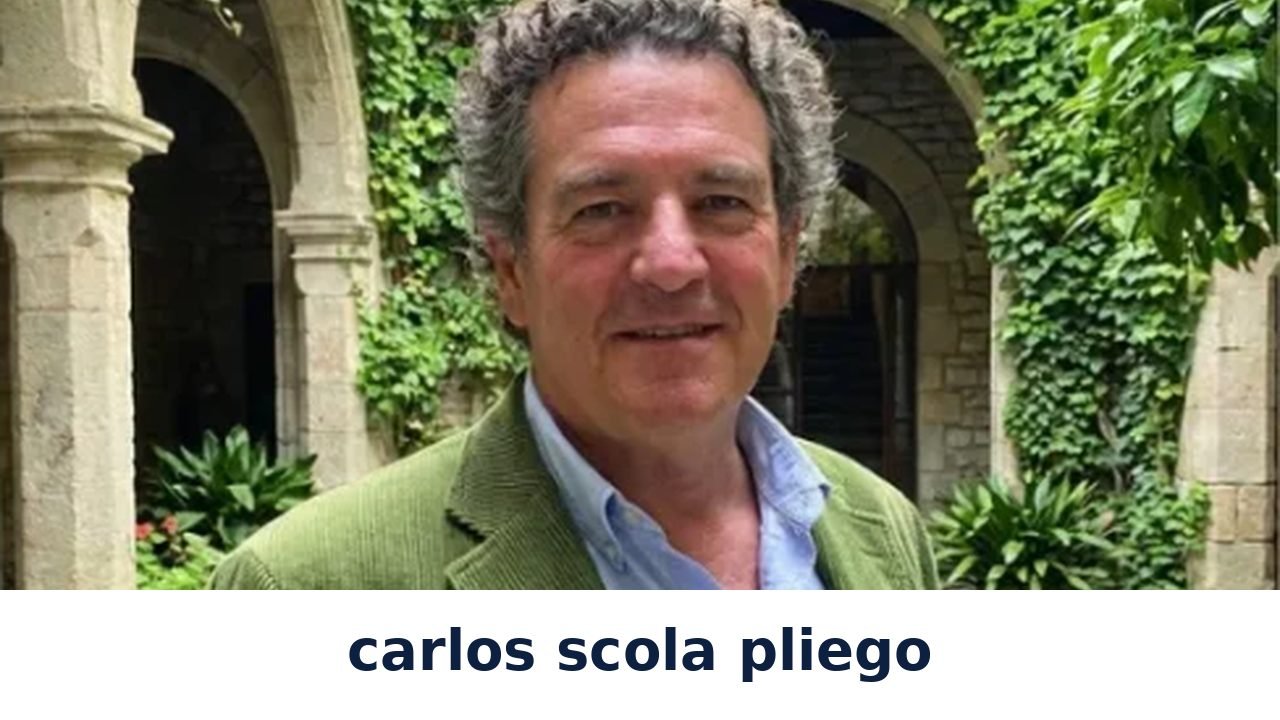
Some names become famous for the work attached to them, and others become famous because of the company they once kept, and carlos scola pliego belongs firmly to the second group. He spent his working life behind a camera rather than in front of one, first keeping order on other people’s film sets and later directing two documentaries of his own in Africa. Yet the reason his name is searched for, decade after decade, is a single chapter of his private life: he is the Spanish filmmaker who married Sade Adu, and he remains the only husband the famously private singer has ever had.
That one fact has proved more durable than almost everything else about him, because nearly every other detail of his life has been allowed to fade into privacy. carlos scola pliego gave no interviews about the marriage, built no public image of his own, and left the film industry so quietly that his final screen credit in 2007 passed without a single headline. What survives is a filmography that can be checked in industry records, a wedding that the Spanish press reported at the time, and a long silence that lesser websites have tried to fill with invention.
This article sets out the story of carlos scola pliego using only what can be supported: his film credits, the reporting of the time, and the few words the people involved actually said in public. Where the record is solid, it is presented plainly, and where it runs out, this article says so rather than guessing, because a respectful biography of a private man has to know where its facts end.
Who carlos scola pliego Is
carlos scola pliego is a Spanish film professional whose career ran from the end of the 1970s to the late 2000s, spent almost entirely in the engine room of film production. He began as a script supervisor, moved up into the assistant director’s department on Spanish and international productions, and eventually wrote, directed and produced two documentary films of his own. His name appears in credits under the shorter form Carlos Scola as well as in full, which is one reason his filmography has sometimes looked thinner than it really is.
To the wider world, though, carlos scola pliego is known for one relationship. In 1989 he married Helen Folasade Adu, the Nigerian-born British singer known simply as Sade, whose records such as Diamond Life and Promise had made her one of the most recognisable voices of the decade. The marriage ended in divorce in 1995, and although Sade has shared her life with a long-term partner in the years since, she has never married again, which is why profiles of the singer so often lead readers back to the husband of her youth.
Readers who follow celebrity profiles and biographies will know how unusual that position is: a man remembered across forty years for a marriage that itself lasted only a few. The explanation lies partly in Sade’s own guardedness, because an artist who reveals so little makes every confirmed detail precious, and partly in his, because carlos scola pliego never once used the connection to promote himself, then or since.
The Early Film Years of carlos scola pliego
The documented working life of carlos scola pliego begins in Spain at the end of the 1970s, in one of the least glamorous and most essential jobs on any film set. As a script supervisor on La boda del señor cura in 1979 and Opera Prima in 1980, he was responsible for continuity: tracking every detail of every scene so that a film shot out of order would still cut together as a coherent story. It is painstaking work that audiences never notice when it is done well, and it remains one of the best schools a future director can attend.
By the early 1980s, carlos scola pliego had moved into the assistant director’s department, the team that turns a director’s plans into a working day on set. Between 1981 and 1985 he is credited on around nine film and television productions, a busy run that took him from Spanish features onto large international shoots that filmed in Spain. The credits from those years, listed under his name in film databases, include work on Hundra, Scarab, the World Cup documentary G’olé! and the drama Eleni, which gave the young John Malkovich one of his first major screen roles.
That apprenticeship says something real about the standing of carlos scola pliego inside his industry, even if it never made him a public name. Assistant directors are hired for reliability, because a production that falls behind schedule burns money by the hour, and a man repeatedly engaged on big, complicated shoots was plainly trusted by the people who ran them. His later move into directing his own documentaries grew naturally out of that decade of watching other directors work at close quarters.
carlos scola pliego and the Bond Years
The credit most often attached to carlos scola pliego comes from 1983, the year he worked as second assistant director for the Spanish unit of Never Say Never Again. The film was a famous production: Sean Connery’s return to the role of James Bond, outside the official series, shot across several countries with a large Spanish section. His role was uncredited on screen, as Spain-unit assistant work often was, but the credit is recorded in film databases and repeated by independent film-credit sources, which is as firm as documentation for such work gets.
The same year brought carlos scola pliego a matching credit on Curse of the Pink Panther, again as second assistant director for the Spanish shoot, and in 1985 he worked as assistant director on the television miniseries Christopher Columbus. That production starred Gabriel Byrne in the title role alongside Virna Lisi, and it belonged to the wave of lavish European co-productions that kept experienced Spanish crew members in steady work through the decade. Taken together, these credits place him inside the machinery of international filmmaking rather than at its edges.
It is worth being precise about what these jobs mean, because the record of carlos scola pliego is sometimes inflated by writers who never checked it. He did not direct a Bond film, and no honest account should suggest otherwise; he was part of the team that made one possible, organising cast, crew and locations on the Spanish leg of the production. That is a respectable place in film history, and it needs no exaggeration to be worth recording.
The Documentaries Directed by carlos scola pliego
In the late 1980s, carlos scola pliego stepped from assisting other directors into making films of his own, and the two works he directed remain the clearest expression of his own interests. In 1988 he wrote, directed and produced Ngira: Gorilas en la montaña, a documentary short about mountain gorillas filmed in Central Africa, in what was then Zaire. A year later came Donde termina el corazón, a feature-length documentary that widened the same lens to take in broader themes of life across the African continent.
These were not commercial assignments handed down by a studio, and that is exactly why they matter in the story of carlos scola pliego. A working assistant director who chooses to spend his own time and money filming wildlife and human stories in Africa is telling the record what he cared about when the choice was his. The gorilla film in particular sits in a honourable tradition of Spanish nature documentary, made by a small crew in difficult country, a world away from the Bond sets of a few years earlier.
After those two films, the directing career of carlos scola pliego effectively pauses in the public record, and no further directing credits follow. His name resurfaces only once more in the listings, as part of the additional crew on the football drama Goal II: Living the Dream in 2007, a production filmed partly in Spain. A career that ends with a footnote rather than a finale is a common enough story in film, and his is simply one of the quietest examples of it.
How carlos scola pliego Met Sade Adu
The meeting that changed the public life of carlos scola pliego took place in Spain in 1985, while Sade was there filming music videos for her album Promise with the director Brian Ward. He was working behind the scenes on those productions, and the two were introduced in the ordinary way of film sets, professionally and without any immediate romance that the reporting of the time records. She was twenty-six and newly, enormously famous; he was a working filmmaker with a decade of sets behind him.
What turned a working acquaintance into something deeper came afterwards, when Sade returned to Spain seeking quiet after the death of her father, Bisi Adu, and the exhaustion of a long promotional tour. By her own later description, given in one of the rare interviews in which she discussed her private life at all, she fell madly in love. By 1987 she was introducing carlos scola pliego as her husband while recording in France, well before any wedding had taken place, and those who wrote about the couple at the time treated the relationship as the settled centre of her life.
There is a symmetry in the pairing that the reporting of the period often noted, and it still reads true. Sade built a career on refusing exposure, letting the songs carry the emotion while she kept herself out of reach, and carlos scola pliego had built his on staying out of the frame altogether. Two people from neighbouring creative worlds, each instinctively private, met at the moment when fame had made privacy the thing she wanted most.
The Marriage of carlos scola pliego
carlos scola pliego and Sade Adu married in 1989, and even the date carries a small lesson in how carefully this story has to be told. Film databases record the wedding day as 11 February 1989, while the Spanish newspaper El País described an October wedding the same year, and her official biography confirms only the year itself. The honest summary is the one all three sources agree on: they married in 1989, and any page that offers a single certain date is claiming more than the record supports.
What the reporting does consistently describe is a wedding in a Spanish castle, attended by close family and friends, after which the couple made their home in Madrid. For a season, the marriage was woven into her working life as well, because carlos scola pliego was a steady presence around the making of her album Stronger Than Pride, the record whose mood of guarded, aching devotion critics have connected to the relationship ever since. Neither of them ever confirmed such readings in detail, but the chronology is a matter of public record.
For readers collecting the fixed points of the story, carlos scola pliego holds a place in it that nobody else does. Sade Adu has had significant relationships before and since, including the later partnership through which she became a mother, but the marriage of 1989 stands alone in her biography. She has never remarried, and so the Spanish filmmaker remains, in the plain language of the record, the only husband she has ever had.
carlos scola pliego in Checked Facts
The table below gathers the details of the life of carlos scola pliego that can be checked against film databases, reputable reporting and the singer’s own biography, so that the solid ground can be seen at a glance. Anything that rests only on unsourced websites has been kept out of the table and is dealt with honestly in the final sections of this article.
| Detail | Verified information |
|---|---|
| Full name | Carlos Scola Pliego, sometimes credited as Carlos Scola |
| Nationality | Spanish |
| Profession | Script supervisor, assistant director and documentary filmmaker |
| Active years | 1979 to 2007, according to film credit listings |
| Best-known assistant director credit | Never Say Never Again (1983), second assistant director for the Spanish unit |
| Other notable credits | Curse of the Pink Panther (1983), Eleni (1985) and the Christopher Columbus miniseries (1985) |
| Films directed | Ngira: Gorilas en la montaña (1988) and Donde termina el corazón (1989) |
| Spouse | Sade Adu, married 1989, divorced 1995 |
| Children with Sade Adu | None |
| Last screen credit | Goal II: Living the Dream (2007), additional crew |
| Date of birth | Not publicly verified in any reliable source |
Two rows of that table deserve emphasis for anyone meeting carlos scola pliego for the first time. The first is the shape of the career, which is genuinely documented rather than decorative: named productions, named years and named roles that can be looked up by anybody. The second is the final row, because the absence of a verified birth date for a man whose marriage made headlines is the clearest possible sign of how successfully he kept his private life private.
The Separation That Followed for carlos scola pliego
The marriage of carlos scola pliego did not hold, and by most accounts the couple had separated roughly a year after the wedding, with Sade leaving Madrid and returning to London. In one of her rare candid comments to the press, she described having to leave very quickly, with a very small bag, and said that it took years before the sadness of the ending stopped shaping how she felt. The legal end came later and more quietly, with the divorce finalised in 1995 and its terms never made public.
What is notable, looking back, is how completely carlos scola pliego kept his side of that story to himself. There was no interview, no memoir and no attempt to answer her account with one of his own, at the time or in the thirty years since. Whatever the truth of the marriage’s end, he left it in Madrid, and the dignity of that silence is a large part of why the public record of the divorce fits into a single paragraph.
The couple had no children together, and their lives afterwards ran on entirely separate tracks. Sade withdrew from recording for a time before returning with Love Deluxe in 1992, an album widely heard as the sound of that heartbreak being worked through, though she never said so in as many words. carlos scola pliego returned to a working life about which almost nothing further was published, which appears to have been exactly the outcome he wanted.
carlos scola pliego After the Spotlight
Since the middle of the 1990s, carlos scola pliego has lived almost entirely outside public view, and the honest account of his later life is a short one. The single later film credit, on Goal II: Living the Dream in 2007, suggests he remained within reach of the Spanish production world long after the marriage ended. Beyond that, no reliable source documents where he lives, what he does now, or whether he ever worked in film again.
That invisibility is itself a kind of statement, because the modern celebrity economy offers a former husband of Sade Adu every incentive to sell his story, and carlos scola pliego has declined all of them for three decades. Readers browsing celebrity life stories and profiles will find few figures who had a clearer path to easy fame and walked further away from it. His public profile today consists of a filmography, a wedding photograph that still circulates, and a name that surfaces whenever the singer’s private life is written about.
There are no verified social media accounts for carlos scola pliego, no official website and no representative offering statements on his behalf. Anyone who encounters a page claiming to speak for him, or to sell access to him, is looking at something unauthorised. The real man, so far as the record can show, simply got on with a life that was never again offered to the public.
What Cannot Be Verified About carlos scola pliego
An honest profile of carlos scola pliego has to close by naming the claims that travel with his name but cannot be checked, because the vacuum around him has been filled by websites that copy one another instead of reporting. His date and place of birth are the first example: Spain is supported by his entire career trail, but no reliable source publishes a birth date, and a minority of low-quality pages even claim an American birth for which no evidence exists. His education, family background and early life are documented nowhere at all.
Money is the second example, because figures for the supposed fortune of carlos scola pliego circulate online with no source behind them whatsoever. No reputable publication has ever reported his earnings, assets or any settlement from the divorce, and the numbers that appear on biography farms are simply invented to fill a template. The same caution applies to detailed descriptions of his personality, his homes and his current relationships, none of which rest on anything a reader can test.
The wedding itself shows the pattern in miniature, since even its date is disputed between film databases and the Spanish press, and the castle of the reporting has never been definitively named in the strongest sources. None of this makes the story of carlos scola pliego unknowable; it simply draws the line where knowledge stops. Inside that line stands a verifiable filmmaker with real credits and a documented marriage, and outside it stands a crowd of confident inventions that a careful reader should leave where they were found.
Conclusion
In short, carlos scola pliego was a working Spanish filmmaker, a trusted assistant director on productions as large as Never Say Never Again and the director of two African documentaries, who became known to the world through his 1989 marriage to Sade Adu. The marriage ended, the divorce was finalised in 1995, and he then did the rarest thing available to a man in his position, which was to disappear completely and let the work, rather than the story, remain.

Related Posts
tina fey and pedro pizarro: A Comedian and an Energy Chief, Two Public Lives Explained
lady gaga and michel vounatsos: Two Famous Lives, No Verified Link — The Singer and the Biogen Chief Explained