Please Be Advised: Meaning and Proper Usage
Please be advised is a formal English phrase that means “please note,” “be informed,” or “be aware.” People use it to introduce important information, especially in business emails, notices, policies, and professional announcements. It is correct, but it can sound stiff, distant, or overly official if the situation is casual. In many cases, a simpler phrase works better.
If you have seen this expression in a message from a company, school, office, or legal department, that tone is no accident. The phrase prepares the reader for information that matters, such as a rule change, deadline, delay, warning, or update. Knowing its meaning is useful, but knowing when it sounds appropriate matters even more.
What Does ‘Please Be Advised’ Mean?
Plain meaning
At its core, please be advised tells the reader to pay attention to the information that follows. It is a polite way to say, “I am informing you of something important.” The phrase does not ask for action by itself, but it often appears before details that affect the reader.
For example, in the sentence “Please be advised that the office will close at 3 p.m. today,” the phrase signals an important update. In “Please be advised that late submissions will not be accepted,” it introduces a rule or warning. In both cases, the meaning is close to “please note.”
How it works in context
This phrase usually appears at the beginning of a sentence and is often followed by “that.” A common structure is: “Please be advised that…” After that, the writer states the key information clearly and directly.
It is most common in professional settings because it sounds formal and controlled. You will often see it in customer service messages, HR communications, legal notices, school announcements, and policy updates. If you want a fuller explanation of the phrase itself, this breakdown of please be advised meaning covers the core idea in a similar way.
Tone and formality
- The tone of this expression is formal, sometimes very formal.
- It can sound polite, but it can also feel impersonal.
- That is why it works best when the message needs authority, distance, or official clarity.
In friendly or everyday communication, it often sounds unnatural. If you text a coworker, “Please be advised I’m running five minutes late,” the wording feels too heavy for the situation. A natural version would be, “Just letting you know, I’ll be five minutes late.”
What it does well
- Signals that important information is coming
- Creates an official or professional tone
- Works well in notices, updates, and policy statements
- Helps separate facts from emotion in sensitive messages
What to watch out for
- It can sound cold or overly formal
- It may feel passive if the sentence after it is vague
- It is often unnecessary in simple emails
- It should not replace clear, direct writing
Quick comparisons
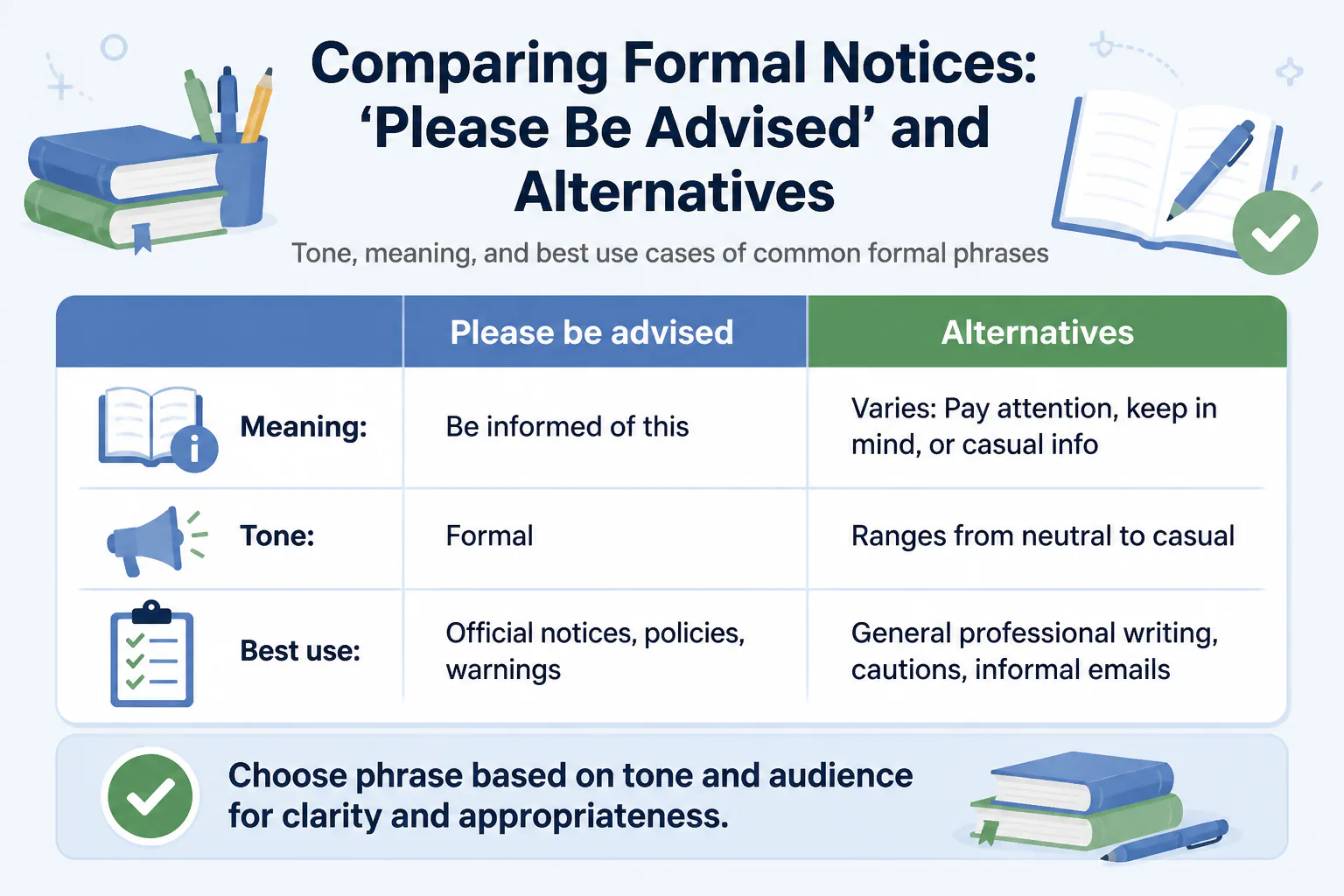
| Phrase | Meaning | Tone | Best use |
|---|---|---|---|
| Please be advised | Be informed of this | Formal | Official notices, policies, warnings |
| Please note | Pay attention to this | Neutral | General professional writing |
| Be aware | Keep this in mind | Direct | Cautions or reminders |
| Just so you know | I’m telling you this | Casual | Informal conversation or email |
Simple examples
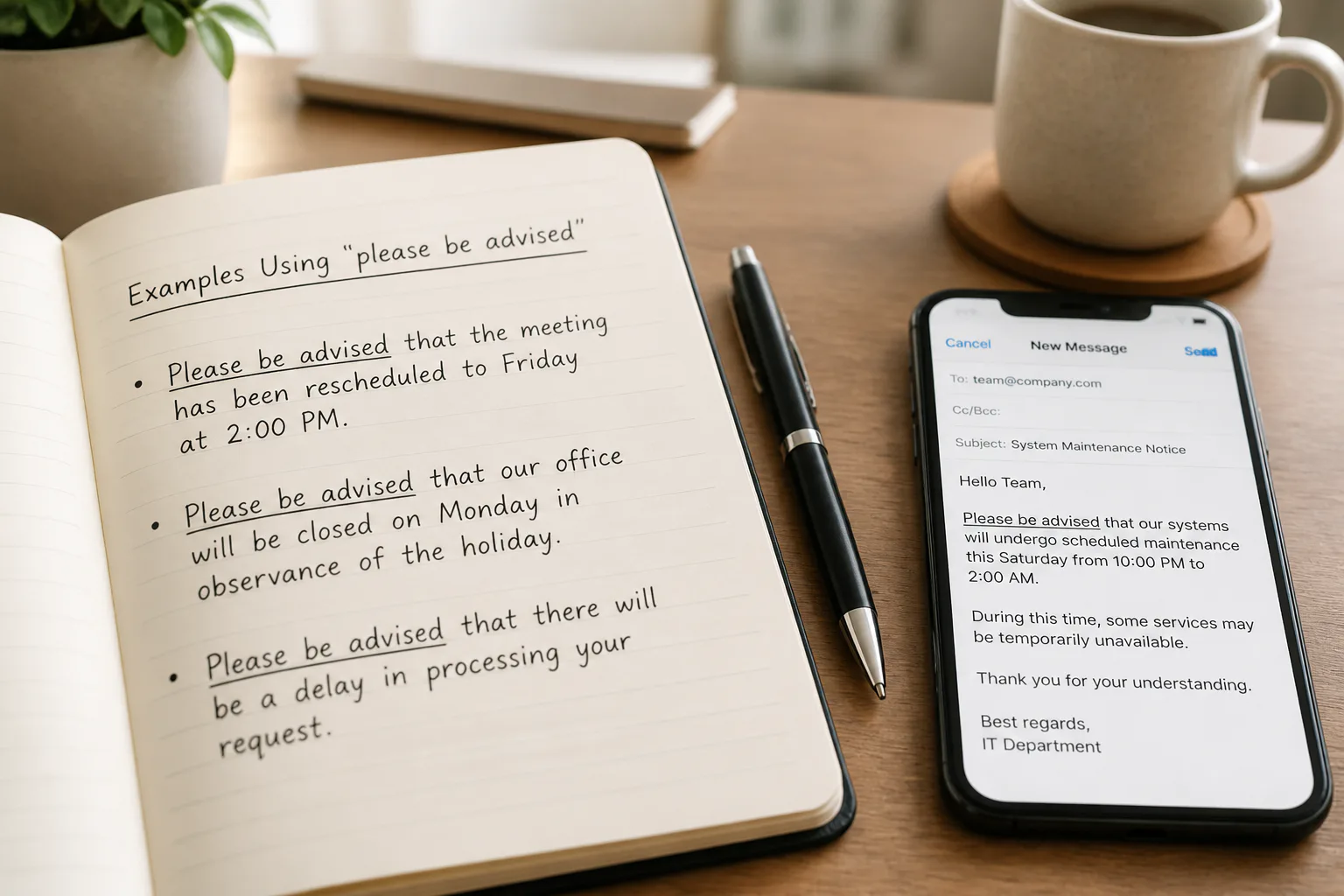
Here are a few short examples that show how the phrase works:
- “Please be advised that your appointment has been rescheduled.”
- “Please be advised that parking is not available on weekends.”
- “Please be advised that all visitors must sign in at reception.”
Each example introduces information the reader needs to know. The phrase is not the main message. It is the signal that says, “Read the next part carefully.”
When and How to Use ‘Please Be Advised’
Best situations
Use this phrase when you need to communicate information in a formal, professional, or official way. It fits messages about procedures, deadlines, restrictions, delays, and policy changes. It is especially useful when the writer needs to sound neutral rather than personal.
For instance, a company might write, “Please be advised that response times are longer than usual.” A school might write, “Please be advised that classes are canceled tomorrow.” In both cases, the phrase matches the institutional tone.
When not to use it
Avoid it in friendly emails, team chats, and everyday conversation unless you intentionally want a very formal tone. In many workplaces, shorter phrases sound more natural and still remain professional. A direct line often reads better than an official one.
Writers who want a softer tone often choose plain alternatives, just as they do in other business phrases such as please see attached, which can also sound more natural when simplified.
Practical rule
- If the message is routine, use plain English.
- If the message is official, sensitive, or policy-related, this phrase can be appropriate.
- The key is matching the expression to the relationship and the setting.
Examples of ‘Please Be Advised’ in Sentences
Professional examples
- “Please be advised that the meeting has been moved to Conference Room B.”
- “Please be advised that your payment is now overdue.”
- “Please be advised that support will be unavailable after 6 p.m.”
- “Please be advised that all expense reports must be submitted by Friday.”
Official notice examples
- “Please be advised that this area is under video surveillance.”
- “Please be advised that entry is restricted to authorized personnel.”
- “Please be advised that the train will depart from Platform 4.”
- “Please be advised that failure to respond may result in cancellation.”
Better rewrites in casual situations
- Instead of “Please be advised I sent the file,” write “I’ve sent the file.”
- Instead of “Please be advised I will call you later,” write “I’ll call you later.”
- Instead of “Please be advised that I received your message,” write “Thanks, I got your message.”
Alternatives to ‘Please Be Advised’
Formal and neutral options
- Please note – clear, professional, and less stiff
- Be aware that – useful for cautions or limitations
- This is to inform you that – formal and explicit
- Kindly note – polite, though less common in some regions
Simpler everyday options
- Just so you know
- I wanted to let you know
- For your information
- Here’s an update
Choosing the right alternative
The best replacement depends on tone. “Please note” is the safest general choice because it is professional without sounding too legal or distant. “Just so you know” is useful in informal settings, while “be aware that” works best when the information has a caution attached.
Sometimes the strongest alternative is no phrase at all. Instead of adding a formal opener, simply state the update. If the goal is acknowledgment rather than notice, a phrase like thank you for letting me know serves a different purpose and sounds warmer.
Common Mistakes and How to Avoid Them
Using it in casual conversation
A common mistake is using the phrase where normal speech would be much simpler. In a message to a friend or close coworker, it often sounds overly serious. Replace it with direct language unless you truly need a formal tone.
Adding it to every email
Some writers use this expression as a habit, even when the information is minor. That can make writing feel repetitive and bureaucratic. Use it only when the update is important enough to justify a formal signal.
Following it with weak wording
The phrase should lead into clear information, not vague language. “Please be advised that there may be some things happening soon” is unclear and ineffective. A stronger version is “Please be advised that the system will be offline from 8 to 10 p.m.”
Forgetting the audience
Always consider who will read the message. A customer notice, legal statement, or HR policy can support this tone. A quick internal chat usually cannot. Good usage depends less on grammar alone and more on fit, purpose, and relationship.
FAQs
Is “please be advised” polite?
Yes, it is polite in a formal way. However, it can sound cold or distant if used in friendly or casual communication.
Is “please be advised” rude?
No, the phrase itself is not rude. It can feel sharp if it introduces a warning, refusal, or strict rule, but that effect usually comes from the message, not the phrase alone.
Can I use “please be advised” in an email?
Yes, especially in professional or official emails. In many everyday emails, “please note” or a direct sentence sounds more natural.
Do I need “that” after it?
No, but it is very common. “Please be advised that the office is closed” sounds more complete than “Please be advised the office is closed.”
Conclusion
“Please be advised” works best when you need a formal way to introduce important information, but in everyday writing, simpler alternatives usually sound clearer and more natural.