Safe Journey: Meaning and Proper Usage
Safe journey is a polite English expression used to wish someone a secure, smooth, and trouble-free trip. People say it as a farewell before someone travels by car, train, plane, or any other form of transport. In everyday English, it carries both a literal meaning, hoping the person arrives without harm, and a social meaning, showing care, warmth, and good manners.
The phrase is simple, but its use depends on tone and context. In many situations, native speakers are more likely to say “Have a safe journey” than the shorter form “safe journey” on its own. Still, both forms are understood, and both work in conversation, cards, messages, and emails.
What Does ‘Safe Journey’ Mean?
Core meaning
At its most direct, safe journey means “I hope your trip is safe.” It is a goodwill phrase said to someone who is about to travel. The focus is not on excitement or fun, but on the person’s well-being while they are away or in transit.
For example, if a friend is leaving for another city, you might say, “Safe journey,” or more naturally, “Have a safe journey.” In both cases, you are expressing concern and kindness, not giving advice.
Literal and social meaning
Literally, the phrase refers to physical safety during travel. Figuratively, it works as a caring farewell. It tells the listener, “I am thinking of you,” in a brief and polite way.
That is why the phrase appears often in personal messages, workplace emails, and family conversations. It is less about the journey itself and more about the relationship between the speaker and the traveler.
How it sounds in English
On its own, “safe journey” can sound slightly formal, compressed, or influenced by greeting-card style. In natural spoken English, people often prefer full versions such as “Have a safe journey,” “Have a safe trip,” or safe travels meaning phrases like “Safe travels.” These sound smoother in many modern contexts.
That does not mean “safe journey” is wrong. It is fully understandable and polite. It simply appears more often in writing, in formal speech, or in varieties of English where short blessing-like expressions are common.
Common patterns
- Safe journey.
- Have a safe journey.
- Wishing you a safe journey.
- I hope you have a safe journey home.
- Have a safe journey back.
Correct usage examples
Here are a few natural examples:
- “You should leave early tomorrow. Have a safe journey.”
- “Thanks for visiting us. Safe journey home.”
- “Wishing you a safe journey and a pleasant stay.”
- “Text me when you arrive. Have a safe journey.”
Common mistake to avoid
The main mistake is treating the phrase like a noun instead of a farewell wish. For instance, “I gave him a safe journey” is not natural. English speakers use it as a spoken or written wish, not as an object you can give.
Another point is tone. If you want to sound natural and warm, the fuller form “Have a safe journey” usually works better than the bare phrase alone. If you want more variety, you can also use have a safe trip in the same situations.
Polite alternatives at a glance
If “safe journey” feels too formal or repetitive, English offers several close alternatives. Each one carries a slightly different tone, but all express care before travel.
| Phrase | Tone | Typical use |
|---|---|---|
| Have a safe journey | Polite, standard | General use |
| Safe travels | Warm, modern | Messages, casual speech |
| Have a safe trip | Natural, common | Everyday conversation |
| Travel safely | Slightly formal | Advice-like farewell |
| Hope you get there safely | Personal, caring | Close relationships |
When and How to Use ‘Safe Journey’
Typical situations
Use the phrase when someone is leaving for a trip, returning home, or traveling a long distance. It fits both personal and professional communication. You might say it at an airport, in a goodbye text, or at the end of an email to a colleague.
The expression is especially useful when you want to sound thoughtful without becoming too emotional. In that way, it works much like other polite farewell formulas in English.
Best form by context
- Conversation: “Have a safe journey” or “Have a safe trip”
- Text message: “Safe journey home” or “Safe travels”
- Email: “Wishing you a safe journey”
- Card or note: “Safe journey and best wishes”
In speech, intonation matters. A warm tone makes the phrase sound sincere. In writing, adding a few extra words often makes it feel more natural, such as “Wishing you a safe journey back on Sunday.”
Cultural Use
Different English-speaking habits
Across English-speaking cultures, the idea behind the phrase stays the same: it is a kind wish for someone who is traveling. The difference is in frequency and preferred wording. Some speakers say “safe journey,” while others strongly prefer “safe trip” or “safe travels.”
In many modern American contexts, “safe travels” sounds especially common in messages and casual farewells. British and other international English varieties may use “have a safe journey” more comfortably, especially in slightly formal settings.
Tone and etiquette
The phrase is polite and gentle, so it suits many relationships: friends, relatives, coworkers, teachers, and clients. It is rarely too strong or too intimate. That makes it a safe choice when you want to be courteous.
English also has many fixed farewell expressions, and their tone changes by region and setting. For example, a phrase like have a safe journey may feel warmer in a personal message, while “safe travels” can sound more modern and concise.
Polite Alternatives to ‘Safe Journey’
Common options
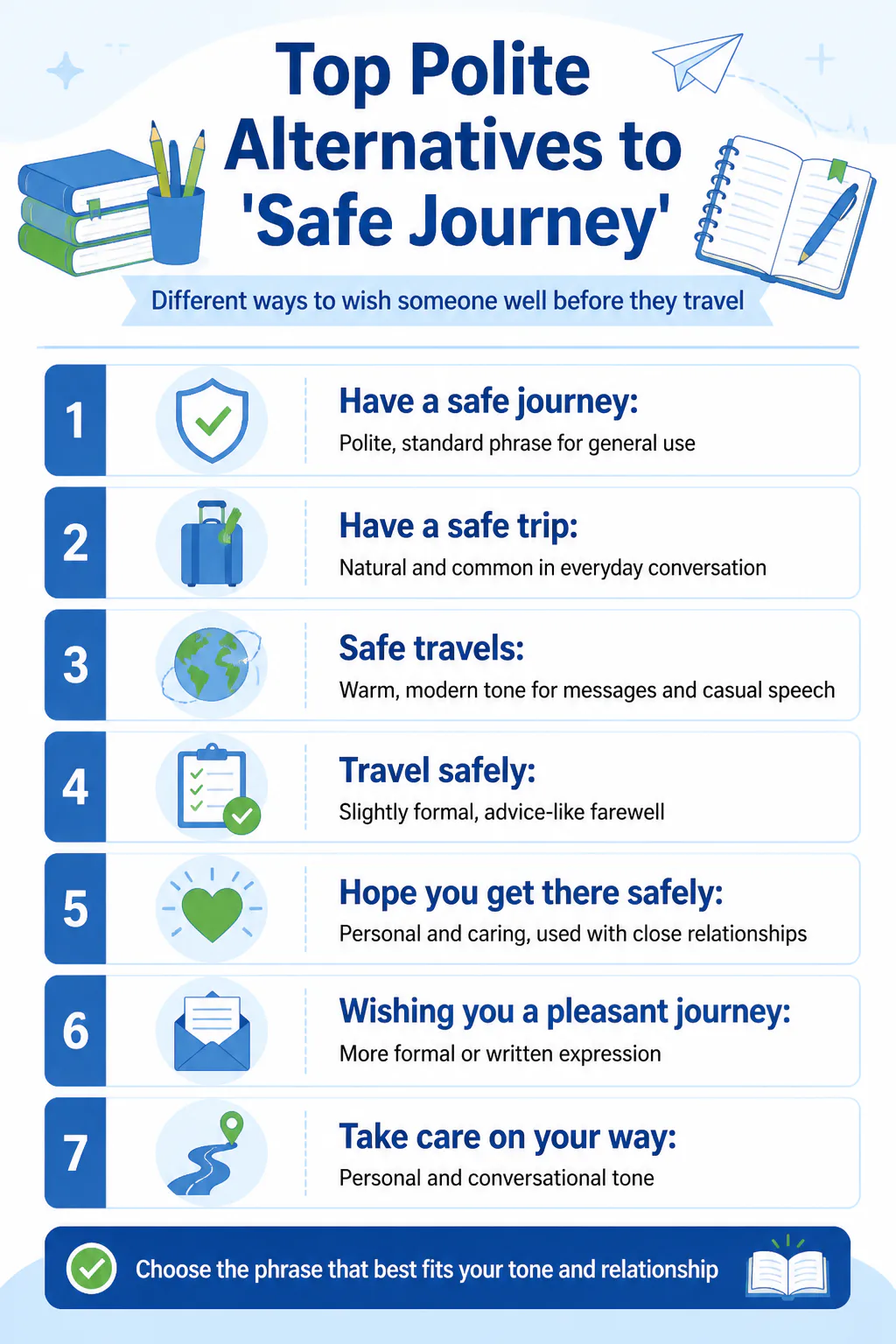
- Have a safe journey
- Have a safe trip
- Safe travels
- Travel safely
- Hope you have a smooth trip
- Hope you get there safely
- Wishing you a pleasant journey
- Take care on your way
How they differ
- Safe travels sounds modern, friendly, and slightly more idiomatic.
- Have a safe trip is one of the most natural choices in everyday speech.
- Wishing you a pleasant journey sounds more formal or written.
- Take care on your way feels personal and conversational.
Examples of ‘Safe Journey’ in Conversation
Short dialogues
- “I am heading to Chicago tonight.”
“Have a safe journey.” - “We should reach home by midnight.”
“Safe journey back.” - “Thanks for coming to visit.”
“Of course. Safe travels.” - “My train leaves in ten minutes.”
“Wishing you a safe journey.”
Sentence examples
- “Have a safe journey, and let me know when you arrive.”
- “We wish you a safe journey home after the conference.”
- “Safe journey to everyone traveling this weekend.”
- “I sent her a message wishing her a safe journey.”
FAQs
Is “safe journey” grammatically correct?
Yes. It is grammatically correct as a farewell expression. In everyday speech, “Have a safe journey” often sounds more complete and natural.
Is “safe journey” or “safe travels” more common?
Both are common, but “safe travels” is often more idiomatic in modern casual English. “Safe journey” can sound slightly more formal or traditional.
Can I say “safe journey” in an email?
Yes. It works well in emails, especially at the end of a message to someone who is about to travel. “Wishing you a safe journey” is a polished choice.
What is the best alternative to “safe journey”?
The best alternative in everyday conversation is usually “Have a safe trip.” It is natural, clear, and widely used.
Conclusion
“Safe journey” is a polite and useful way to wish someone well before they travel, especially when you want to sound caring and courteous.