Have you ever come across the words symptomology and symptomatology and wondered if they mean the same thing—or if one is just incorrect? You’re not alone. The confusion around Symptomology vs Symptomatology is surprisingly common, even among professionals.
In this article, we’ll break down the real difference between these terms, explore their origins, explain correct usage, and show you when (and if) each should be used. By the end, you’ll have clarity—and confidence—in choosing the right word.
What Is Symptomatology?
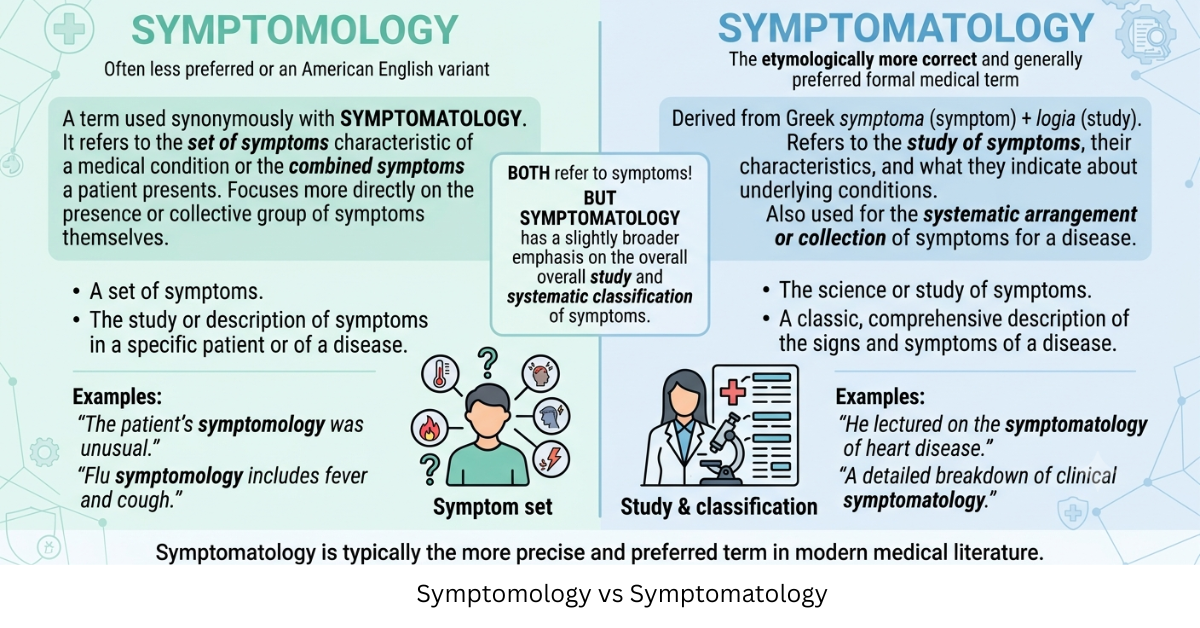
Symptomatology is the correct and widely accepted medical term. It refers to:
The study of symptoms
The collection or pattern of symptoms associated with a disease
A structured way to analyze how illnesses present in patients
Example:
“The symptomatology of influenza includes fever, fatigue, and body aches.”
Why It Matters
In fields like medicine, psychology, and clinical research, precision is everything. Symptomatology provides a standardized way to describe how diseases manifest.
What Is Symptomology?
Symptomology is often used informally—but it is not considered a standard or correct term in formal medical or academic contexts.
Key Points:
It is commonly viewed as a misconstructed or shortened version of symptomatology
Sometimes used in casual conversation or non-technical writing
Rarely accepted in scientific literature
Example (informal use):
“The symptomology of stress varies from person to person.”
While understandable, this usage is technically incorrect.
Symptomology vs Symptomatology: Core Differences
1. Accuracy and Acceptance
Symptomatology → Correct, formal, widely accepted
Symptomology → Informal, often incorrect
2. Usage Context
Symptomatology → Medical journals, academic writing, clinical discussions
Symptomology skips part of this structure, making it linguistically incomplete
Why Do People Confuse These Terms?
Common Reasons:
Simplification: People naturally shorten longer words
Pronunciation ease: “Symptomology” feels quicker to say
Lack of awareness: Many don’t realize there’s a correct version
Online misuse: Incorrect usage spreads through blogs and social media
When Should You Use Symptomatology?
Use symptomatology whenever accuracy matters.
Best contexts:
Medical writing
Academic papers
Healthcare communication
Research documentation
Practical Tip:
If you’re writing anything professional or SEO-focused, always choose symptomatology to maintain credibility.
Is Symptomology Ever Acceptable?
Technically, no—but context matters.
Acceptable (loosely):
Casual conversations
Informal blog posts
Non-technical discussions
Not acceptable:
Scientific papers
Clinical reports
Educational materials
Insight:
Using symptomology in professional settings can signal a lack of expertise—something you definitely want to avoid.
Real-World Example
Imagine a doctor writing a report:
❌ “The patient’s symptomology suggests a viral infection.”
✅ “The patient’s symptomatology suggests a viral infection.”
That small difference can impact perceived professionalism and accuracy.
Key Takeaways
Symptomatology is the correct term—use it in all formal contexts
Symptomology is informal and often incorrect
The difference lies in linguistic accuracy and professional acceptance
Using the right term improves credibility and clarity
Practical Tips for Writers & Professionals
Always double-check medical terminology
Avoid shortcuts in formal writing
Use tools or glossaries for technical accuracy
When in doubt, choose the longer, standard form
FAQ Section
1. Is symptomology a real word?
Yes, it exists in informal usage, but it is not considered correct in professional or medical contexts. Symptomatology is the proper term.
2. What does symptomatology mean?
Symptomatology refers to the study or collection of symptoms associated with a particular disease or condition.
3. Why is symptomatology preferred over symptomology?
Because it is linguistically accurate and widely accepted in academic and medical fields, unlike symptomology.
4. Can I use symptomology in casual writing?
Yes, in informal contexts it may be understood, but it’s still better to use symptomatology for clarity and correctness.
5. Is symptomatology used outside medicine?
Yes, it can also be used in psychology and other fields where patterns of symptoms or behaviours are studied.
Conclusion
Understanding the difference between Symptomology vs Symptomatology is more than just a vocabulary lesson—it’s about precision, credibility, and clear communication. While symptomology might slip into everyday language, symptomatology remains the correct and professional choice.
If you’re aiming to write with authority—whether for SEO, academia, or professional communication—stick with what’s accurate. Small details like this can make a big difference.
Want to improve your writing further? Keep exploring nuanced language differences—they’re the key to standing out.