wenrath: The Small German Locality Behind the Schwalbe Tire Town of Reichshof
Introduction
Search for wenrath and the results can be confusing at first, because the word seems to point in several directions at once: a German place, a business address, a surname, and a handful of blog posts that treat it as something mysterious. The confusion clears up quickly once the spelling is understood, because wenrath is most firmly and most verifiably a place name, and the place it names is a small locality in western Germany whose modern spelling carries one extra letter. The story of wenrath is therefore the story of a single letter, a village landscape, and a surprisingly well-known bicycle tire company.
At its core, wenrath is the older or variant spelling of Wehnrath, one of the many small localities that make up the municipality of Reichshof in the Oberbergischer Kreis, in the German state of North Rhine-Westphalia. The current official spelling used by the municipality itself is Wehnrath, but the form without the second letter h appears in institutional records, company addresses and older references, and it is that form which searchers keep typing. Understanding wenrath means understanding both spellings at once, and why the place behind them is worth knowing about at all.
This article sets out what can genuinely be verified about wenrath: where it sits, how it fits into the municipality of Reichshof, what history surrounds it, and why a quiet corner of the Bergisches Land has become the headquarters of a bicycle tire brand sold all over the world. Where the record runs thin, the article says so plainly rather than filling the gaps with invention. Readers who enjoy guides to German place names will find that wenrath is a good example of how much history a single village name can carry.
What wenrath Is: A Place Name, Not a Mystery Word
The simplest and most important fact about wenrath is that it is not a separate town, a company, or a product. It is a locality, in German an Ortsteil, inside a larger municipality, and the municipality in question is Reichshof, about forty kilometres east of Cologne. Reichshof itself is made up of no fewer than 106 villages and hamlets scattered across wooded hills, and wenrath is one small part of that patchwork, best known today through its industrial area and the companies based there.
The evidence for the connection between the two spellings is unusually concrete. An article in the archive of the German Bundestag, the country’s federal parliament, dated 2012, uses the spelling “Reichshof-Wenrath” when describing a visit to the bicycle tire manufacturer Schwalbe, whose headquarters stands in the locality. Business and trade publications have used the same form for years, including reports of the extrusion specialist EDS GmbH, whose headquarters are likewise given as Reichshof-Wenrath, and technical datasheets from the transponder company SCEMTEC that carry the same address. Against that, the municipality of Reichshof consistently uses the spelling Wehnrath in its current planning and economic development material. The two forms therefore describe the same place, and the difference is one of spelling convention rather than of geography.
It is worth saying plainly what wenrath is not, because the internet has a habit of turning unfamiliar names into mysteries. There is no evidence that wenrath is a word in any language with a separate meaning of its own, and no widely documented public figure, brand or fictional character carries the name in a way that explains the searches for it. The name does appear as a surname in the way that many German place names do, since families historically took their names from the villages they came from, but the documented referent that explains the search traffic is the locality in Reichshof, and that is where this article keeps its focus.
Wenrath and Wehnrath: Why the Two Spellings Exist
German place names have not always been spelled the way they are spelled today, and the story of wenrath is a small example of that larger truth. Spelling in Germany was only standardised relatively late, and local names were written down over centuries by different hands: parish clerks, tax collectors, railway officials and mapmakers, each recording what they heard in the spelling habits of their own time. A letter could appear or disappear from a village name without anyone moving a boundary or renaming anything, and both forms could then live on side by side for decades.
In the case of wenrath, the form with the extra letter h is the one that survived into modern official use, while the shorter form continued to circulate in older documents, company letterheads and international references. This is a common pattern in the Oberbergischer Kreis and the wider Bergisches Land, where small settlements have long histories and where the written record preserves several layers of spelling at once. A searcher who types wenrath is therefore not making a mistake in any meaningful sense; they are using a form of the name that real institutions have genuinely used, and the search engines that return results for Wehnrath alongside it are doing the right thing.
The practical consequence for anyone writing about the place is that both spellings need to be acknowledged. An article that mentioned only Wehnrath would leave a searcher who typed wenrath wondering whether they had found the right place at all, while an article that treated wenrath as a separate settlement would invent a village that does not exist. The honest position, and the one this article takes throughout, is that wenrath and Wehnrath are two spellings of one locality, and that the modern official form is the one with the letter h.
Where wenrath Sits: Reichshof and the Oberbergischer Kreis
To place wenrath on the map, it helps to start from the municipality that contains it. Reichshof lies in the Oberbergischer Kreis, a rural district in the Cologne administrative region of North Rhine-Westphalia, roughly forty kilometres east of Cologne itself. The district takes its name from the Oberbergisches Land, the hilly, wooded country of the Bergisches Land, and its administrative seat is the town of Gummersbach, with the neighbouring towns of Wiehl and Waldbröl close by. Reichshof is one of thirteen municipalities in the district, which was formed in 1932 and took its current shape in the territorial reforms of 1975.
Reichshof is a scattered municipality rather than a single compact town. It covers about 114.66 square kilometres of hills and valleys, at elevations between 289 and 342 metres, and its population was recorded as 18,509 at the end of 2025. Its postal code is 51580, its vehicle registration code is GM, and its administration is based in Denklingen, the largest of its villages. The municipality describes itself as a health resort known for its good climate, and that description fits the landscape: a patchwork of forest, farmland and small settlements rather than an industrial city.
The largest villages give a sense of the scale of the place. Denklingen has a population of about two thousand, Eckenhagen about nineteen hundred, Brüchermühle about seventeen hundred and Wildbergerhütte about sixteen hundred, and the remaining hundred or so settlements are smaller still. Wenrath belongs to this world of small places, and its particular distinction is not its size but its industry: while most of the municipality’s villages are purely residential and agricultural, the locality of wenrath hosts an industrial area that has brought it a profile far beyond its population.
The History Behind wenrath and Reichshof
The history of the area around wenrath reaches back much further than the modern municipality, and it begins with an imperial gift. Reichshof was first officially mentioned on 1 August 1167, when it was granted by Friedrich I, known as Barbarossa, to Rainald of Cologne, the Archbishop of Cologne. The name of the municipality comes from the former Imperial Estate of Reichshof Eckenhagen, established in that same year and later acquired by the Counts of Berg in 1257, and the municipal coat of arms, granted on 11 September 1972, still tells that story in pictures: the upper half shows the imperial eagle, while the lower half shows the lion of the Counts of Berg, taken from the seal of Eckenhagen of 1557.
The modern municipality is much younger than its medieval roots. As a consequence of the municipal reorganisation of 1969, the formerly independent municipalities of Denklingen and Eckenhagen were consolidated into the single municipality of Reichshof, with its administration seated in Denklingen. That reorganisation is the reason Reichshof today contains so many villages: it gathered up a whole landscape of small settlements, each with its own history, under one administrative roof. Wenrath, like its neighbours, kept its local identity within that larger whole, and its name continued to appear in both of its spellings in the decades that followed.
Denklingen itself illustrates the depth of local history around wenrath. Between the sixteenth and eighteenth centuries a castle with a chapel was built there, renamed the Rentei in 1672 when the administration of Windeck moved to Denklingen Castle, and the village later gained both a Catholic church, built between 1885 and 1886, and an Evangelical church built between 1889 and 1903. A railway connecting Brüchermühle, Denklingen and Wildbergerhütte opened on 31 October 1910, though it never brought the economic upswing its builders hoped for and was completely dismantled in the early 1960s. The area around wenrath is therefore not a new industrial estate dropped onto empty land, but an old settled landscape in which modern industry arrived late.
Why wenrath Matters Today: Schwalbe, EDS and the Industrial Area
If wenrath is known anywhere outside its own district, it is because of the companies based there, and the first of them is by far the most famous. Schwalbe, the bicycle tire brand of the family company Ralf Bohle GmbH, is based in Reichshof-Wehnrath, with its headquarters and logistics centre at Otto-Hahn-Strasse 1, 51580 Reichshof. The company was founded in Bergneustadt in 1922, the Schwalbe brand itself was introduced in 1973, and the business is now run by the third generation of the Bohle family. It is Europe’s leading manufacturer of bicycle tires, with subsidiaries in England, France, Italy, the Netherlands and the United States, sales partners in more than sixty countries, and a 2023 revenue of 237.5 million euros.
The scale of the operation at wenrath is easy to underestimate from the outside. Around two hundred employees work at the headquarters in Reichshof, developing the tires, managing marketing and running global logistics, while the tires themselves are manufactured at the company’s factories in Indonesia, run with its Korean joint venture partner PT Hung-A, and in Vietnam. The best known products are the Marathon range of commuting and touring tires, alongside reinforced tires for electric bikes, heavy duty tires for cargo bikes, and the company’s distinctive tube recycling scheme, through which used inner tubes handed in at retailers are recycled into new tubes. In 2017 the company launched Green Compound, a rubber compound made largely from renewable and recycled rubber, and it remains the first manufacturer in the world to recycle used tubes and tires in this way.
The second company that puts wenrath on the map is EDS GmbH, an international supplier of high-end extrusion tools and a specialist in flat dies for film production. EDS has its headquarters in Reichshof-Wenrath, and on 17 January 2018 it became part of the Reifenhäuser Group of Troisdorf, continuing to operate as an independent business unit under its previous owner Johannes P. Müller together with the group’s operations director. A third firm, SCEMTEC Transponder Technology GmbH, also gives its address as Reichshof-Wenrath in its technical documentation, and the industrial area is further associated with MUG, a textile construction company whose BAHAMA brand of large all-weather screens has been a market leader for more than twenty-five years. The locality of wenrath is therefore a genuine, if small, industrial centre, and its companies explain why the name appears in business registers and trade publications far from the Oberbergischer Kreis.
Life Around wenrath: The Bergisches Land
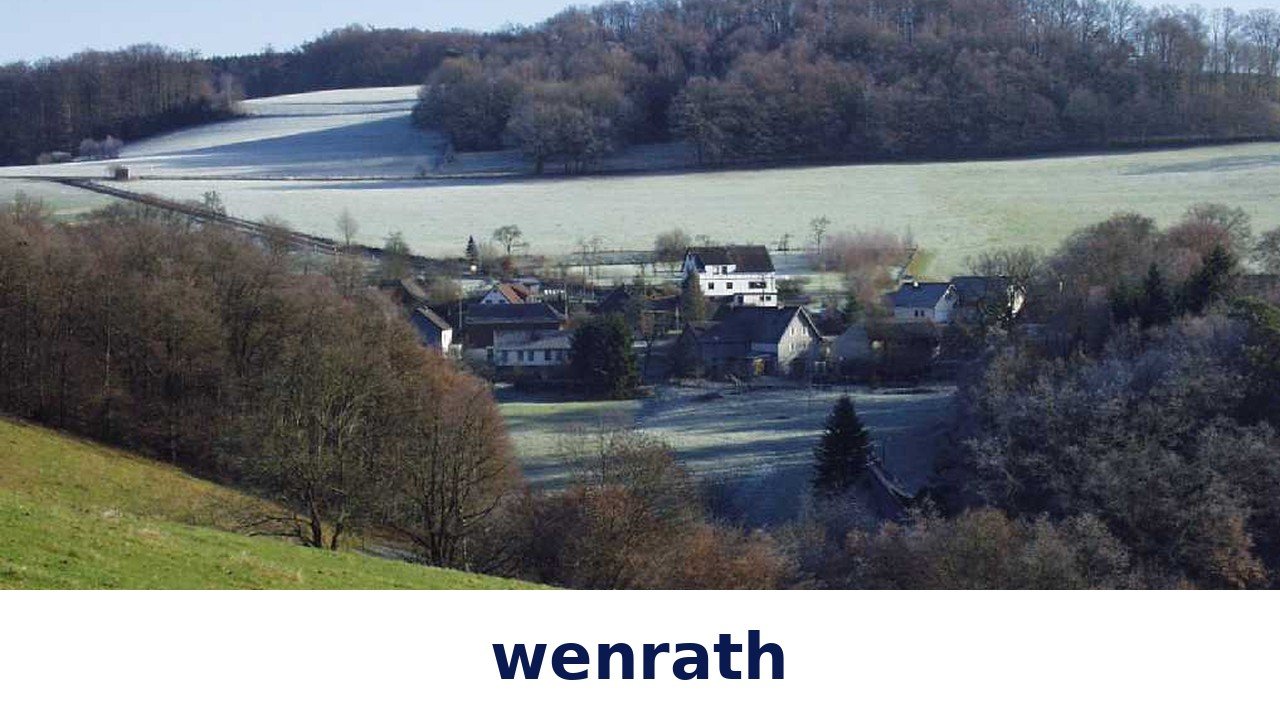
Beyond its factories, the world around wenrath is the Bergisches Land at its most characteristic: wooded hills and valleys, grey slate on older facades, and the half-timbered houses that give the region its visual identity. The Oberbergischer Kreis is a district of small and middle-sized industry, particularly in plastics and metal processing, but its settlements remain villages first and industrial sites second, and the landscape between them is forest and farmland. The district is connected by the autobahns A4 and A45, and a regional train links Engelskirchen, Gummersbach and Marienheide with Cologne, so the quiet of the villages sits within easy reach of one of Germany’s great cities.
The wider area offers the kinds of attractions that suit a rural district of this character. Homburg Castle and Gimborn Castle stand among its historic buildings, the so-called coloured churches with their medieval wall and ceiling paintings are known nationally, there is a stalactite cave at Wiehl, and an open-air museum at Lindlar shows the traditional life of the region. The municipality of Reichshof also has a large employer of a different kind in BPW Bergische Achsen of Wiehl, which runs branch factories at Brüchermühle and Hunsheim within the municipality. For a visitor, the appeal of the area around wenrath is not a single famous sight but the combination of an old settled landscape, working villages and easy access to the walking country of the Bergisches Land.
That combination also explains the municipality’s self-description as a health resort with a good climate. The oceanic climate of the region, with mild summers and no extreme season, and the elevation of the hills between roughly 289 and 342 metres, make the area around wenrath a comfortable place to live and to walk, and the scattered settlement pattern means that a visitor can pass from forest to farmland to village street within a few minutes. The locality itself is not a tourist destination in the conventional sense, and no honest article should pretend otherwise, but it sits inside a region that rewards slow exploration, and its industrial story gives that exploration an unexpected twist.
Visiting wenrath: What to Expect
A traveller who sets out to visit wenrath should set expectations accordingly, because the locality is a working place rather than a showpiece. There is no grand town centre, no famous church and no museum bearing the name, and a visitor arriving in search of a single sight with that name on a sign will instead find a small settlement, an industrial area, and the everyday life of a Reichshof village. The value of the visit lies in the surroundings: the villages of the municipality, the castles and coloured churches of the district, and the walking routes of the Bergisches Land, with the knowledge that the tires on many of the bicycles passing by were developed a short distance away.
Practically, the area is straightforward to reach. Reichshof lies about forty kilometres east of Cologne, the nearest larger towns are Gummersbach and Wiehl, and the postal code for the whole municipality, including wenrath, is 51580. Anyone navigating to the companies of the locality should use the current spelling, Wehnrath, since that is the form used by the municipality and by modern mapping, while anyone searching older records or international business registers should be ready to meet the form wenrath instead. Readers following travel stories from small European towns will recognise the pattern: the most useful thing a guide can do for a place like this is to explain the name before the journey begins.
One further practical note is worth making. Because wenrath is a locality rather than an independent municipality, it has no separate population figure, mayor or town hall of its own, and statistics about it are published as part of Reichshof as a whole. A searcher who finds no separate entry for wenrath in a gazetteer or a census table has not missed anything; the place is administered, counted and governed through Reichshof, and that is entirely normal for a settlement of its kind in Germany.
Wenrath at a Glance
The essential facts about wenrath can be gathered in a short table, and the table is worth reading with the spelling point in mind: every row that mentions the locality applies equally to both forms of the name.
| Detail | Wenrath in brief |
|---|---|
| What it is | A locality in the municipality of Reichshof, Germany |
| Modern spelling | Wehnrath, as used by the municipality of Reichshof |
| Variant spelling | Wenrath, used in Bundestag records, business addresses and older references |
| District | Oberbergischer Kreis, in the Cologne region |
| State | North Rhine-Westphalia, Germany |
| Municipality | Reichshof, about 40 km east of Cologne, population 18,509, area 114.66 square kilometres |
| Postal code | 51580, shared with the whole municipality |
| Best known for | The Schwalbe bicycle tire headquarters of Ralf Bohle GmbH, and the EDS extrusion works |
| Region | The Bergisches Land, wooded hills, slate facades and half-timbered villages |
| First mention of the area | Reichshof first mentioned 1 August 1167, in a gift from Friedrich I Barbarossa to the Archbishop of Cologne |
Read with that table in mind, the name resolves into something simple: a small place with two spellings, a long history behind it, and a modern industrial life that reaches far beyond its own hills. It is the kind of name that rewards a searcher who looks past the first confusing results.
Conclusion
Wenrath turns out to be neither a mystery nor a separate town, but the variant spelling of Wehnrath, a small locality in Reichshof whose bicycle tire headquarters and extrusion works give it a reach far beyond its size. For anyone who typed the name wondering what it meant, the answer is a quiet corner of the Bergisches Land with medieval roots, a modern industrial area, and a spelling quirk worth knowing before the journey.