
What Municipalities Should Know Before Investing In Solar Power Pole Lights
What Are Solar Power Pole Lights?
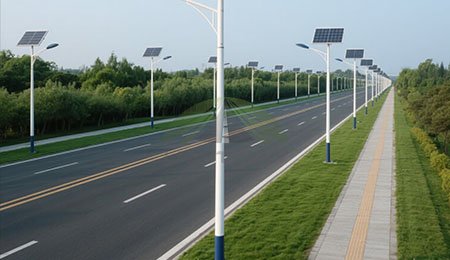
Solar power pole lights are standalone poles that make, store, and use their own electricity. A panel on the pole charges a battery through the day, and a controller switches the light on at dusk, drawing on that stored charge through the night. No trench, no conduit run, no grid connection. For a public works team, that means a new road segment or parking area can have working lights within days of installation, not months after a utility application.
Because the electrical work stays entirely on the pole, permitting is usually lighter too, and crews aren’t left coordinating around a utility’s install schedule. That makes solar power pole lights a practical fit for phased road projects, where lighting needs to go up in sections as paving finishes rather than all at once.
Characteristics of Smart Power Pole Lights
Not every solar pole is “smart.” A smart version adds sensors, connectivity, and software on top of the basic solar-and-battery setup, turning a single pole into infrastructure that does more than light the road. Here’s what that usually includes.
- Security cameras: Mounted cameras give a department eyes on intersections, entrances, and stretches of road that would otherwise go unmonitored, feeding footage back through the pole’s own connectivity.
- Traffic monitoring: Sensors track vehicle counts and flow patterns, data that traffic engineers can use to time signals or flag a spot that needs a closer look.
- Environmental monitoring: Some poles carry air quality or weather sensors, useful for departments that need to report on conditions along a corridor or near a school zone.
- Wireless connectivity: Built-in Wi-Fi, 4G, 5G, or RF-mesh radios let a pole act as a small connectivity node, which matters in areas where cell coverage is thin.
- Emergency alarms and battery backup: A call button or alarm feature, paired with battery reserve, keeps the pole functioning through outages and gives residents a way to reach help along an unlit stretch.
Do Outdoor Solar Lights Need Direct Sunlight?
Direct sunlight helps, but it isn’t the only thing that matters. A well-engineered solar power pole light is built to capture usable light even on overcast days, or when the panel only gets a few hours of unobstructed sun each afternoon. Panel angle, mounting height, surface area, and how efficiently the system converts light into stored charge all affect performance more than raw sun exposure on its own, especially across a full winter season.
Where this becomes a real concern is heavy tree cover or tall buildings casting long shadows for most of the day. In those spots, a department should ask a vendor for a site assessment before installation, not after. A short shadow study upfront avoids the more common failure mode: a pole that looks fine on paper but never charges enough to hold light through a full night.
How to Choose a Reliable Platform to Purchase Reliable Solar Power Pole Lights
Picking solar power pole lights is only half the decision. The other half is picking who you buy them from, because a pole is only as good as the maintenance and support behind it. A handful of factors separate a platform worth a long-term contract from one that leaves a department managing warranty claims on its own.
No upfront cost.
Some providers offer lighting as a service rather than a straight purchase, meaning a department gets new poles installed without tying up capital that’s needed elsewhere in the budget.
Predictable budget.
A flat monthly payment, instead of a mix of parts, labor, and surprise repair bills, makes it far easier to plan a multi-year public works budget with confidence.
Maintenance included.
Look for a platform that installs, monitors, and services the poles as part of the agreement, rather than leaving a department’s own crew responsible for battery swaps and panel cleaning.
Sustainable and clean.
Since the system runs entirely on stored solar power, there’s no ongoing utility bill and no emissions tied to running the lights, which matters for departments with sustainability targets to hit.
Resilient by design.
Reliable platforms are built for wind, rain, and grid outages from the start, so lighting keeps working during the exact conditions when a road most needs it.
Departments doing this kind of vetting for the first time should ask any prospective vendor for references from other municipal clients, a clear maintenance schedule, and documented battery and panel warranties before comparing pricing.
What Are Some Good Solar Lights for Outside Poles?
Not all solar lighting hardware is built the same way, and the option that fits a rural county road may not fit a downtown corridor. A few categories are worth knowing before requesting quotes.
Vertical retrofit panels: These wrap around a new or existing pole rather than sitting on top of it, which keeps the panel self-cleaning as rain and wind naturally shed dust and snow off the vertical surface, while preserving the look of the street.
Smart pole platforms: These combine solar power pole lights with the sensor and connectivity features covered earlier, useful for corridors where a department wants lighting and monitoring from the same install.
Mobile solar trailers: For construction zones, events, or emergency response, a trailer-mounted solar lighting unit can be deployed and moved without any fixed installation at all.
A department evaluating options for a specific project can look at how one platform lines up these choices at clearworld.us, where the panel technology, smart pole hardware, and mobile trailer options are laid out side by side.
The Bottom Line
Solar Power Pole Lights are no longer a stopgap for hard-to-reach spots. For municipalities and public works departments planning new roads, they’re a practical, budget-friendly way to light a corridor without a grid connection, a trench, or a surprise utility bill five years into the contract.