
Welcome Back Meaning: Definition & Usage
The welcome back meaning is simple: it is a warm greeting used when someone returns after being away. People say it to show happiness, acknowledgment, and a sense of belonging. You can use it in conversation or writing when a person comes back to work, school, home, a group, or even an online space after an absence.
In everyday English, the phrase sounds friendly and natural. It fits both personal and professional situations, which is why you hear it in emails, meetings, chats, and face-to-face conversations. The exact tone depends on context, but the message stays the same: the person was missed, noticed, and is gladly received again.
What Does ‘Welcome Back’ Mean?
Basic definition
“Welcome back” means “I am glad you have returned” or “It is good to have you here again.” It is used to greet someone who has come back after being absent for a period of time. That absence can be short, like a weekend or lunch break, or longer, like a vacation, leave, or extended travel.
The phrase carries more than simple recognition. It also expresses warmth and acceptance. In many situations, saying “welcome back” helps the returning person feel included and valued.
How it works in real use
You use this phrase when the return matters in some way to the speaker or group. A manager may say it to an employee after leave. A teacher may say it to students at the start of a new term. Friends may say it after a trip or time away.
Because it is short and flexible, it works in many forms of communication. You can say it aloud, write it in an email, send it in a group chat, or include it in a meeting message. In workplace English, it is polite and professional without sounding stiff.
Typical contexts
- Returning to work after vacation or leave
- Coming back to school after a break
- Rejoining a social group after time away
- Returning home from travel
- Logging back into a class, meeting, or shared workspace
In tone, “welcome back” is warmer than a plain “hello.” It suggests that the person’s absence was noticed and that their return is positive. If you want a similar expression of positive feeling, everyday phrases such as glad to hear that also show warmth, though they are used in different situations.
Simple examples
Here are a few quick examples:
- Welcome back, Sarah. We missed you at the office.
- Welcome back to school, everyone.
- It is great to see you again. Welcome back.
- Welcome back from your trip. How was it?
You can also expand the phrase to sound more personal. For example, “Welcome back, we missed you” adds emotion. “Welcome back to the team” adds a group feeling. “Welcome back, hope you are doing well” can sound especially thoughtful in writing, much like other polite check-in phrases such as hope you are doing well.
Common Situations to Use ‘Welcome Back’
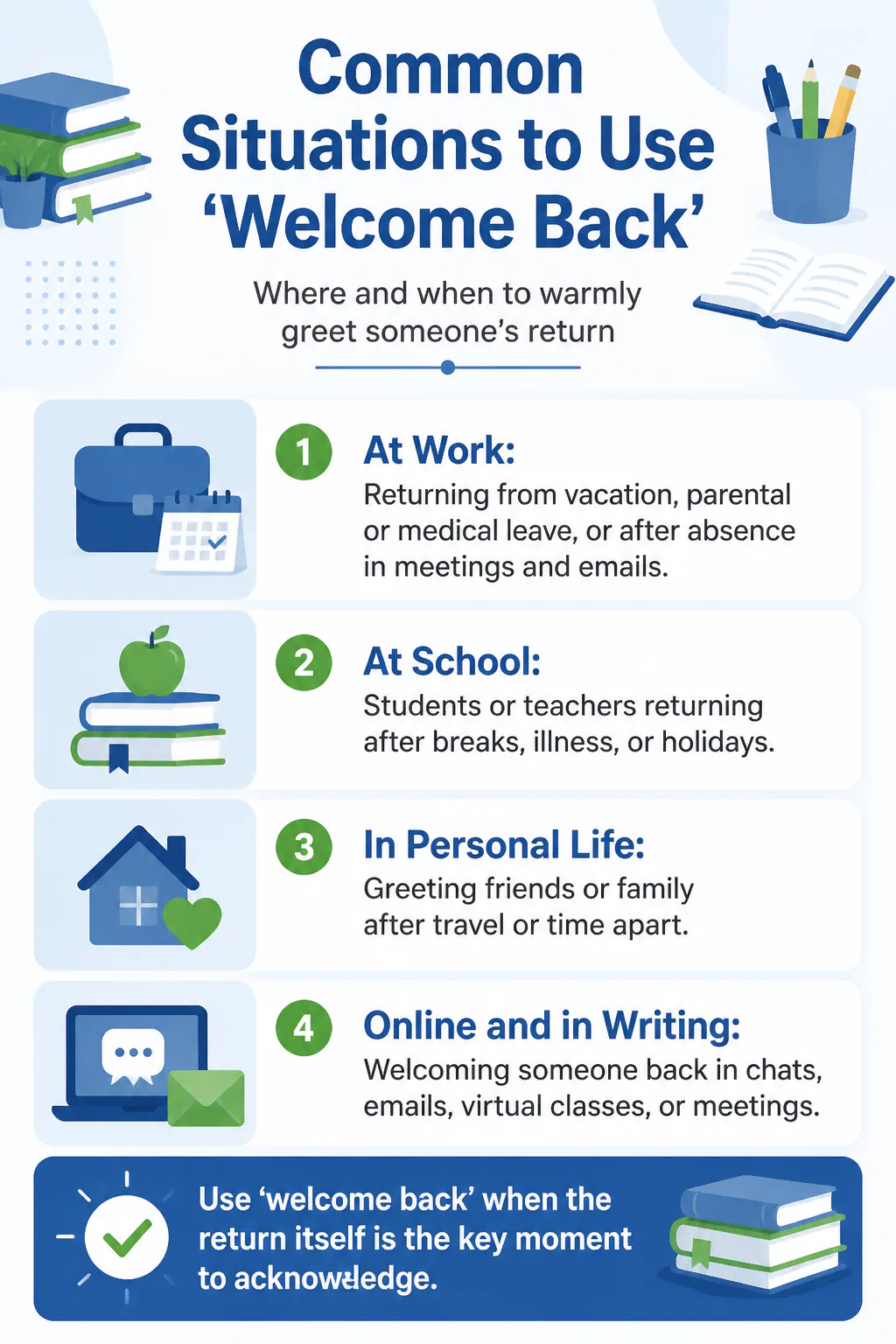
At work
- When a coworker returns from vacation
- When an employee comes back from parental or medical leave
- At the start of a meeting after someone has been absent
- In a team email after a colleague returns
At school
- When students return after summer or holiday break
- When a classmate comes back after illness
- When a teacher returns to the classroom
In personal life
- Greeting a friend after travel
- Welcoming a family member home
- Seeing someone again after they have been away for a while
Online and in writing
- In chat messages when someone returns to a group
- In emails to reopen communication after absence
- In virtual classes or meetings when someone logs in again
One useful rule is this: say “welcome back” when the return itself is the important point. If you are greeting someone for the first time, use “welcome,” not “welcome back.” If you want to sound especially positive in a professional message, phrases like looking forward to working with you can pair well with a return greeting when someone is rejoining a project or team.
Examples of ‘Welcome Back’ in Sentences
Friendly examples
- Welcome back, Alex. It is so good to see you again.
- Welcome back from vacation. I hope you had a great time.
- Hey, welcome back. We were just talking about you.
Professional examples
- Welcome back to the office. We are glad to have you with us again.
- Welcome back, Maria. I hope your leave went well.
- On behalf of the team, welcome back.
School examples
- Welcome back, students. Let us begin the new term.
- Welcome back to class, Jordan. We saved your notes for you.
- Welcome back, everyone. I hope you enjoyed the break.
Alternatives with a similar tone
| Phrase | Use | Tone |
|---|---|---|
| Welcome back | General return after absence | Warm and standard |
| Great to have you back | Personal or workplace return | Enthusiastic |
| Good to see you again | Reunion after time apart | Friendly and natural |
| Welcome back, we missed you | Close teams, friends, family | More emotional |
These alternatives help avoid repetition while keeping the same basic message. The best choice depends on how formal you want to sound and how close you are to the person. “Good to see you again” often feels a bit lighter than “welcome back,” while “we missed you” adds stronger feeling.
Social Nuances
Warmth and belonging
In American English, “welcome back” often does more than mark someone’s return. It can signal that the person is part of the group and that their presence matters. That is why the phrase works well in offices, classrooms, and families: it reinforces connection without needing a long explanation.
The phrase is also socially safe in most everyday situations. It is professional enough for work and friendly enough for personal use. Still, tone matters. A cheerful “welcome back” fits a happy return, while a gentler version works better if someone has been away for a difficult reason.
Formality and etiquette
In formal writing, the phrase is still acceptable, especially in workplace emails and team messages. You can keep it simple, such as “Welcome back, James,” or make it more polished: “Welcome back to the team.” If the situation is sensitive, avoid sounding overly casual or playful.
It also helps to match your words to your relationship with the person. With close friends, “Welcome back, we missed you” sounds warm and personal. With a colleague or client, a shorter and calmer version is usually better.
FAQs
Is “welcome back” grammatically correct?
Yes. It is a standard English greeting used when someone returns after being away. It is correct in both speech and writing.
Is “welcome back” formal or informal?
It works in both formal and informal settings. The phrase is naturally friendly, but it is also appropriate in professional communication.
Can I say “welcome back” in an email?
Yes. It is common in workplace emails, school messages, and personal notes. It sounds polite, warm, and clear.
What can I say instead of “welcome back”?
You can say “Great to have you back,” “Good to see you again,” or “Welcome back, we missed you.” Choose the one that matches the tone and relationship.
Conclusion
“Welcome back” is a useful everyday greeting for marking someone’s return in a warm, natural, and appropriate way across work, school, and personal situations.