
Is “Well Noted with Thanks” Correct? Meaning, Tone, and Better Alternatives
“Well noted with thanks” is understandable and polite, but it is not the most natural standard phrase in English. In professional email communication, “noted with thanks” is grammatically correct and widely used to show acknowledgment, confirm receipt, and express appreciation. “Well noted” on its own is also common, but it can sound formulaic or stiff depending on the tone of the exchange.
If you want a short, professional reply, better choices are often “Noted, thank you”, “Received with thanks”, or “Thank you for the update”. The best option depends on whether you are confirming receipt, showing understanding, or responding more warmly to a manager, colleague, or client.
What the phrase means
Noted means the message has been received and understood. Adding with thanks turns it into a polite acknowledgment that also shows appreciation for the information, document, or update.
So in plain terms, “noted with thanks” means: I have received your message, I understand it, and thank you for sending it. That makes it useful in workplace emails where the main goal is receipt confirmation rather than a long reply.
Is it grammatically correct?
Yes. “Noted with thanks” is grammatically correct. It works as a brief elliptical expression in email, where short acknowledgment phrases are common.
“Well noted with thanks” is also understandable, but it sounds less natural to many English speakers than “noted with thanks” or “noted, thank you.” The issue is not grammar so much as tone and naturalness.
Why “well noted” can sound off
“Well noted” appears often in business writing, especially in international workplace communication. However, in many English-speaking settings, it can feel more marked than simple alternatives like “noted”, “understood”, or “thanks for letting me know”.
The adverb well adds emphasis, but that emphasis does not always improve the sentence. In some emails, it makes the reply sound formulaic, overly formal, or slightly stiff rather than more professional.
Where it is commonly used
“Noted with thanks” and “well noted” are especially common in workplace emails across Singapore, Malaysia, Hong Kong, India, and other Asian business contexts. In those settings, the phrase is often treated as a normal polite reply for acknowledgment and receipt confirmation.
That regional usage matters. A phrase can be correct and professional in one business environment, yet sound abrupt or unusually formal in another. Good email etiquette depends not just on grammar, but on audience and register.
Tone in workplace emails
The main risk with short acknowledgment phrases is not correctness. It is tone. A very brief reply can read as neutral, efficient, curt, or even dismissive if the original email involved effort, nuance, or a sensitive update.
That is why a professional response should match the situation. If someone sends a simple file or schedule change, a short acknowledgment is fine. If a client shares a detailed update or a colleague raises a concern, a warmer reply is usually better.
Good situations for short acknowledgment
- Confirming receipt of a document
- Acknowledging a meeting time change
- Responding to a routine internal update
- Confirming you have seen instructions from a manager
- Replying where no further discussion is needed
When a warmer reply is better
- A client has sent a detailed message
- A colleague has explained a problem
- The email requires action or a deadline
- The message contains bad news or a sensitive issue
- You want to confirm understanding clearly
Best alternatives
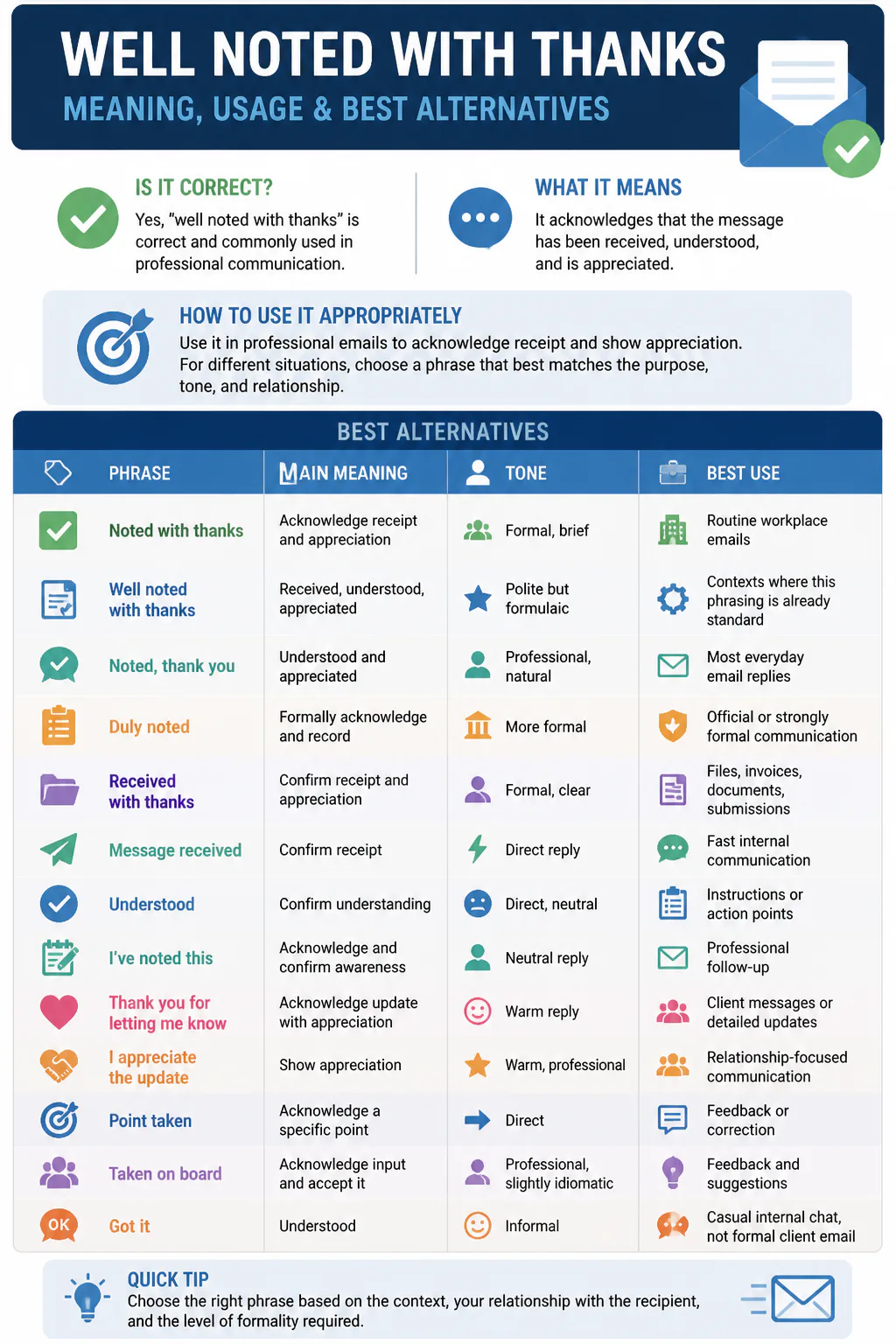
If your goal is to sound natural, polite, and professional, use a phrase that fits the purpose of the email. Some alternatives focus on receipt, others on understanding, and others on appreciation.
| Phrase | Main meaning | Tone | Best use |
|---|---|---|---|
| Noted with thanks | Acknowledge receipt and appreciation | Formal, brief | Routine workplace emails |
| Well noted with thanks | Received, understood, appreciated | Polite but formulaic | Contexts where this phrasing is already standard |
| Noted, thank you | Understood and appreciated | Professional, natural | Most everyday email replies |
| Duly noted | Formally acknowledge and record | More formal | Official or strongly formal communication |
| Received with thanks | Confirm receipt and appreciation | Formal, clear | Files, invoices, documents, submissions |
| Message received | Confirm receipt | Direct reply | Fast internal communication |
| Understood | Confirm understanding | Direct, neutral | Instructions or action points |
| I’ve noted this | Acknowledge and confirm awareness | Neutral reply | Professional follow-up |
| Thank you for letting me know | Acknowledge update with appreciation | Warm reply | Client messages or detailed updates |
| I appreciate the update | Show appreciation | Warm, professional | Relationship-focused communication |
| Point taken | Acknowledge a specific point | Direct | Feedback or correction |
| Taken on board | Acknowledge input and accept it | Professional, slightly idiomatic | Feedback and suggestions |
| Got it | Understood | Informal | Casual internal chat, not formal client email |
Which version sounds most natural?
For most professional communication in English, these choices sound more natural than “well noted with thanks”:
- Noted, thank you.
- Thank you for the update.
- Received with thanks.
- I’ve noted this. Thank you.
- Understood. Thank you.
“Noted and thank you” is understandable, but it is less natural than “noted, thank you” or “I’ve noted the update. Thank you.” If you want polished business English, punctuation and phrasing matter.
Better replies by situation
To a manager
- Noted, thank you.
- Understood. I’ll proceed accordingly.
- I’ve noted this and will send the update by 3 p.m.
To a colleague
- Thanks for letting me know.
- Noted, thank you.
- Message received. I’ll take care of it.
To a client
- Thank you for the update.
- Received with thanks. We’ll review this today.
- I appreciate the update. We’ll get back to you by noon tomorrow.
For files or documents
- Received with thanks.
- The document has been received. Thank you.
- Acknowledged with thanks.
How to make the reply more useful
The most effective email acknowledgment does more than confirm receipt. It also confirms understanding or states the next step. This removes ambiguity and improves professional communication.
Instead of ending with only “noted with thanks”, add one useful detail. That can be an action, deadline, or confirmation point.
Stronger email examples
- Noted, thank you. I’ll update the report this morning.
- Received with thanks. We will review the attachment and reply by Friday.
- Thank you for letting me know. I understand the change and will inform the team.
- I’ve noted the update. Thank you. The revised file will be sent shortly.
What to avoid
Some replies are correct but not ideal in tone. Others create unnecessary friction because they are too blunt, too formal, or not quite natural in English.
- Well noted with thank you — less standard than
with thanksorthank you - Noted and thank you — understandable, but less natural than
noted, thank you - Noted. — can sound curt if the message needed appreciation
- Duly noted. — very formal and can sound cold in some situations
- Got it. — too informal for many workplace emails
Quick recommendations
If you want one simple rule, use “Noted, thank you” for short professional replies and “Thank you for the update” when you want a warmer tone. Use “Received with thanks” when the emphasis is on receipt confirmation.
Keep “well noted with thanks” for settings where that style is already normal. If your audience is international, client-facing, or sensitive to tone, a more natural alternative usually works better.
FAQ
Is “well noted with thanks” wrong?
No. It is understandable and polite. The main issue is tone, not grammar. Many readers find “noted with thanks” or “noted, thank you” more natural.
Is “noted with thanks” formal?
Yes. It has a formal register and is common in workplace emails. It is suitable for acknowledgment, receipt confirmation, and brief professional communication.
Does “noted” mean understood?
Yes. In email etiquette, noted usually means the message has been received and understood. It can also imply that the information has been recorded for action or reference.
Can “noted” sound rude?
Yes, if it stands alone in a situation that deserves more engagement. A very brief direct reply can feel curt. Adding thank you, appreciation, or the next step makes the tone more polite.
What is better than “well noted” in an email?
Better alternatives include “Noted, thank you”, “Thank you for letting me know”, “I’ve noted this”, “Received with thanks”, and “I appreciate the update.”
Is “duly noted” the same as “noted”?
They are close in meaning, but “duly noted” is more formal. It can work in official communication, but in everyday workplace emails it may sound stiffer than necessary.
Final take
“Well noted with thanks” is acceptable, but it is not the strongest default choice for modern professional email. If you want a reply that is grammatically correct, polite, and natural, use “Noted, thank you” for a brief acknowledgment or “Thank you for the update” for a warmer response.
The best email etiquette rule is simple: match your tone to the relationship, the message, and the action needed. A clear acknowledgment with appreciation and one next step will almost always sound more professional than a formulaic one-line reply.

Related Posts
35 Other Ways to Say “However” (With Examples)

35 Other Ways to Say “You’re Welcome” (With Examples)