
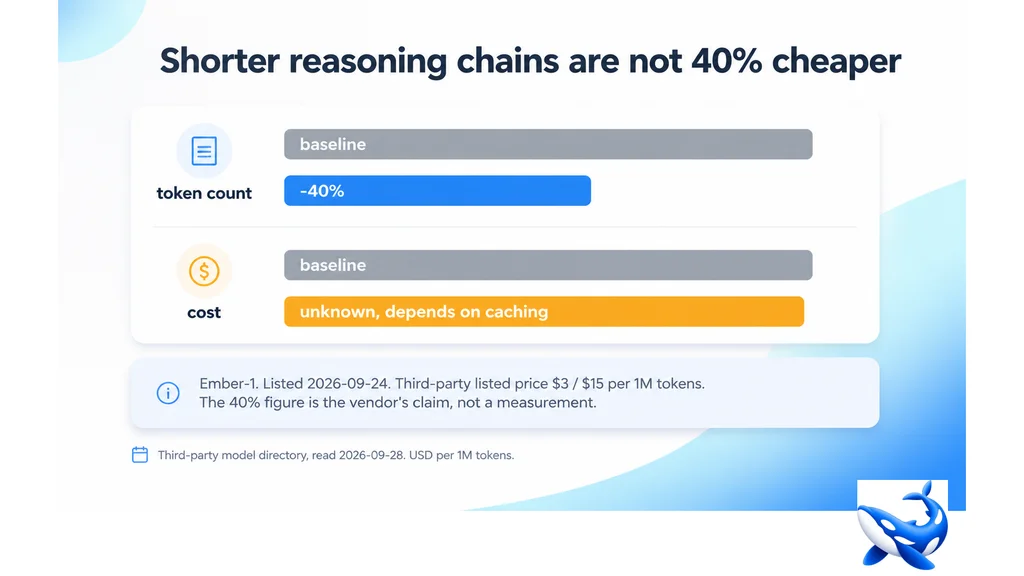
Ember-1’s 40% Shorter Reasoning Chains Don’t Automatically Cost 40% Less
A model listed on 24 September 2026 comes with the most quotable number in this month’s crop of latest LLM models: reasoning chains 40% shorter than the model it is measured against, at that model’s quality. It is the kind of claim that travels well because it sounds like a price cut. It is not one. On OrcaRouter a request is billed on tokens actually consumed across the latest llm models in the catalogue, which is exactly why the arithmetic here deserves a second look before anyone repeats the number as a saving.
What the claim actually says
Read literally, the claim is about a length. A reasoning model produces a chain of intermediate tokens before it answers; the vendor says this model’s chains are 40% shorter while matching the quality of the comparator. That is a statement about output token count.
It is not a statement about price, and the gap between the two is where most of the coverage will go wrong. Output tokens are the expensive half of almost every price list — on this model’s own listing, output costs five times input — so a 40% reduction in output tokens is a real thing to want. But length reduction and cost reduction are the same number only when three other things hold, and usually at least one of them does not.
Three things that break the conversion
The first is caching. In a multi-turn agent loop, most of the input is a prefix that was already sent. If your provider serves that prefix from cache at a fraction of the input rate, then input is already cheap and shortening the output is nearly the whole bill. If it does not, input is a meaningful share and the saving is diluted. A 40% shorter chain means something different in each case, and no vendor claim can tell you which case you are in.
The second is thinking-token accounting. Not every provider charges for hidden reasoning tokens the same way. Some bill them as output. Some report them separately and bill them at the output rate anyway. A vendor that publishes a chain-length reduction is describing its own accounting, and if the reduction is real but the tokens are still emitted and billed, the price does not move at all.
The third is retries. A shorter chain that is wrong is more expensive than a long chain that is right, because you pay for both the failed attempt and the correction. The claim pairs shorter chains with equal quality, which is the vendor’s characterisation. If the equal-quality part holds on your traffic, you keep the whole saving. If it holds on a benchmark but not on your task, you have bought a cheaper wrong answer.
The price on the listing, and what to compare it with
The third-party directory row read on 28 September 2026 lists $3 per million input tokens and $15 per million output. That is a frontier-adjacent band: cheaper than the most expensive entries this month, more expensive than the accelerated variants and the small multimodal models.
The comparison that matters is not against the cheapest model in the catalogue, because a reasoning model at this price is not competing with a $0.05 model. It is competing with whatever you currently route the hard 20% of your traffic to, and the honest way to compare is cost per completed task rather than cost per million tokens. Cost per task folds in chain length, retry rate, and how many turns the loop takes — which is precisely the quantity the 40% claim moves, and precisely the quantity that a per-token price list cannot show you.
If you want one number to hold onto: a 40% reduction in output tokens, at an unchanged output rate, with input held constant, is a 40% reduction in the output half of your bill. Anything else is a different claim.

What is missing, and why that is the useful part
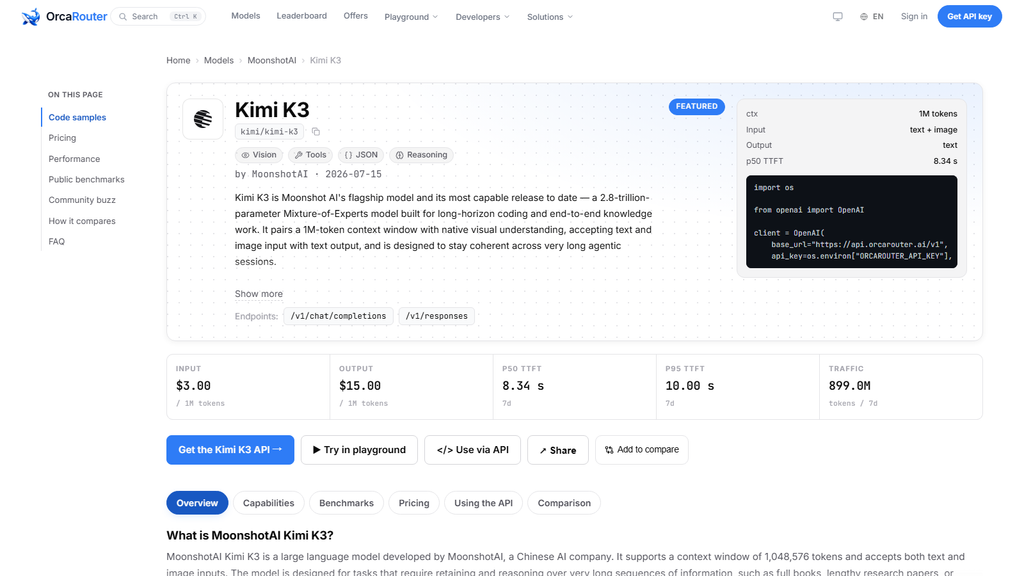
There is no page for this model on the independent intelligence index we checked on 28 September 2026. We searched the obvious slugs and they all returned a 404. The consequence is narrow but important: the 40% figure has exactly one source, and that source is the vendor.
That does not make the number false. It makes it unverifiable from outside, and it means that anyone repeating it is repeating a vendor claim rather than a measurement. The distinction is worth holding onto because this batch of releases contains several claims of the same shape — a percentage improvement over an unnamed or loosely named comparator — and they will all read like findings once they have been through three summaries.
The vendor’s own model page and its published weights are the only primary sources, and neither of them contains an independent token-count measurement. If you need one, you have to produce it, and producing it is cheap: send the same fifty hard prompts to this model and to your current reasoning model, log the output token counts, and compare the distributions rather than the means. A 40% mean reduction with a long right tail behaves very differently from a 40% reduction everywhere, and only one of those is a reliable budget input.
How to read it before you route to it
Three checks, in order, and none of them require trusting the vendor.
First, measure the denominator. Log your current model’s output token count per completed task, not per request. If your loops average four turns, a 40% per-call reduction is not a 40% per-task reduction.
Second, measure the retry rate on your own eval set. This is the variable that decides whether a shorter chain is a saving or a subsidy, and it is the one the vendor claim cannot address because it depends on your task.
Third, check whether the model is even reachable the way you need. A model with published weights and a vendor API is available through those channels; the operational question is whether you want a second provider integration for one model, which is usually a worse trade than the percentage suggests.
The larger point about this release is about the shape of the claim rather than its size. A shorter chain is a genuine engineering achievement, and it is being sold as a discount. Those are different products, and the way to tell which one you got is to measure your own bill rather than to read the vendor’s percentage.
Sourcing note: Ember-1’s listing date of 24 September 2026 and its third-party listed prices of $3 per million input tokens and $15 per million output tokens were read from a third-party public model directory on 28 September 2026 and are that directory’s figures. The claim that its reasoning chains are 40% shorter than the model it is compared against, at comparable quality, is the vendor’s own claim and is not an independent measurement; no third-party token-count verification exists. The absence of an independent intelligence index page for this model was our own check of the neutral third-party leaderboard on 28 September 2026, and the screenshot in this article is that leaderboard’s own first screen, included to show the check rather than to show a score. The caching, thinking-token accounting and retry arguments, the instruction to compare distributions rather than means, and the recommendation to measure tokens per completed task are editorial framing. No index score is quoted because no page exists to quote. This article names no competing platform and describes none.