No-Code Game Maker Tools for Quick Game Concepts
Not every game idea needs a year of development behind it. Sometimes the whole point of a concept is that it’s small, sharp, and built around a single fun idea rather than a sprawling feature list. The problem has always been that even small ideas used to require real technical effort to bring to life, which meant a lot of quick, promising concepts never made it past the notebook stage. No-code game maker tools are changing that, letting creators turn a simple idea into something playable in a fraction of the time it used to take.
Why Quick Concepts Deserve More Attention
Small Ideas Often Outperform Big Ones
There’s a common assumption that a bigger, more feature-rich game is automatically a better one. In practice, some of the most memorable games are built around a single tight mechanic executed well, rather than a long list of systems stretched thin. A quick concept with a clear hook can outperform an ambitious project that never quite comes together.
The Old Cost of Testing a Small Idea
The frustrating part of traditional development was that even a small idea still required real setup work, learning an engine, writing code, building basic systems, before a creator could tell whether the core idea was actually fun. That upfront cost discouraged a lot of quick experimentation, because the effort didn’t match the size of the idea being tested.
What No-Code Tools Actually Remove
No-code game makers strip away the technical setup that used to stand between a quick idea and a playable version of it.
No Need to Learn an Engine First
Traditional engines like Unity or Unreal come with a real learning curve, even for simple projects. No-code tools skip that step entirely, letting a creator start building the actual game instead of spending the first few weeks learning how the software works.
Logic Without Writing Code
Instead of writing functions to define how objects interact, no-code platforms let creators set up behavior through visual systems or plain language descriptions. A creator can specify what happens when a player collects an item or reaches a goal without touching a single line of code, which keeps the focus on the idea itself rather than the implementation.
Immediate Feedback Instead of a Long Build Process
One of the most valuable parts of no-code tools is how quickly a concept becomes playable. Instead of building for weeks before there’s anything to test, a creator can see a rough version of their idea working almost immediately, which makes it much easier to tell early on whether a concept has real potential.
Turning a Quick Idea Into a Real Prototype
Having an idea and having a tool to build it are only useful together if the workflow between them is fast. This is where a platform designed specifically around quick, no-code creation makes a real difference.
A Platform Suited to Fast Concepts
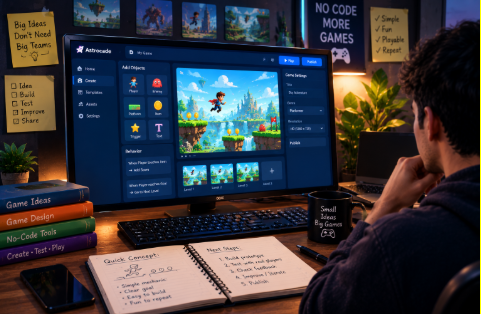
Astrocade is a good example of a no-code game maker built with this kind of quick turnaround in mind. Rather than requiring a long setup process before anything is playable, it lets creators describe a concept and get a working version fast enough to actually test whether the idea holds up.
An Example of a Focused, Quick Concept
Superhero Evolution is a good illustration of what a tight, hook-driven concept looks like in practice. It’s built around a clear, easy-to-understand premise rather than a wide array of systems, which reflects the kind of scope that tends to work best when moving quickly from idea to playable build.
What Makes a Quick Concept Actually Work
Speed of creation doesn’t automatically mean a concept is good. A few things separate quick ideas that land from ones that fall flat.
A Hook That’s Obvious Immediately
A strong quick concept should be understandable within seconds of a player starting it. If the appeal of the game needs to be explained before it makes sense, the concept probably needs to be simplified further, regardless of how fast it was to build.
A Loop That Holds Up on Repetition
Because these concepts are often simple by design, the core loop needs to hold a player’s attention across multiple rounds rather than just the first one. A quick idea that’s fun once but repetitive on the second or third try usually needs another pass before it’s worth sharing widely.
Scope That Matches the Idea
Part of what makes a quick concept work is resisting the urge to keep adding to it. A focused idea executed cleanly tends to perform better than the same idea stretched with extra features that dilute what made it appealing in the first place.
Common Mistakes Creators Make With Quick Concepts
Overbuilding a Simple Idea
It’s tempting to keep adding mechanics once the basic version works, especially when a no-code tool makes it easy to keep tweaking. This often waters down a concept that was strong specifically because it was simple and focused.
Skipping Real Playtesting
Because no-code tools make building fast, it can be tempting to skip straight to publishing without testing with real players first. Even a quick concept benefits from a handful of outside testers pointing out whether the hook actually lands the way the creator intended.
Treating Every Idea as Worth Finishing
Not every quick concept needs to become a polished, published game. Part of the value of fast, no-code prototyping is being able to try an idea, realize it doesn’t work, and move on to the next one without having wasted weeks of effort.
A Simple Workflow for Quick Concepts
A practical approach looks something like this. Start with one clear mechanic or premise rather than a list of features, and use a no-code tool to build a rough playable version as fast as possible. Test it with a few real players right away, paying attention to whether the hook lands within the first few seconds. If it holds up, spend a little more time polishing the loop and presentation. If it doesn’t, move on to the next idea rather than forcing it to work.
Final Thoughts
No-code game maker tools have made it realistic to test far more ideas than developers could ever afford to build the traditional way. That shift favors quick, focused concepts with a clear hook over sprawling projects that take months to prove out. For creators sitting on a handful of small game ideas, there’s rarely been an easier way to find out which ones are actually worth building further.