Noted with Thanks: Meaning, Tone, and Better Alternatives
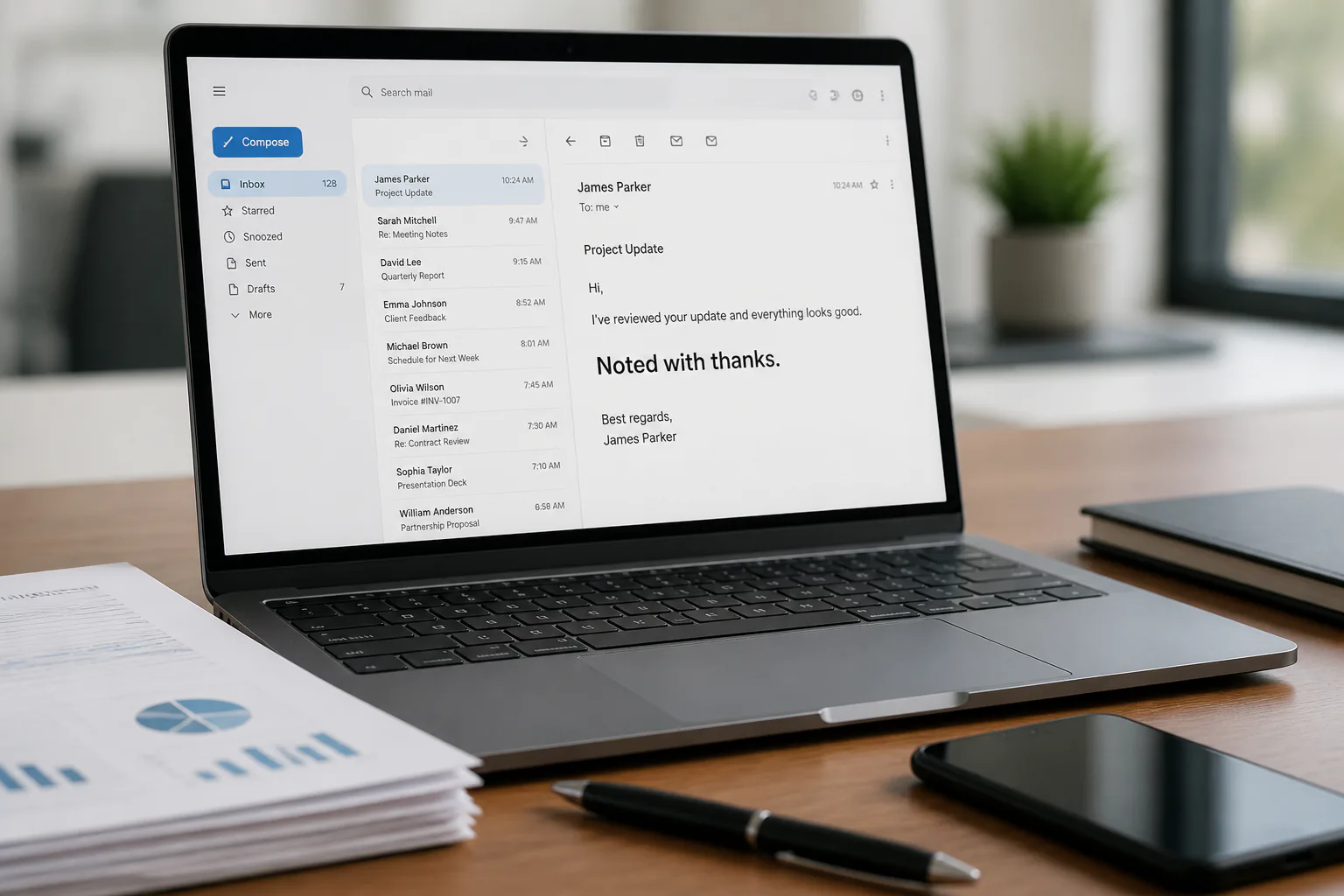
“Noted with thanks” means “I received and understood your message, thank you”. It is a short written reply used mostly in emails to confirm receipt and understanding without starting a longer conversation. In the right setting, it is efficient and polite. In the wrong one, it can sound stiff, abrupt, or emotionally flat.
If you have seen this phrase in office emails, especially in routine admin messages, that is where it fits best. It works when the sender simply needs acknowledgement. It is less suitable when the message is sensitive, detailed, or client-facing, because a fuller reply usually sounds more thoughtful.
What Does ‘Noted with Thanks’ Mean?
Clear meaning
The phrase combines two ideas in one short line: “noted” means the information has been seen and understood, and “with thanks” adds a brief expression of appreciation. Put together, it tells the sender that their message was received, understood, and acknowledged politely.
That is why it often appears in fast-moving email threads. A manager sends a schedule update, a colleague shares a file, or an administrator confirms a date, and the response does not need much more than a simple acknowledgement.
What it implies
Beyond the literal meaning, the phrase also implies that no immediate clarification is needed. It suggests, “I have the information, and I will proceed from here.” That can be useful in low-stakes communication where efficiency matters.
Still, the phrase does not always communicate warmth. In some workplaces it reads as perfectly normal, while in others it feels clipped. If your reader expects a more human response, a slightly longer message often works better.
Where it is commonly used
“Noted with thanks” is mostly used in writing, especially email. It is rarely spoken in everyday conversation. You are much more likely to see it in office communication than hear someone say it aloud.
It is especially common in Singapore and in some Asian corporate settings, where direct and efficient acknowledgement is normal business etiquette. In those environments, the phrase often sounds practical rather than rude.
Example sentences
- Noted with thanks.
- Noted with thanks. I will submit the report by noon.
- Your revised schedule is noted with thanks.
- Noted, with thanks.
The version with a comma, “Noted, with thanks,” can read a little more clearly because it separates the acknowledgement from the appreciation. It does not completely change the tone, but it can make the phrase feel slightly smoother on the page.
When it works best
Use it when the message is brief, practical, and routine. Good examples include receiving a meeting time, confirming a file arrived, or acknowledging a simple instruction. If you are deciding between this phrase and a warmer reply, compare it with options such as well noted and choose the one that fits your relationship with the reader.
It is less effective when the sender has shared a concern, given detailed feedback, or asked for careful follow-up. In those cases, a reply that adds appreciation and a next step sounds more engaged.
When and How to Use ‘Noted with Thanks’
Best contexts
This phrase works best in routine, low-stakes administrative exchanges. It is useful when the main purpose of your reply is simply to confirm that you saw the message and understood it.
- Receiving a timetable or schedule update
- Confirming receipt of a document
- Acknowledging a simple instruction
- Responding to an internal status update
How to make it better
On its own, the phrase can feel complete but minimal. If you want to sound clearer and more professional, add a short next step. Replies built around acknowledge receipt language also work well when the sender needs confirmation.
- Noted with thanks. I will review this today.
- Noted with thanks. I will share the final draft by 3 p.m.
- Noted, with thanks. I have updated the calendar.
Etiquette Considerations
How it sounds
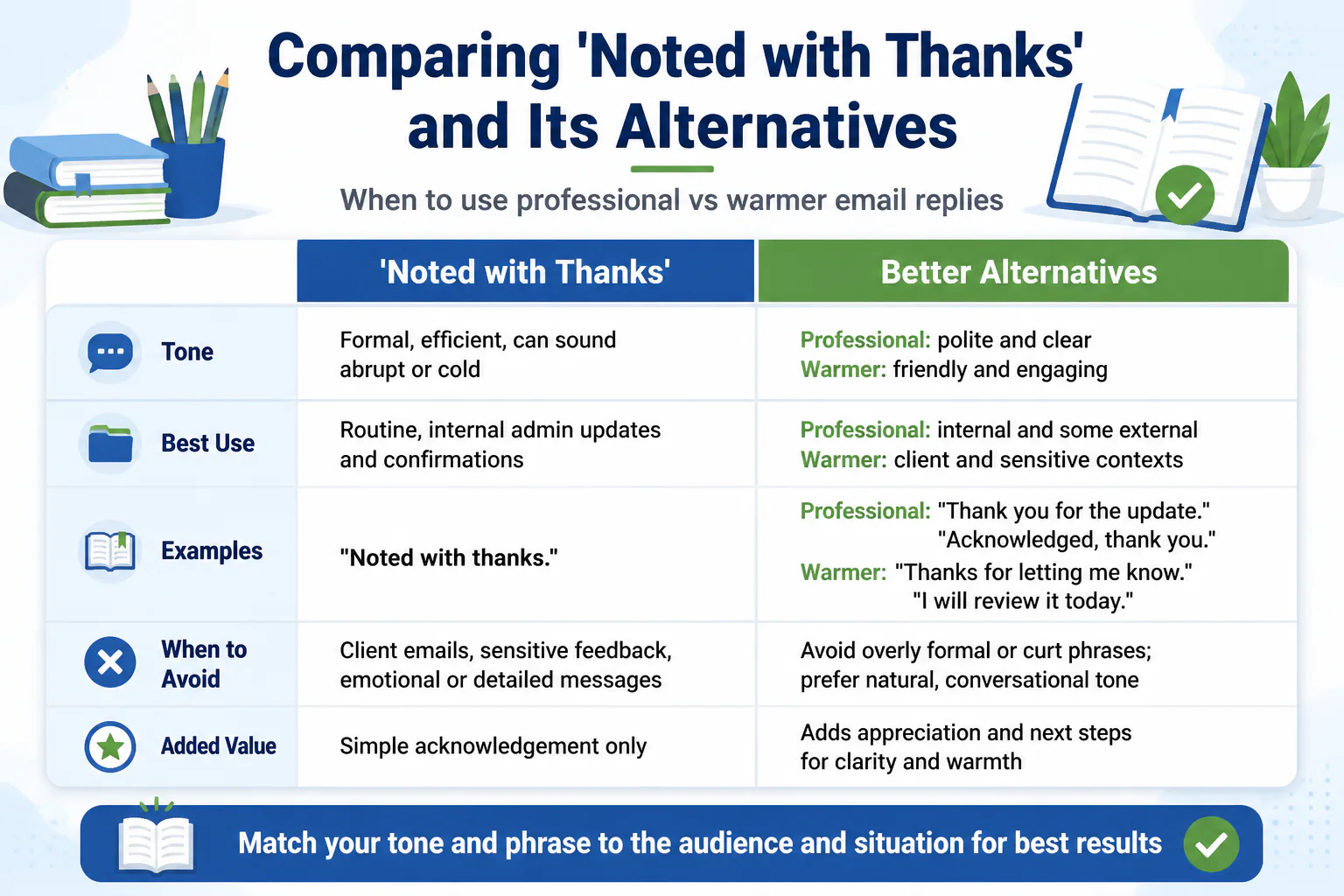
The tone is generally formal, efficient, and restrained. That can be helpful in busy workplace communication, but it can also sound abrupt if the situation calls for warmth or tact.
Western readers, in particular, often read the phrase as cold or dismissive in sensitive exchanges. A senior colleague or client may prefer a response that sounds more conversational and appreciative.
When to avoid it
Avoid using it in emotionally nuanced situations. If someone has raised a problem, offered detailed feedback, or shared bad news, a one-line acknowledgement can seem careless even if that was not your intention.
The same applies to client-facing communication and senior-level emails. In those settings, phrases like thanks for letting me know often sound more natural and attentive.
| Situation | Use it? | Better approach |
|---|---|---|
| Internal admin update | Yes | Keep it brief |
| File or schedule confirmation | Yes | Add next step if needed |
| Client email | No | Use a warmer reply |
| Sensitive feedback | No | Acknowledge thoughtfully |
| Bad news or concern | No | Respond with empathy |
Alternatives to ‘Noted with Thanks’
Professional options
- Thank you for the update.
- Acknowledged, thank you.
- Received with thanks.
- Thanks for sharing this.
- Thank you. I have noted this.
Warmer options
- Thank you for the update. I will review it today.
- Thanks for letting me know. I will take care of it.
- Got it, thanks.
- Thank you. I understand and will follow up shortly.
- Thanks, I have received this and will proceed.
How to choose the right one
- Use a short reply for routine internal messages.
- Add a next step if the sender needs reassurance.
- Choose a warmer phrase for clients, senior staff, or delicate situations.
- Use plain, natural wording if the exchange is conversational.
Common Mistakes and How to Avoid Them
Using it in the wrong situation
The biggest mistake is using the phrase where more care is expected. A bare acknowledgement can seem dismissive if the original message contains feedback, concern, or emotional weight. Match your tone to the situation, not just the information.
Sounding too abrupt
Another common issue is sending only “Noted with thanks” when a fuller reply would help. If the sender needs confidence that you will act, say what you will do next. One extra sentence can make the message sound much more professional.
Overusing formal shorthand
Some writers rely on stock phrases so often that their emails begin to sound impersonal. Mix in natural alternatives, especially when writing outside purely administrative contexts. Clear acknowledgement matters, but so does human tone.
Forgetting the audience
A phrase that feels normal in one workplace may feel curt in another. Consider culture, hierarchy, and relationship. If you are unsure, choose the warmer option.
FAQs
Is “noted with thanks” polite?
Yes, it is polite in many routine written exchanges. The problem is not politeness but tone, because it can feel formal or abrupt in the wrong context.
Is “noted with thanks” correct English?
It is widely understood and commonly used in email, even though some people find it slightly awkward in form. Writing “Noted, with thanks” can make the meaning a little clearer.
Can I use “noted with thanks” in client emails?
It is better to avoid it in most client-facing messages. A warmer reply with appreciation and a next step usually sounds more professional.
What is better than “noted with thanks”?
Better options include “Thank you for the update,” “Acknowledged, thank you,” and “Thanks for sharing this.” If action is needed, add your next step.
Conclusion
“Noted with thanks” works best for brief, routine acknowledgements, but the right choice depends on your audience and the tone the situation requires.