
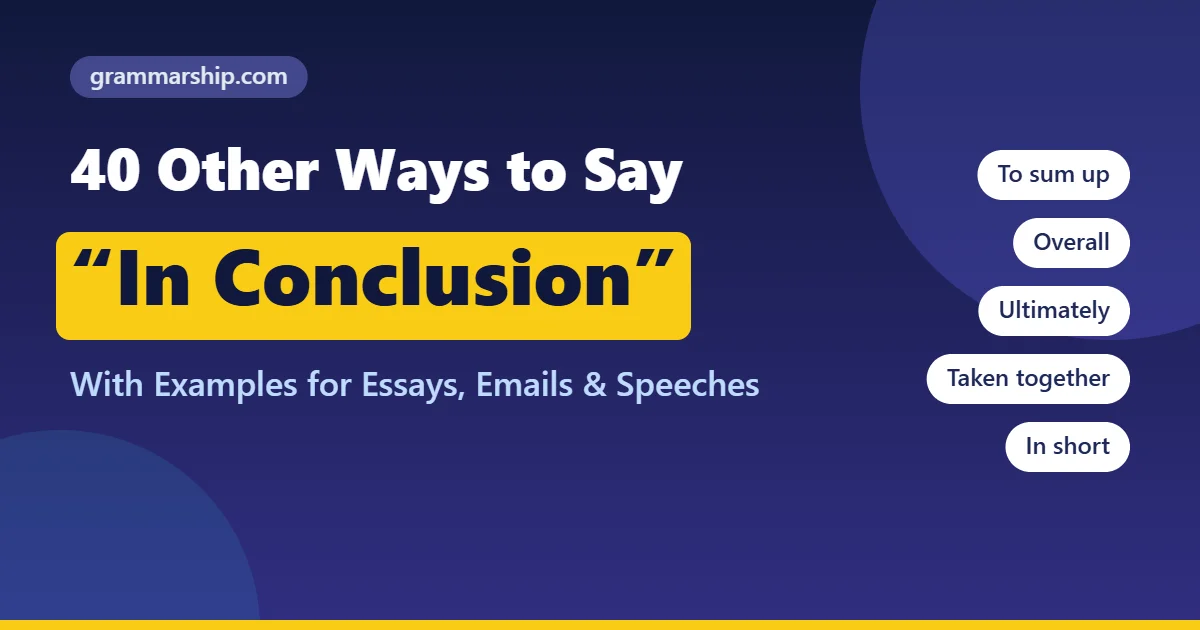
40 Other Ways to Say “In Conclusion” (With Examples)
You have written a strong essay with clear points and solid evidence. Then you reach the last paragraph and type the same two words as everyone else: “In conclusion.” It works, but it makes a good piece of writing sound like every other paper on the teacher’s desk. Luckily, there are many other ways to say in conclusion that sound fresher and more confident.
If you are looking for other ways to say “in conclusion”, this guide gives you 40 of them. They are grouped by situation, from essays and research papers to emails, speeches, and casual blog posts. Each one comes with its tone and a real example, so you can choose the right phrase in seconds.
Quick Answer: Best Alternatives to “In Conclusion”
Short on time? These six alternatives work in almost any situation and are safe to use today:
- To sum up – neutral and works almost anywhere
- Overall – short, smooth, and natural
- Ultimately – strong and confident
- All things considered – balanced and thoughtful
- Taken together – ideal for research and data
- In short – quick and direct
“In Conclusion” Synonyms: One-Word Options
Sometimes a single word is all you need to signal the ending. The table below lists the most useful one-word synonyms for “in conclusion” and explains when each one fits best.
| Word | Best For | Quick Note |
|---|---|---|
| Overall | Essays, reports | The most natural all-round choice |
| Ultimately | Persuasive writing | Adds weight to your final point |
| Finally | Lists, speeches | Use only for the last item in a series |
| Lastly | Lists, instructions | Like “finally,” a bit more informal |
| Therefore | Logical arguments | Means “as a result,” not just “to end” |
| Thus | Academic writing | Formal; common in science |
| Hence | Very formal writing | Can sound old-fashioned |
| Altogether | General writing | Means “taking everything into account” |
| Clearly | Strong arguments | Only when your evidence is convincing |
| Briefly | Short summaries | Signals a quick recap |
Tip: “Therefore,” “thus,” and “hence” show cause and effect, so they are not exact synonyms for “in conclusion.” Use them only when your final sentence truly follows from the points you made before it.
Why Look for Other Ways to Say In Conclusion?
“In conclusion” is grammatically correct, and nothing is wrong with it on its own. The real problem is that it is heavily overused, especially in student essays. When a reader sees it for the hundredth time, your ending starts to feel mechanical.
In a short essay, readers can already see that they have reached the final paragraph, so announcing it adds little. That does not mean you must ban the phrase completely. It still works well in long reports and formal speeches, where listeners need a clear signal. You simply need better options ready for everything else.
Did You Know?
The word “conclusion” comes from the Latin concludere, which means “to shut up closely” (you can see the full history in the Merriam-Webster entry for conclusion). In other words, your final paragraph literally “closes” your argument. Keeping that image in mind is a helpful way to remember what a conclusion should actually do.
Formal Ways to Say “In Conclusion” in an Essay
These phrases suit school and college essays. They sound confident and academic without feeling stiff or repetitive.
1. To Sum Up
Tone: Neutral. This is the closest everyday replacement for “in conclusion.” It tells readers a brief recap of your main points is coming, and it fits almost any type of writing.
Example: To sum up, regular exercise improves both physical and mental health.
2. Overall
Tone: Neutral. “Overall” is short, smooth, and very natural. It helps you move from the details of your essay to the big picture in a single word.
Example: Overall, the evidence shows the policy reduced traffic accidents.
3. Ultimately
Tone: Confident. Use “ultimately” when your final sentence needs extra weight. It suggests “when everything is said and done” and works especially well in persuasive essays.
Example: Ultimately, a school’s success depends on the quality of its teachers.
4. All Things Considered
Tone: Balanced. This phrase is perfect for argumentative essays where you discussed both sides. It shows the reader that you weighed every point fairly before reaching your decision.
Example: All things considered, online learning offers more benefits than drawbacks.
5. In Summary
Tone: Formal. “In summary” is a slightly more formal version of “to sum up.” You will see it often in lab reports, academic papers, and textbooks.
Example: In summary, the experiment confirmed that temperature affects reaction speed.
6. Given These Points
Tone: Logical. This phrase links your ending directly to the arguments you already made. It reminds readers that your conclusion is built on evidence, not just opinion.
Example: Given these points, the city clearly needs better public transport.
7. As Has Been Shown
Tone: Academic. Use this to remind readers that you have already proven your point in the body of the essay. It sounds scholarly without being difficult to understand.
Example: As has been shown, social media can shape voting behavior in subtle ways.
8. As Has Been Demonstrated
Tone: Very formal. This is a stronger cousin of “as has been shown.” It works best when your essay relied on data, experiments, or detailed case studies.
Example: As has been demonstrated, the new method cuts production costs by 20%.
9. On the Whole
Tone: Neutral. “On the whole” introduces a general judgment, much like “overall.” It is especially common in British English and sounds calm and measured.
Example: On the whole, the novel offers a hopeful view of human nature.
10. In the Final Analysis
Tone: Serious. This phrase suggests careful, deep thinking. Save it for longer essays on serious topics, because it can feel too heavy in short or casual writing.
Example: In the final analysis, lasting peace depends on trust between nations.
11. Clearly
Tone: Assertive. “Clearly” is powerful when your evidence is strong and convincing. If your argument is still open to debate, however, it can make you sound overconfident.
Example: Clearly, early reading habits shape a child’s academic future.
12. In Brief
Tone: Formal and concise. “In brief” promises a short, focused summary. It is a good formal replacement for casual phrases like “in a nutshell.”
Example: In brief, the plan is affordable, simple, and effective.
Ways to Say “In Conclusion” in a Research Paper
Research writing needs phrases that sound precise and objective. These options keep the focus on your data and findings.
13. Taken Together
Tone: Academic. This phrase is very common in scientific papers. It means “when we look at all of these results as a group,” which makes it ideal after presenting several findings.
Example: Taken together, these findings suggest that sleep quality affects memory.
14. These Findings Indicate That
Tone: Objective. This phrase puts the spotlight on your data instead of on you as the writer. That makes it a natural fit for research papers and formal reports.
Example: These findings indicate that customer satisfaction rose after the redesign.
15. Based on the Evidence
Tone: Objective. Use this when you want to show that your conclusion rests firmly on facts. It is especially useful in reports that make recommendations.
Example: Based on the evidence, the treatment appears both safe and effective.
16. In Light of This
Tone: Formal. “In light of this” connects your findings to a next step. It works well when your conclusion leads directly to a recommendation or decision.
Example: In light of this, we recommend extending the trial by six months.
17. To Conclude
Tone: Formal and direct. “To conclude” means almost the same thing as “in conclusion.” Because it is used less often, it feels slightly fresher in reports and speeches.
Example: To conclude, the project met all of its main goals on time.
18. In Essence
Tone: Reflective. Use “in essence” to capture the core idea of your whole paper in one statement. It helps readers remember your main message.
Example: In essence, climate change is as much an economic issue as an environmental one.
Professional Ways to Say “In Conclusion” in Emails and Presentations
At work, you want to sound clear and professional without sounding robotic. These phrases help you close emails, meetings, and slides with confidence.
19. To Recap
Tone: Professional and friendly. “To recap” is ideal for repeating the key points at the end of a meeting or email. It helps everyone leave with the same understanding.
Example: To recap, the budget is due Friday and the client call is on Monday.
20. To Review
Tone: Professional. This phrase walks your audience back through your main points step by step. It is especially useful in training sessions and tutorials.
Example: To review, there are three simple steps to filing a request.
21. In Short
Tone: Direct. Busy readers appreciate “in short” because it promises a quick takeaway. It is perfect when you need to summarize a long update in one line.
Example: In short, the launch was a success and sales are ahead of target.
22. The Bottom Line Is
Tone: Business-like. Use this to highlight the single most important point of your message. It sounds decisive and works well in management updates.
Example: The bottom line is that we cannot afford another delay.
23. Moving Forward
Tone: Action-focused. “Moving forward” closes the current discussion and turns attention to next steps. It is a natural way to end a planning email or meeting.
Example: Moving forward, each team will send a short weekly update.
24. Key Takeaways
Tone: Modern. This phrase works well as the title of your final slide or before a short bullet list. It tells the audience exactly what they should remember.
Example: Here are the key takeaways from today’s session.
25. With All This in Mind
Tone: Polite. “With all this in mind” connects your summary to a request or decision. It sounds thoughtful and respectful, which makes it great for proposals.
Example: With all this in mind, I suggest we delay the release until June.
26. To Wrap Up
Tone: Friendly and semi-formal. “To wrap up” is a relaxed way to end a meeting, webinar, or long email. It feels warm without losing its professional tone.
Example: To wrap up, thanks again for your quick and helpful feedback.
Ways to Say “In Conclusion” in a Speech
Listeners cannot scroll back to check where you are. These phrases give your audience a clear signal that your speech is coming to an end.
27. In Closing
Tone: Somewhat formal. “In closing” is a classic choice for speeches. It often leads into a call to action or a final message for the audience.
Example: In closing, I urge everyone here to vote this Tuesday.
28. On a Final Note
Tone: Warm and formal. This phrase is perfect for introducing thank-yous or a last important message. It sounds polished in both speeches and formal letters.
Example: On a final note, thank you to our amazing volunteers.
29. As I Close
Tone: Personal. “As I close” feels warm and sincere. It is a great fit for graduation speeches, wedding toasts, and award ceremonies.
Example: As I close, I want to thank every parent who supported us this year.
30. Let Me Leave You With This
Tone: Engaging. This phrase prepares your audience for a memorable final thought. Follow it with a strong quote, lesson, or challenge.
Example: Let me leave you with this: small daily habits create big results.
31. Before I Finish
Tone: Conversational. “Before I finish” signals the end without sounding stiff. It works well when you want to add one last story or point.
Example: Before I finish, I’d like to share one last story.
32. Finally
Tone: Neutral. “Finally” works best when you have been building a list of points and this is the last one. Avoid it if you have not been counting through ideas.
Example: Finally, remember that every expert was once a beginner.
33. Lastly
Tone: Neutral, slightly informal. “Lastly” works just like “finally” for the last item in a sequence. It is common in instructions and short presentations.
Example: Lastly, don’t forget to back up all of your files.
Casual Other Ways to Say In Conclusion
For blogs, social media posts, and friendly writing, a lighter tone feels more natural. Keep these phrases out of formal essays.
34. All in All
Tone: Friendly. “All in all” sums things up in a relaxed, upbeat way. It is perfect for reviews, travel posts, and personal stories.
Example: All in all, it was a great trip despite the rain.
35. In a Nutshell
Tone: Informal. This phrase means “in very few words.” It is fun and clear, but you should avoid it in serious academic writing.
Example: In a nutshell, the movie is fun but a little too long.
36. Long Story Short
Tone: Very casual. “Long story short” is great in conversation and personal blogs. It sometimes adds a humorous touch, but never use it in an academic essay.
Example: Long story short, we missed the train but found a great café.
37. At the End of the Day
Tone: Informal. This common spoken phrase means “when everything is considered.” It sounds natural in conversation but too casual for formal papers.
Example: At the end of the day, what matters is that everyone got home safely.
38. When All Is Said and Done
Tone: Informal and reflective. This phrase looks back on everything before giving a final thought. It works well in personal essays and opinion posts.
Example: When all is said and done, family matters most.
39. To Put It Simply
Tone: Friendly and clear. Use this right after explaining something complicated. It helps readers grab the main idea without the technical details.
Example: To put it simply, always spend less than you earn.
40. So There You Have It
Tone: Casual, blog-style. This is a friendly way to end a how-to post or tutorial. It feels like you are talking directly to your reader.
Example: So there you have it: five easy ways to save on groceries.
Bonus: End With a Question Instead
You do not always need a transition phrase. A thoughtful question can end an essay powerfully, because it leaves readers thinking about your topic after they finish reading. This works especially well in persuasive and opinion essays.
Example: If we can protect our forests today, why are we still waiting?
Conclusion Words and Phrases: Quick Reference List
Save this list of other words for “in conclusion” for your next assignment, email, or speech.
- Essays: to sum up, overall, ultimately, all things considered, in summary, given these points, as has been shown, as has been demonstrated, on the whole, in the final analysis, clearly, in brief
- Research: taken together, these findings indicate, based on the evidence, in light of this, to conclude, in essence
- Work: to recap, to review, in short, the bottom line is, moving forward, key takeaways, with all this in mind, to wrap up
- Speeches: in closing, on a final note, as I close, let me leave you with this, before I finish, finally, lastly
- Casual: all in all, in a nutshell, long story short, at the end of the day, when all is said and done, to put it simply, so there you have it
Which Alternative Should You Use?
Still not sure which phrase fits? Use this table to match the alternative to your situation.
| Situation | Best Choices | Avoid |
|---|---|---|
| School essay | Overall, Ultimately, To sum up | Long story short, In a nutshell |
| Research paper | Taken together, In summary | At the end of the day |
| Business email | To recap, In short, Moving forward | In the final analysis |
| Presentation | Key takeaways, To review | As has been demonstrated |
| Speech | In closing, On a final note | These findings indicate |
| Blog post | All in all, So there you have it | Hence, Thus |
How to Write a Strong Conclusion (4 Simple Steps)
The best conclusions often need no transition phrase at all. Their content alone shows the reader that the piece is ending. Follow these four steps:
- Restate your main idea in new words. Don’t copy your thesis sentence word for word.
- Connect your key points. Show how they fit together instead of listing them again.
- Answer “so what?” Explain why your argument matters to the reader.
- End with a strong final line. Try a recommendation, a prediction, or a question.
Before and After Example
Before: In conclusion, homework is bad because it causes stress, takes time, and is not useful.
After: Homework was meant to build learning, yet for many students it now replaces rest with stress. Schools should assign less, but make every task count.
Notice that the second version never says “in conclusion,” yet the reader still knows the essay is ending. It also gives a clear recommendation, which makes the ending far more memorable.
Sample Conclusion Paragraphs
Seeing a phrase inside a full paragraph makes it much easier to use in your own writing. Here are three short examples.
Argumentative Essay
All things considered, a four-day school week offers more than it takes away. Students get more time to rest, and teachers gain extra planning time. The childcare concerns are real, but community programs can solve them.
Research Paper
Taken together, these results show that short daily study sessions improve memory more than one long session. The pattern held across all age groups. Future studies should test whether the same effect appears in online courses.
Business Email
To recap, the new design is approved and development starts on Monday. Moving forward, I will share a short update every Friday. Please let me know if anything is unclear.
Common Mistakes to Avoid
- Using “in conclusion” in a very short essay. Readers already know they have reached the end.
- Adding new arguments. A conclusion wraps things up; it should not start a new topic.
- Stacking transitions. “In conclusion, to sum up, overall” is too much. One signal is enough.
- Mixing tones. Don’t use “long story short” in a formal report or “hence” in a text message.
- Apologizing. Phrases like “this is just my opinion” weaken an otherwise strong ending.
Practice: Pick the Best Phrase
Test yourself by choosing the best alternative for each situation. The answers are below.
- Ending a lab report about plant growth
- Closing a weekly team meeting
- Finishing an essay that argued both sides
- Ending a funny travel blog post
- Closing a graduation speech
Answers: 1. Taken together · 2. To recap · 3. All things considered · 4. All in all · 5. As I close
Frequently Asked Questions
What is another word for “in conclusion”?
Good single-word options are overall, ultimately, finally, and lastly. Popular short phrases include to sum up, in summary, and in short.
What are good conclusion words for an essay?
Try overall, ultimately, to sum up, or all things considered. They sound academic but feel much fresher than “in conclusion.”
Is it wrong to start a conclusion with “In conclusion”?
No, it is grammatically correct. However, many teachers consider it overused in short essays, so a fresher phrase usually reads better.
What can I say instead of “in conclusion” in a speech?
In closing, on a final note, and let me leave you with this all sound natural when spoken aloud. They also help your audience prepare for your final message.
Is “to conclude” better than “in conclusion”?
Both phrases mean the same thing and have a similar formal tone. “To conclude” is used a little less often, so it can feel slightly fresher.
Is “in a nutshell” formal?
No, “in a nutshell” is informal. Keep it for blogs and conversation, and use “in brief” in essays instead.
How do I end an essay without saying “in conclusion”?
Restate your thesis in new words, connect your main points, and explain why they matter. Then finish with a strong final line, such as a recommendation or a question.
Final Thoughts
“In conclusion” isn’t wrong, but it is rarely the most interesting choice. For essays, try overall or ultimately. For research, use taken together, and at work, to recap keeps things crisp.
Best of all, let your final paragraph do the work itself. When your ending restates your idea and shows why it matters, readers will feel the conclusion instead of just being told about it.
Want more phrases like these? Read our guides to other ways to say “thank you” and affect vs effect.
More Guides to Improve Your Writing

Related Posts
35 Other Ways to Say “However” (With Examples)

35 Other Ways to Say “You’re Welcome” (With Examples)
2 thoughts on “40 Other Ways to Say “In Conclusion” (With Examples)”