Quick Learner Synonym: Better Words to Use
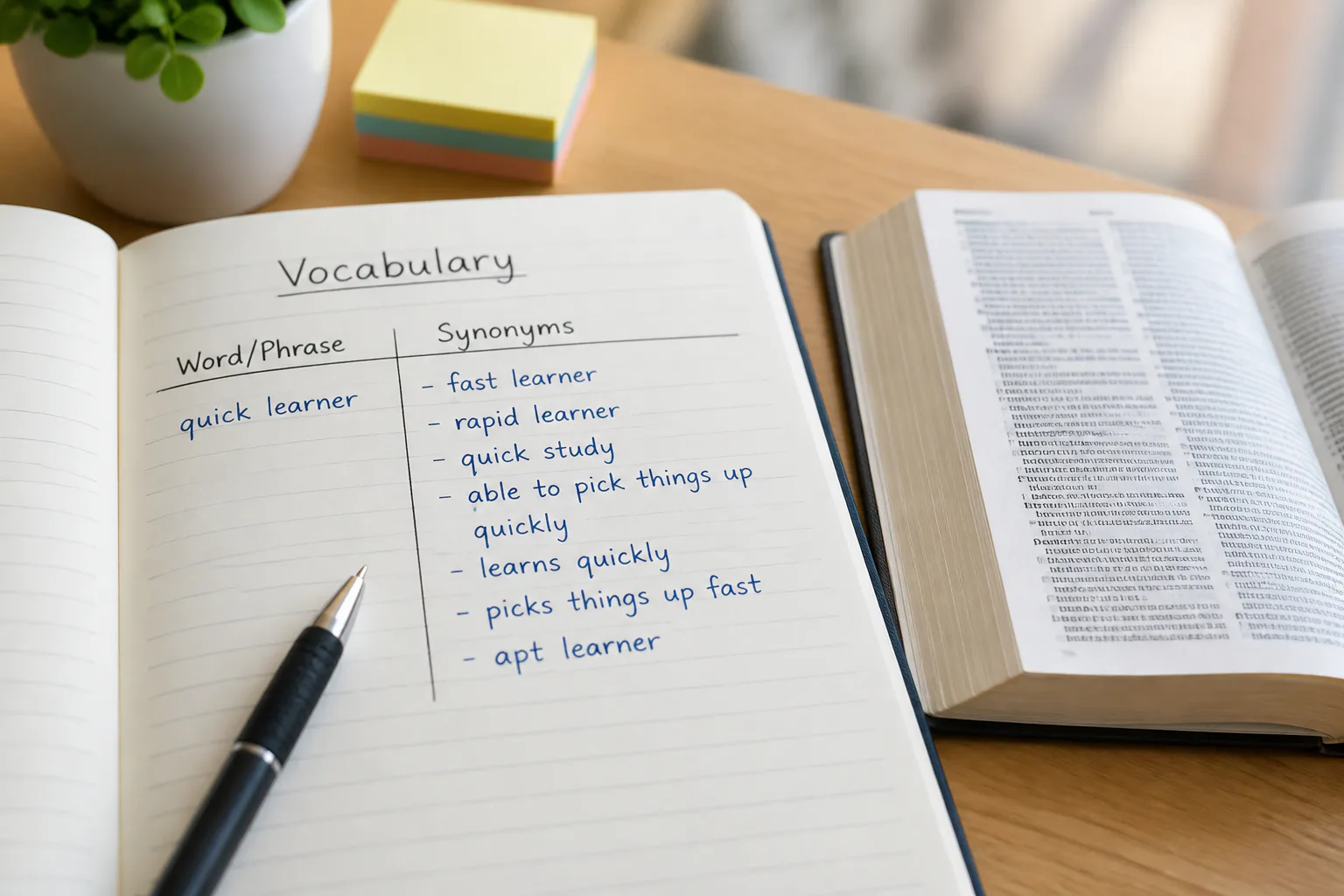
A quick learner is someone who understands new information, skills, or processes in a short amount of time and can apply them effectively. If you are looking for a better quick learner synonym, the best choice depends on context: professional settings often favor words like adaptable, fast learner, or quick study, while academic or descriptive writing may use phrases like picks things up quickly or grasps concepts easily. Choosing the right alternative helps your writing sound more precise, polished, and natural.
What Does ‘Quick Learner’ Mean?
Core meaning
The phrase “quick learner” describes a person who can absorb knowledge, understand instructions, and develop competence faster than average. It is commonly used in resumes, job interviews, school evaluations, and recommendation letters. The idea is not just speed alone, but speed combined with understanding and practical use.
In professional contexts, calling someone a quick learner suggests they need less training, adapt well to new systems, and can handle changing responsibilities. In educational settings, it often means a student understands lessons rapidly and transfers that understanding to new tasks. In everyday speech, it can simply mean someone catches on fast.
Best direct substitutes
Some alternatives are close replacements, while others shift the tone slightly. A hiring manager, teacher, or colleague may hear each one differently, so word choice matters.
- Fast learner – the simplest and most direct alternative
- Quick study – polished and common in business English
- Adaptable – emphasizes learning through adjustment
- Apt – highlights natural ability to learn
- Receptive – suggests openness to new ideas or instruction
- Bright – informal and broad, often linked to intelligence
- Sharp – informal, confident, and conversational
- Capable – less direct, but useful when learning leads to performance
When each works best
Fast learner works well in resumes and cover letters because it is plain and familiar. Quick study sounds slightly more polished and often fits recommendations or interview feedback. Adaptable is stronger when you want to stress how someone responds to change rather than only how quickly they learn.
Words like bright and sharp are more informal, so they fit casual conversation better than formal application materials. If you are refining broader workplace language, phrases such as looking forward to working with you show the same need for tone awareness that applies when choosing between “quick learner” and a more specific synonym.
Sometimes a phrase works better than a single word because it sounds more natural. For example, “she picks up new software quickly” often feels more credible than simply saying “she is a quick learner.” Specific phrasing can also make your claim easier to prove.
Top Synonyms for Quick Learner
Most useful options
- Fast learner – best all-purpose substitute
- Quick study – ideal for professional writing
- Adaptable – strong for changing roles or environments
- Apt – concise and skill-focused
- Receptive – best when learning from guidance matters
- Sharp – conversational and confident
- Bright – informal and broad
- Trainable – practical, though less elegant
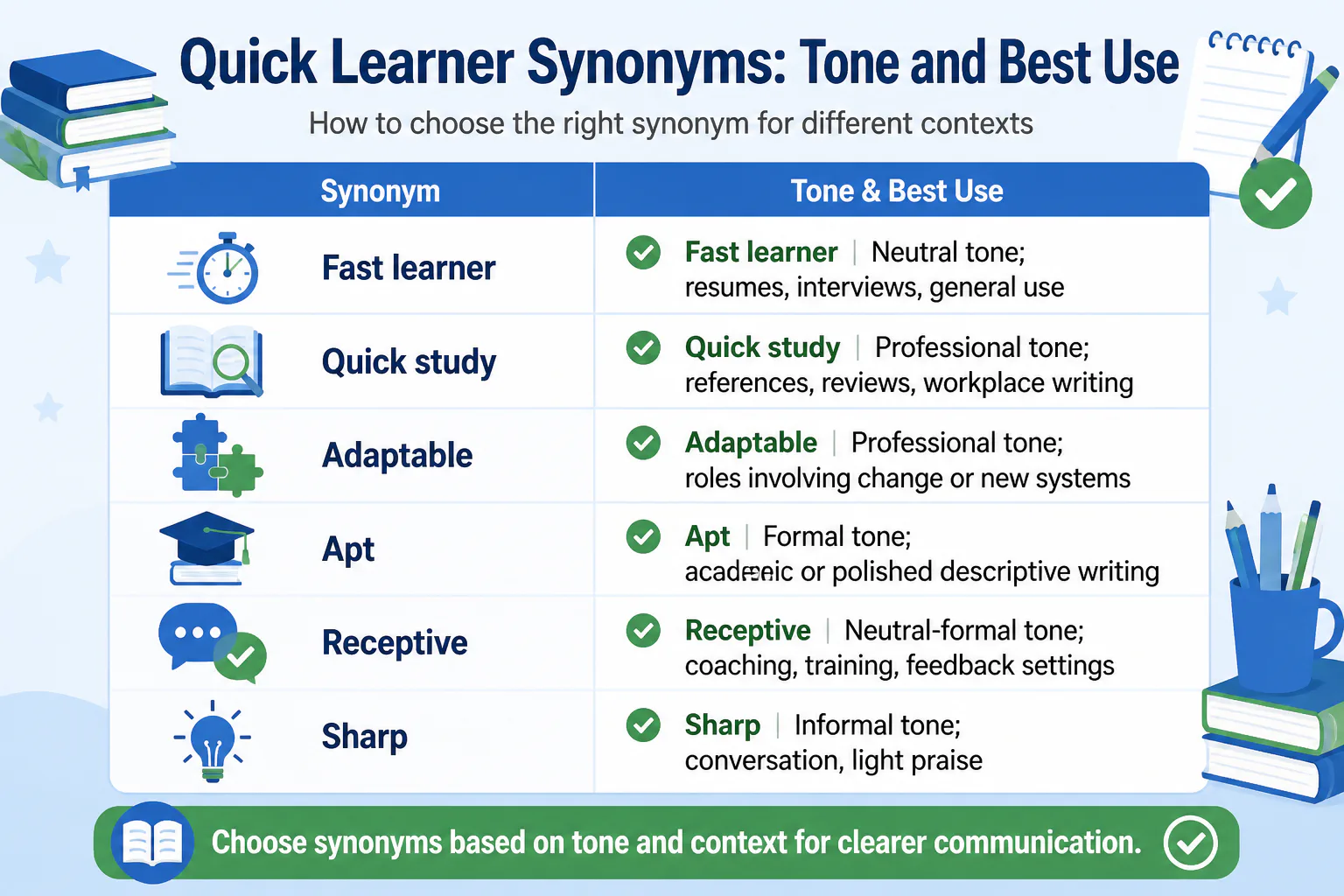
Comparison table
| Synonym | Tone | Best use |
|---|---|---|
| Fast learner | Neutral | Resumes, interviews, general use |
| Quick study | Professional | References, reviews, workplace writing |
| Adaptable | Professional | Roles involving change or new systems |
| Apt | Formal | Academic or polished descriptive writing |
| Receptive | Neutral-formal | Coaching, training, feedback settings |
| Sharp | Informal | Conversation, light praise |
| Bright | Informal | General compliments, school contexts |
| Trainable | Practical | Hands-on work and skill development |
If you want a phrase that sounds strong without feeling exaggerated, “quick study” is often the safest upgrade. It sounds natural, confident, and professional. By contrast, “bright” describes general intelligence, so it does not always prove someone learns specific tasks quickly.
Alternative Phrases
Resume-friendly phrases
- Picks up new skills quickly
- Grasps new concepts easily
- Learns new systems rapidly
- Adapts quickly to new processes
- Becomes proficient in a short time
Natural everyday expressions
- Catches on fast
- Gets up to speed quickly
- Has a knack for learning
- Takes to new tasks easily
- Learns on the fly
These phrases are useful because they can sound more believable than a label alone. “Gets up to speed quickly” is especially strong in workplace communication because it connects learning with performance. In the same way that praise can be phrased in several tones, options like keep up the good work show how small wording changes can make language sound more formal, warmer, or more direct.
For applications and professional profiles, specific phrasing often beats a vague claim. “She learned the reporting system within a week” is stronger than “she is a quick learner” because it gives a concrete result. If you still want a compact phrase, pair it with evidence.
Using Synonyms Appropriately
Formal settings
In resumes, cover letters, and recommendation letters, use words that sound credible and measured. Fast learner, quick study, and adaptable are usually the strongest choices. They are clear, widely understood, and unlikely to sound inflated.
Academic settings
In school or training environments, phrases like “grasps concepts easily” or “picks up new methods quickly” work well because they focus on understanding. Teachers and mentors often prefer descriptive language over labels. That makes the praise feel more specific and useful.
Informal settings
In conversation, “sharp,” “bright,” or “catches on fast” can sound more natural than “quick learner.” These choices are friendly and easy to understand, but they can feel too casual for formal writing. Tone matters just as much as meaning.
If you are expanding your vocabulary for common expressions, exploring another phrase set such as let me know synonym can help you notice how context changes word choice. The same principle applies here: the best synonym is the one that fits your audience, purpose, and level of formality.
FAQs
What is the best synonym for quick learner?
The best all-purpose synonym is “fast learner.” For a more polished tone, “quick study” is often the better choice.
Is quick learner professional language?
Yes, but it can sound generic if used alone. In professional writing, it is stronger when paired with proof, such as a skill learned quickly or a system mastered in a short time.
What can I say instead of quick learner on a resume?
You can use “fast learner,” “quick study,” “adaptable,” or phrases like “picks up new systems quickly.” Choose wording that matches the job and, if possible, add a specific example.
Is adaptable the same as quick learner?
Not exactly. “Adaptable” emphasizes adjusting well to change, while “quick learner” focuses more directly on absorbing and applying new knowledge.
Conclusion
If you want a stronger quick learner synonym, start with “fast learner,” “quick study,” or “adaptable,” then choose a phrase that fits your audience. The best alternatives do more than replace words; they make your meaning clearer, more specific, and more professional.

Related Posts

Best Fast Learner Synonyms for Resumes and Reviews

30 Ways to Say Bro: Casual Slang and Nicknames