

Rest in Peace Other Term: Respectful Alternatives Explained
If you are looking for a rest in peace other term, there are many respectful options you can use in condolence messages, memorial posts, and sympathy cards. The best choice depends on tone, relationship, and cultural context. Some alternatives are gentle and universal, while others carry religious, spiritual, or poetic meaning.
People often want wording that feels sincere without sounding repetitive. A phrase that comforts one family may feel too formal, too religious, or too distant for another. That is why it helps to understand not just the meaning of each expression, but also when it is appropriate to use it.
Meaning and Origin of ‘Rest in Peace’
“Rest in peace” is a traditional expression used after someone has died. It comes from the Latin phrase requiescat in pace, often shortened as RIP. In English, it expresses the hope that the deceased has found peace after death, and it has long appeared on gravestones, funeral programs, and sympathy messages.
Today, the phrase is widely understood even outside religious settings. Still, not everyone wants to use it. Some people prefer language that sounds more personal, less formulaic, or more suitable for a specific culture or belief system. That is where alternatives become useful.
What the phrase conveys
At its core, “rest in peace” communicates respect, remembrance, and a wish for calm after death. It is brief, familiar, and solemn. Because it is so common, it works well in public condolences, but it can also feel generic in a deeply personal message.
- It expresses a wish for peace after death.
- It signals sympathy and respect.
- It fits formal memorial language.
- It is recognized across many English-speaking communities.
Why people look for alternatives
Many writers want words that better match the situation. A public tribute may call for dignified wording, while a message to a close friend may need something warmer and more personal. Some alternatives also avoid specific religious wording, which can matter in interfaith or secular settings.
In memorial writing, tone matters as much as meaning. Phrases such as “forever remembered” or “gone but never forgotten” focus less on rest and more on memory. If you want more beautiful ways to say rest in peace, softer wording often works better in personal tributes than a fixed formula.
How alternatives differ in tone
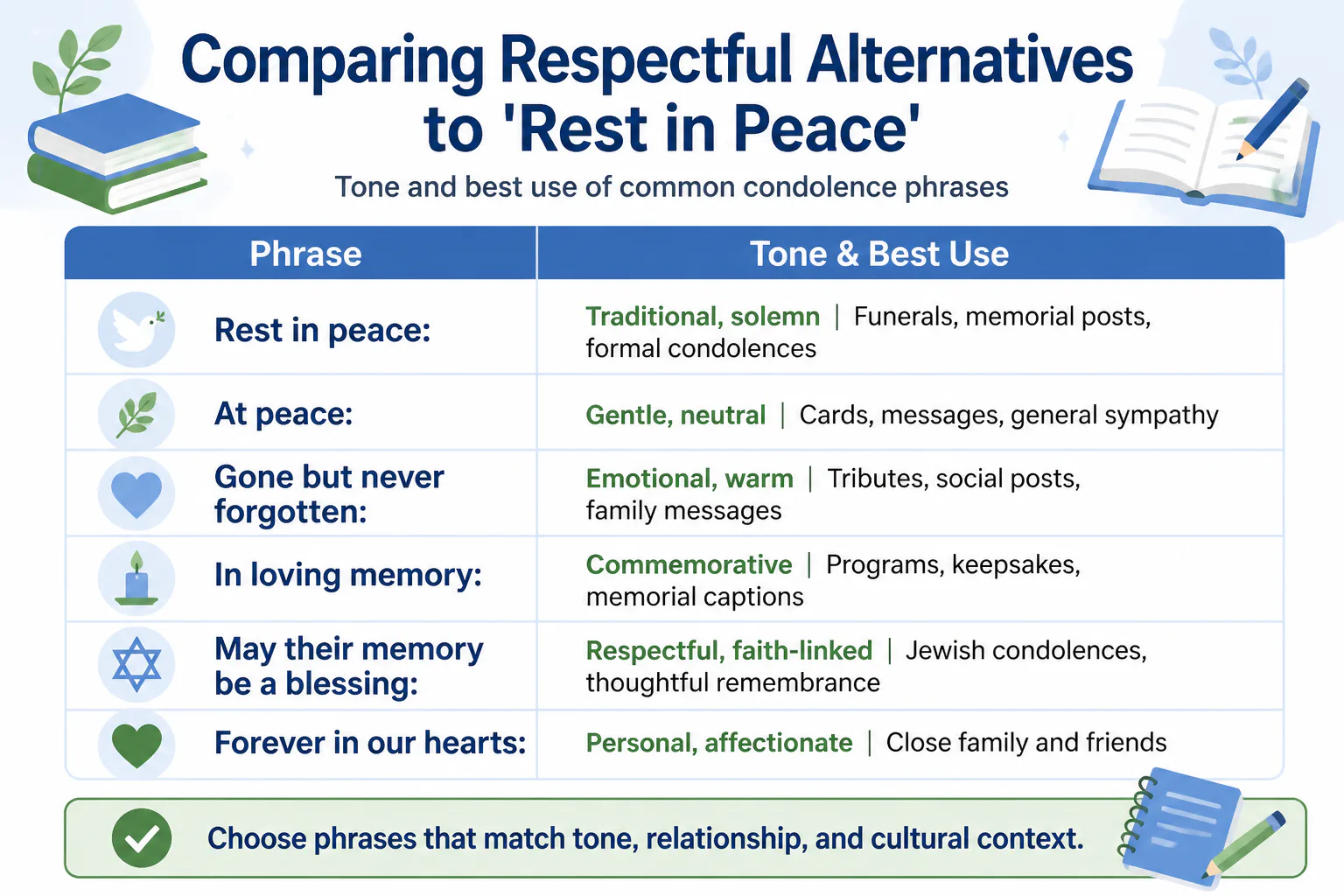
Not every substitute means exactly the same thing. Some phrases are spiritual, some are poetic, and some focus on the living rather than the deceased. For example, “at peace” is calm and simple, while “in loving memory” is more about remembrance than rest.
| Phrase | Main tone | Best use |
|---|---|---|
| Rest in peace | Traditional, solemn | Funerals, memorial posts, formal condolences |
| At peace | Gentle, neutral | Cards, messages, general sympathy |
| Gone but never forgotten | Emotional, warm | Tributes, social posts, family messages |
| In loving memory | Commemorative | Programs, keepsakes, memorial captions |
| May their memory be a blessing | Respectful, faith-linked | Jewish condolences, thoughtful remembrance |
| Forever in our hearts | Personal, affectionate | Close family and friends |
Usage notes to remember
Choose a phrase that matches both the relationship and the audience. Public messages usually benefit from simple, widely understood wording. Private messages allow more warmth, shared memories, or language that reflects the beliefs of the grieving family.
- Use neutral wording if you do not know the family’s beliefs.
- Use warmer phrases for close personal relationships.
- Avoid ornate or archaic expressions unless they fit the family’s style.
- Keep the message sincere and brief rather than overly clever.
Common Alternative Phrases
Widely used options
- At peace – calm, simple, and suitable in many settings.
- Forever remembered – emphasizes lasting memory.
- Gone but never forgotten – warm and emotional.
- In loving memory – common on memorial cards and tributes.
- Forever in our hearts – personal and affectionate.
- May they rest gently – soft and poetic.
Faith-linked or cultural options
- May their memory be a blessing – commonly used in Jewish condolence contexts.
- Returned to God – appropriate only when the family’s beliefs clearly support it.
- Called home – Christian-leaning and comforting for some families.
- Rest in eternal peace – more spiritual and formal than standard RIP.
Alternative expressions appear in many areas of language, and the same care applies when choosing wording for greetings, sympathy, or celebration. That is why style guides often collect other ways to say happy birthday or similar phrases people use in emotionally specific situations.
Using Alternatives with Cultural Sensitivity
Match the family, not yourself
The safest approach is to center the grieving person or family. If they use religious language, you can reflect that gently. If they speak in secular terms, neutral phrases such as “with deepest sympathy,” “in loving memory,” or “forever remembered” are usually more appropriate.
Choose neutral language when unsure
If you do not know the person’s beliefs, avoid assuming them. “At peace,” “gone too soon,” and “forever in our hearts” are often safer than wording tied to a specific doctrine. This is especially important in workplace messages, school communities, and public statements.
Consider medium and formality
A social media tribute can be more expressive than a professional condolence email. A gravestone or funeral program often uses shorter, timeless wording. In contrast, a handwritten note can include a phrase plus a personal memory, which usually feels more meaningful than a stand-alone expression.
Short sympathy phrases work best when they sound natural beside the rest of your message, much like choosing the right wording in everyday expressions such as hope you are doing well depends on tone and context rather than dictionary meaning alone.
Examples of Usage in Condolence Messages
Short message examples
- “She will be forever remembered for her kindness and grace.”
- “Keeping your family in my thoughts as you honor his life in loving memory.”
- “May your mother be at peace, and may you find comfort in the love around you.”
- “Gone but never forgotten, he will remain in the hearts of everyone who knew him.”
More personal examples
- “Your sister brought joy wherever she went. She will be forever in our hearts.”
- “I am so sorry for your loss. May her memory be a blessing to all who loved her.”
- “He lived with warmth and generosity, and he will be lovingly remembered always.”
- “Thinking of you during this difficult time and honoring your father in loving memory.”
How to build your own message
- Start with sympathy: “I am sorry for your loss.”
- Add the remembrance phrase: “She will be forever remembered.”
- If appropriate, include a personal detail: “Her kindness touched so many people.”
This structure keeps the message respectful and clear. It also prevents the memorial phrase from sounding isolated or copied. A few sincere words are usually stronger than elaborate language.
FAQs
What can I say instead of rest in peace?
You can say “at peace,” “forever remembered,” “gone but never forgotten,” or “in loving memory.” The best choice depends on how formal, personal, or faith-specific you want the message to be.
Is rest in peace religious?
It has religious roots, but many people now use it as a general expression of respect after death. Even so, some families prefer nonreligious alternatives.
What is the safest condolence phrase?
If you are unsure about beliefs or preferences, neutral phrases such as “in loving memory” or “forever remembered” are usually appropriate. They express care without making spiritual assumptions.
Can I use a poetic phrase in a sympathy card?
Yes, if it remains clear and sincere. Avoid wording that sounds ornate or old-fashioned unless it matches the family’s style and the setting.
Conclusion
Choosing a rest in peace other term comes down to matching your words to the family, the setting, and the tone you want to convey.

Related Posts

Best Fast Learner Synonyms for Resumes and Reviews

30 Ways to Say Bro: Casual Slang and Nicknames