

30+ Thoughtful Rest in Peace Synonyms for Condolence Messages
If you want a respectful alternative to rest in peace, the best choice depends on where you are writing and how personal, formal, or faith-based the message should be. Good options include in loving memory, gone but never forgotten, forever in our hearts, rest easy, may your soul rest in peace, until we meet again, at peace now, and with deepest sympathy for a condolence message.
Rest in peace, often shortened to RIP, expresses the hope that a person’s spirit has found peace after death. It appears in sympathy cards, obituaries, memorial pages, tribute posts, gravestones, epitaphs, and engravings, but it is not always the most personal or appropriate wording for every situation.
Best alternatives
These are widely accepted rest in peace synonyms and near-equivalents you can use in mourning, remembrance, and bereavement settings. Some are better for private grief, some for public tributes, and some for religious messages.
- In loving memory
- Gone but never forgotten
- Forever in our hearts
- Rest easy
- May your soul rest in peace
- Until we meet again
- At peace now
- Eternal peace
- Eternal rest
- You will be deeply missed
- Always loved
- Forever remembered
- Your memory will live on
- You will always be remembered
- Sleep in heavenly peace
- Rest with the angels
- In God’s care
- May angels watch over you
- At rest
- Peace to your memory
- Rest softly
- May you find eternal peace
- Safe in heaven
- Held in God’s love
- Peace be with you always
- Remembered with love
- Cherished in memory
- Your legacy lives on
- Rest in power
- Never far from our hearts
Choose by context
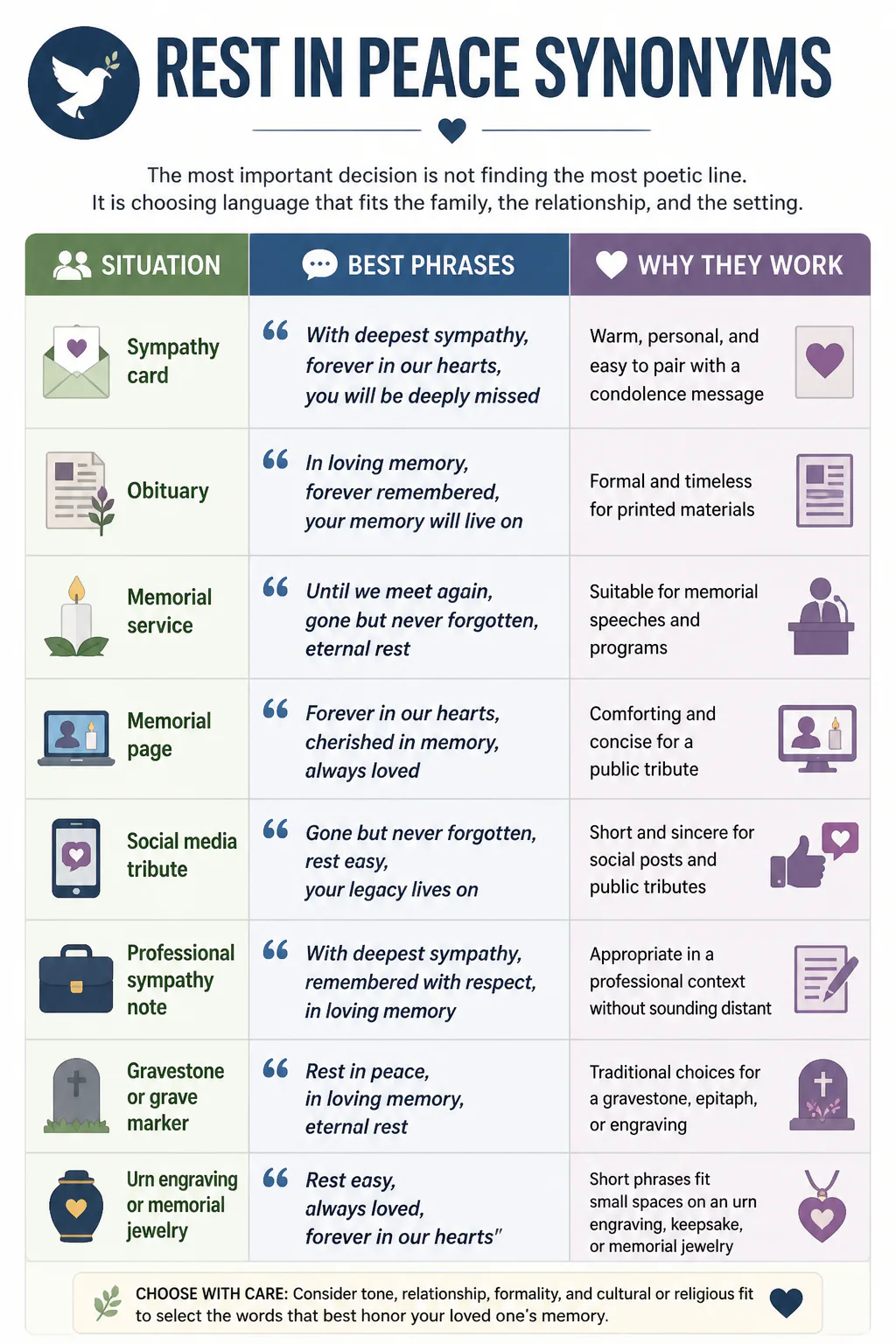
The most important decision is not finding the most poetic line. It is choosing language that fits the family, the relationship, and the setting.
| Situation | Best phrases | Why they work |
|---|---|---|
| Sympathy card | With deepest sympathy, forever in our hearts, you will be deeply missed | Warm, personal, and easy to pair with a condolence message |
| Obituary | In loving memory, forever remembered, your memory will live on | Formal and timeless for printed materials |
| Memorial service | Until we meet again, gone but never forgotten, eternal rest | Suitable for memorial speeches and programs |
| Memorial page | Forever in our hearts, cherished in memory, always loved | Comforting and concise for a public tribute |
| Social media tribute | Gone but never forgotten, rest easy, your legacy lives on | Short and sincere for social posts and public tributes |
| Professional sympathy note | With deepest sympathy, remembered with respect, in loving memory | Appropriate in a professional context without sounding distant |
| Gravestone or grave marker | Rest in peace, in loving memory, eternal rest | Traditional choices for a gravestone, epitaph, or engraving |
| Urn engraving or memorial jewelry | Rest easy, always loved, forever in our hearts | Short phrases fit small spaces on an urn engraving, keepsake, or memorial jewelry |
Traditional phrases
Traditional wording works well when you want a familiar expression that most people will understand immediately. These phrases suit a sympathy card, memorial card, obituary, or engraving without drawing attention to the wording itself.
- Rest in peace
- May your soul rest in peace
- Eternal rest
- Eternal peace
- In loving memory
- Forever remembered
- At rest
Personal phrases
If you knew the dear departed well, a more intimate phrase often feels more sincere than RIP. These choices are common in a private message, family tribute, or note to a grieving friend.
- Forever in our hearts
- Gone but never forgotten
- Always loved
- You will be deeply missed
- Your memory will live on
- Never far from our hearts
- Cherished in memory
Spiritual wording
Faith-based condolences can bring spiritual comfort, but they should match the family’s beliefs. If you do not know whether the grieving family is religious, choose neutral remembrance language instead of mentioning heaven, angels, or God.
- Sleep in heavenly peace
- Rest with the angels
- In God’s care
- May angels watch over you
- Safe in heaven
- Held in God’s love
- May your soul rest in peace
When “at peace now” fits
At peace now is especially appropriate when the person experienced a long illness or visible suffering. It acknowledges the end of pain while staying gentle and dignified.
Use it carefully. If the family has not spoken publicly about suffering, or if the cause of death is private, a more neutral memorial phrase is safer in a public tribute or social media tribute.
Short phrases for engravings
Space matters on an engraving, urn plaque, memorial jewelry piece, or small keepsake. Shorter wording is usually clearer and more elegant than a full sentence.
- RIP
- Rest in peace
- Rest easy
- In loving memory
- Always loved
- Forever in our hearts
- Eternal rest
- At peace
What to write instead of RIP
RIP is common, but it can feel abrupt in a condolence message or sympathy card. Writing out a fuller phrase often sounds warmer, especially for a grief-stricken relative or grieving friend.
Better for a sympathy card
- With deepest sympathy
- In loving memory
- Forever in our hearts
- You will be deeply missed
Better for a public tribute
- Gone but never forgotten
- Your legacy lives on
- Forever remembered
- Rest in power
Better for close family
- Always loved
- Until we meet again
- Your memory will live on
- Never far from our hearts
Examples by format
Sympathy card
“With deepest sympathy for your loss. She will remain forever in our hearts.”
“In loving memory of your father. May your soul rest in peace.”
Condolence message
“I am so sorry for your loss. Your mother will always be remembered with love.”
“Sending you comfort during this time of grief. Gone but never forgotten.”
Obituary
“In loving memory of James Carter, whose legacy, kindness, and devotion to family will never be forgotten.”
“Forever remembered, forever loved, and held close in remembrance.”
Memorial service program
“Until we meet again.”
“Eternal rest grant unto him, and let perpetual peace remain with him.”
Social media tribute
“Rest easy. Your memory will live on in everyone who knew you.”
“Gone but never forgotten. Thank you for the light you brought to so many lives.”
Engraving or epitaph
“Rest in peace.”
“In loving memory.”
“Forever in our hearts.”
How to make it personal
A short phrase becomes more meaningful when you add one personal detail. This works well in a memorial page, obituary, sympathy card, or keepsake inscription.
- Add the person’s name
- Include a date range
- Mention a defining quality such as kindness, courage, or devotion
- Add a brief memory if the setting allows
- Keep public tributes respectful and avoid private details unless the family has already shared them
For example, “In loving memory of Elena, forever in our hearts” feels warmer than a standalone phrase. “Gone but never forgotten, your generosity lives on” also honors legacy without becoming overly long.
Phrases to avoid
Some expressions can sound too casual, too certain about the afterlife, or out of place in formal mourning. This is especially important in a professional context, a workplace condolence, or a public tribute.
- Humorous death slang
- Overly casual phrases in a sympathy card
- Religious messages when beliefs are unknown
- Dramatic metaphors that sound impersonal
- Language that suggests relief unless suffering is clearly known
- Private medical or family details in social posts
Best picks by tone
| Tone | Recommended phrase | Best use |
|---|---|---|
| Classic | Rest in peace | Gravestone, memorial card, obituary |
| Warm | Forever in our hearts | Family tribute, sympathy card |
| Simple | Rest easy | Keepsake, social post, private message |
| Formal | In loving memory | Obituary, program, engraving |
| Spiritual | May your soul rest in peace | Faith-based condolences |
| Hopeful | Until we meet again | Memorial speeches, close family messages |
| Comforting | At peace now | After illness or suffering |
| Legacy-focused | Rest in power | Activists, public figures, strong public legacy |
FAQ
Is “rest in peace” the same as RIP?
Yes. RIP is the abbreviation for rest in peace. The full phrase usually feels more thoughtful in a condolence or memorial message.
Can I use “rest in peace” for someone who is alive?
No. The phrase is used only for someone who has died.
What is the best phrase for a nonreligious condolence?
In loving memory, gone but never forgotten, forever in our hearts, and your memory will live on are respectful, nonreligious choices.
What should I write in a professional sympathy note?
Use restrained, respectful wording such as with deepest sympathy, in loving memory, or remembered with respect. Keep the note sincere and brief.
What phrase works best on a gravestone?
Rest in peace, in loving memory, and eternal rest are among the most common choices for a gravestone, grave marker, or epitaph.
Is “rest in power” appropriate?
Yes, in the right context. It is most often used for activists, public figures, or people remembered for a strong legacy and public impact.
What should I post on social media after a death?
Keep the tribute sincere, brief, and respectful. Good options include gone but never forgotten, rest easy, and your memory will live on. Avoid sharing private details unless the family has made them public.
Final guidance
If you are unsure, choose simple and timeless wording: in loving memory, forever in our hearts, or with deepest sympathy. For an engraving, keep it short. For a condolence message, make it personal. For a public tribute, stay respectful, protect the family’s privacy, and let the words support remembrance rather than draw attention to themselves.

Related Posts

30 Other Ways to Say “Thank You” (With Examples)
ONG Meaning in Text: What Does ONG Stand For?