See Attached: Meaning and Proper Use
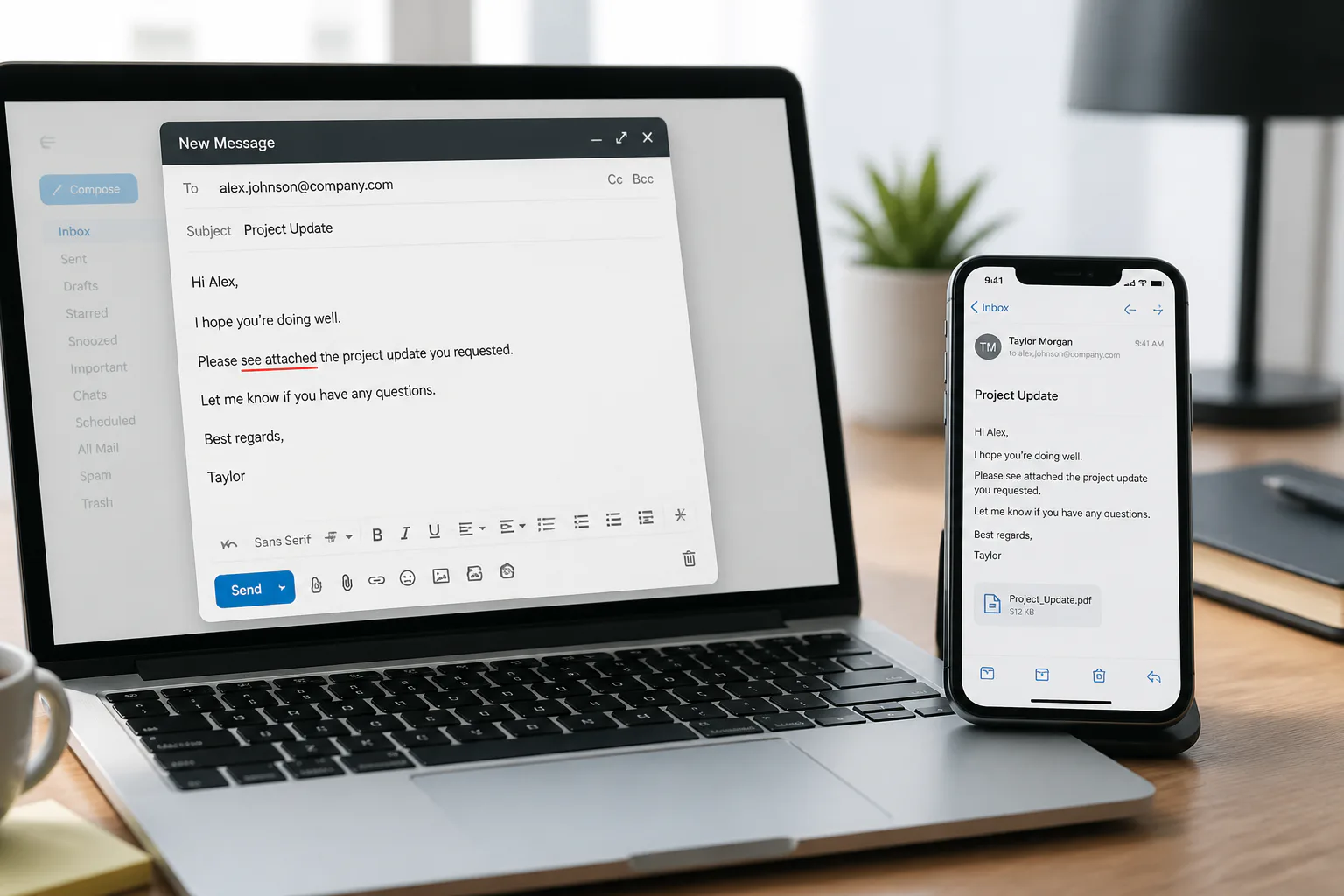
“See attached” means that a file, document, or image has been included with your email or message for the reader to check. It is a short way to direct someone to an attachment, and it works best when you want to sound clear and efficient. In modern communication, the phrase is common, but it should still be used with context so the recipient knows what the attachment is and what to do with it.
Used well, this phrase helps readers notice an attachment without forcing the email into stiff, old-fashioned language. The most effective approach is to mention the file clearly, place the reference where it makes sense, and match the tone to the situation.
What Does ‘See Attached’ Mean?
Basic meaning
“See attached” tells the reader that something is attached to the message and should be reviewed. In professional writing, it serves as a pointer: it moves the reader from the email text to the file itself. You will often see it near the end of an email, especially when the main purpose of the message is to send a document.
The phrase belongs to the same family as “please find attached” and “attached, please find.” Those versions come from older business writing and paper-letter etiquette, when documents were physically enclosed with a letter. Today, because email systems already show attachments clearly, many writers prefer simpler wording such as “I’ve attached the report” or “Please see attached.” If you want a closer look at that more formal variant, compare it with please see attached and note how small wording changes affect tone.
When people use it
People use “see attached” when sending items such as reports, invoices, resumes, contracts, photos, or supporting documents. It is common in workplace emails, school communication, and practical everyday messages. The phrase is short, so it fits best when the context is already obvious or when the attachment name is stated in the same sentence.
- See attached for the meeting agenda.
- Please see the attached invoice for payment.
- I’ve attached my resume for your review.
- See attached: draft proposal due Friday.
What tone it carries
On its own, “see attached” sounds brief and neutral. It is less formal than “please find attached” but still acceptable in many professional emails. That said, a message made of only “See attached” can sound abrupt, especially if you are writing to a manager, client, or someone for the first time.
A better approach is to add context. Writing “I’ve attached the budget summary for your review” is clearer and more helpful than sending only “See attached” because it names the file and explains its purpose.
Examples in real messages
Here are a few natural ways to use the phrase in emails and documents:
- See attached for the signed agreement.
- Please see attached the final draft of the presentation.
- I’ve attached the updated schedule for Monday’s meeting.
- Attached for your review is the project outline.
- See the attached file and let me know your feedback by 3 p.m.
These examples work because they do more than point to a file. They tell the reader what the attachment is and, in some cases, what action is needed.
Email etiquette basics
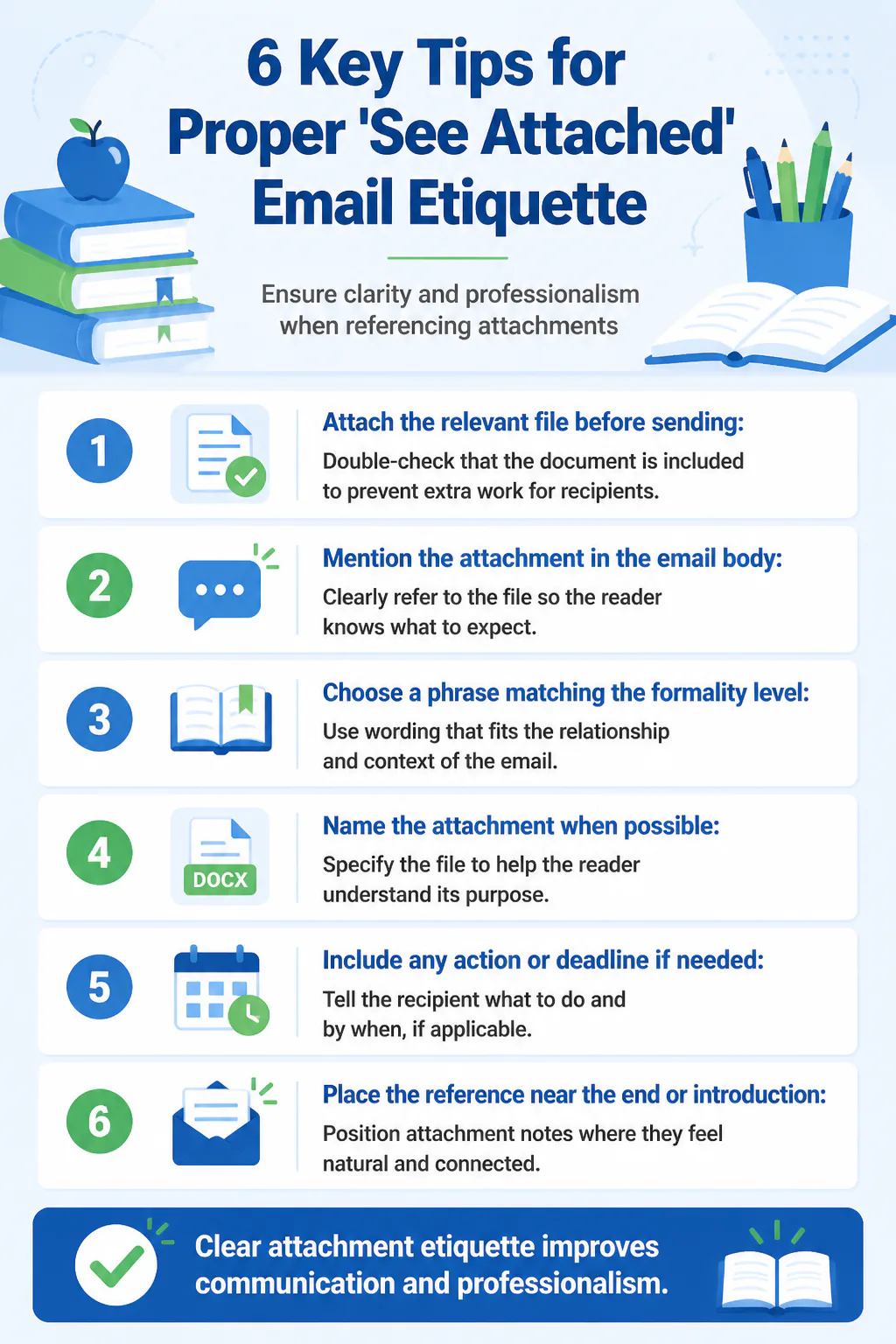
Good attachment etiquette is about clarity, not ceremony. Mention the attachment in the body of the email, use a professional phrase that fits the level of formality, and make sure the file is actually attached before sending. If the message matters, include the file name and any deadline or required response.
You should also consider the relationship and setting. A note to a close coworker can be direct, while a first email to a client should sound more polished. The same judgment applies to other formal phrases; for example, language like please be advised meaning often sounds heavier than necessary in everyday email.
How to Use ‘See Attached’ Correctly
Attach the file first
Make sure the document is actually included before you send the message. This sounds obvious, but it is one of the most common email mistakes. If your note says “see attached” and there is no file, the email immediately creates extra work for the recipient.
Mention the attachment clearly
State what the file is, rather than using the phrase by itself. “See attached for the revised contract” is much clearer than simply writing “see attached.” Naming the file helps the reader understand why it matters.
Match the phrase to context
Use wording that fits the relationship and purpose. “See attached” works for routine communication, while “I’ve attached the signed proposal for your review” sounds more polished in a formal setting. If you are writing to a superior, client, or hiring manager, include any needed action or deadline.
Place it naturally
Put the attachment reference where the document is introduced or near the end of the email. That placement feels natural because the reader gets the context before being directed to the file. In friendly but still professional notes, opening lines matter too, so balancing the attachment reference with courteous phrasing like hope you are doing well can soften the tone when appropriate.
| Situation | Better wording |
|---|---|
| Routine internal email | See attached for the updated timeline. |
| Formal external email | I’ve attached the proposal for your review. |
| Email to a manager | Please see attached the Q2 report. Kindly share feedback by Thursday. |
| Job application | I’ve attached my resume and cover letter for your consideration. |
Common Mistakes to Avoid
Frequent problems
- Writing “see attached” without actually attaching a file.
- Using the phrase with no explanation of what the attachment contains.
- Sounding too abrupt by sending a one-line email that only says “see attached.”
- Using outdated wording such as “attached herewith” or “kindly find attached.”
- Choosing language that is too casual for first-time or high-stakes communication.
- Forgetting to mention any required action, response, or deadline.
- Placing the attachment reference where it feels disconnected from the rest of the email.
Why these mistakes matter
Most attachment problems are not grammar errors. They are clarity errors. A reader should know what the file is, why it is there, and what happens next.
Alternatives to ‘See Attached’
Professional options
- I’ve attached the report for your review.
- Please see attached the signed form.
- Attached is the updated invoice.
- Attached for your review is the draft agreement.
- I have included the meeting notes.
- Enclosed, please find the requested document.
How tone changes the choice
- Very formal: Enclosed, please find the requested file.
- Professional and modern: I’ve attached the requested file.
- Neutral: Please see attached the requested file.
- Brief: See attached for the requested file.
- Action-focused: Attached is the draft contract. Please review by Friday.
In modern business writing, direct language usually sounds better than old formulas. Clear wording builds rapport because it sounds human, not copied from a letter template.
Email Etiquette for Attachments
Keep it clear
The best attachment etiquette is simple: attach the right file, refer to it clearly, and give the reader enough context. If the attachment matters, identify it by name and explain what you want the recipient to do with it. That could be reviewing it, signing it, approving it, or replying by a certain date.
Adjust for the relationship
A quick internal message can be brief, but formal communication should be more complete. When writing to a superior, client, or someone you do not know well, avoid language that feels too casual or too old-fashioned. A sentence like “I’ve attached the budget proposal for your review. Please send comments by Tuesday” is polite, specific, and easy to act on.
Final etiquette checklist
- Attach the relevant file before sending.
- Mention the attachment in the email body.
- Choose a phrase that matches the level of formality.
- Name the attachment when possible.
- Include any action or deadline if needed.
- Place the reference near the end or where the document is introduced.
- Avoid outdated or overly formal phrases unless the context truly calls for them.
FAQs
Is “see attached” professional?
Yes, it is professional enough for many routine emails. It works best when you add context, such as the document name or the action you want the reader to take.
Is “please find attached” better than “see attached”?
Not usually. “Please find attached” sounds more formal, but many readers hear it as outdated. Modern email style generally prefers shorter, clearer phrases.
Should I write only “see attached” in an email?
No. A complete sentence is better because it tells the reader what the file is and why it matters. Even one extra detail makes the message clearer.
Where should I place the attachment reference?
Place it where you introduce the document or near the end of the message. That way, the reference feels connected to the purpose of the email.
Conclusion
“See attached” works best when you use it with enough context to name the file and explain the next step, making the message clearer and more professional.

Related Posts
How Did You Sleep: Meaning and Everyday Usage
Happy to Help: Meaning and When to Use IT