Happy to Help: Meaning and When to Use IT
Happy to help means you are pleased or willing to assist someone, and it is often used as a polite response after giving support, answering a question, or solving a problem. In everyday English, it can sound warm and friendly. In professional settings, especially customer service, it is common, but it can also sound routine if it is overused or delivered without sincerity.
The phrase usually works best when you want to show that helping was not a burden. You might say it in an email, in a customer reply, or in a casual conversation with a friend or coworker. Still, tone matters: people often respond better when the phrase feels specific and genuine rather than scripted.
What Does ‘Happy to Help’ Mean?
Core meaning
At its simplest, happy to help means “I was glad to assist you” or “Helping you was no trouble.” It is often used in place of “you’re welcome” after someone says thank you. The phrase signals willingness, friendliness, and a positive attitude toward helping.
For example, if someone thanks you for explaining a process, replying with “Happy to help” tells them that you were glad to give your time. In that sense, the phrase is both polite and reassuring. It suggests that the other person did not inconvenience you.
Tone and impression
The tone of the phrase is usually professional, upbeat, and cooperative. That is why it appears so often in customer service replies, workplace emails, and support conversations. It helps create a smooth, pleasant ending to an exchange.
At the same time, the phrase can feel impersonal if it is repeated too often. In customer communication, people notice when language sounds automatic. A plain “happy to help” can sometimes come across as “I’m just doing my job” instead of showing real care.
When it works best
Use it when the situation is straightforward and the tone should be friendly but neutral. It fits well after answering a question, fixing a simple issue, or sending useful information. It also works when you want to keep your message brief.
It is especially natural in exchanges like these:
- Someone thanks you for clarifying something
- You finish helping a customer with a request
- A coworker appreciates your quick support
- A friend thanks you for a small favor
When to be more specific
In emotional or sensitive situations, a more personal reply often works better. If a customer is frustrated, worried, or upset, “happy to help” may sound too generic. A more tailored response can show stronger empathy.
Instead of one fixed phrase, vary your language based on the moment. The same principle applies in other polite expressions, where context shapes tone, as with phrases like hope you are doing well that can sound warm or formulaic depending on how they are used.
Useful alternatives
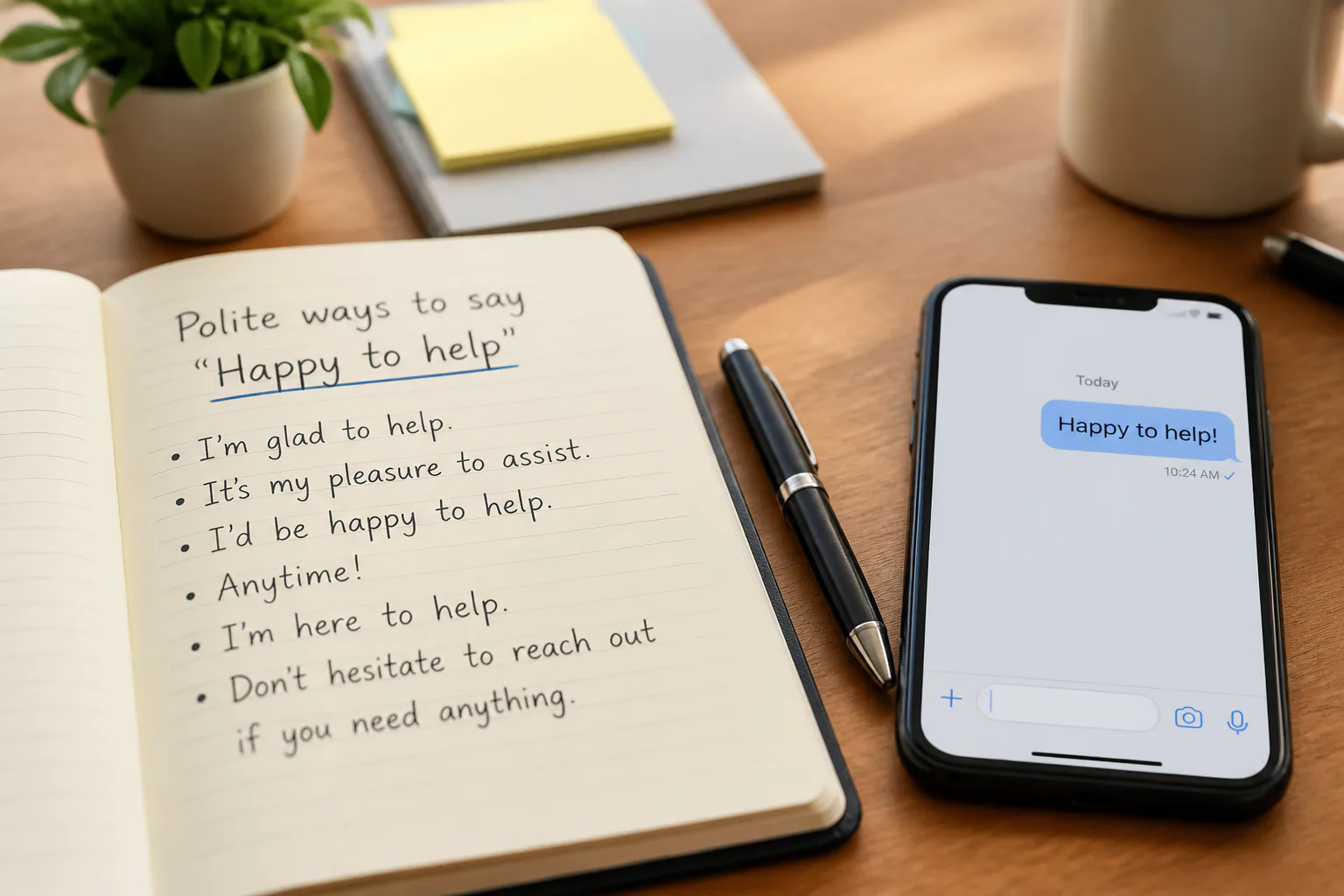
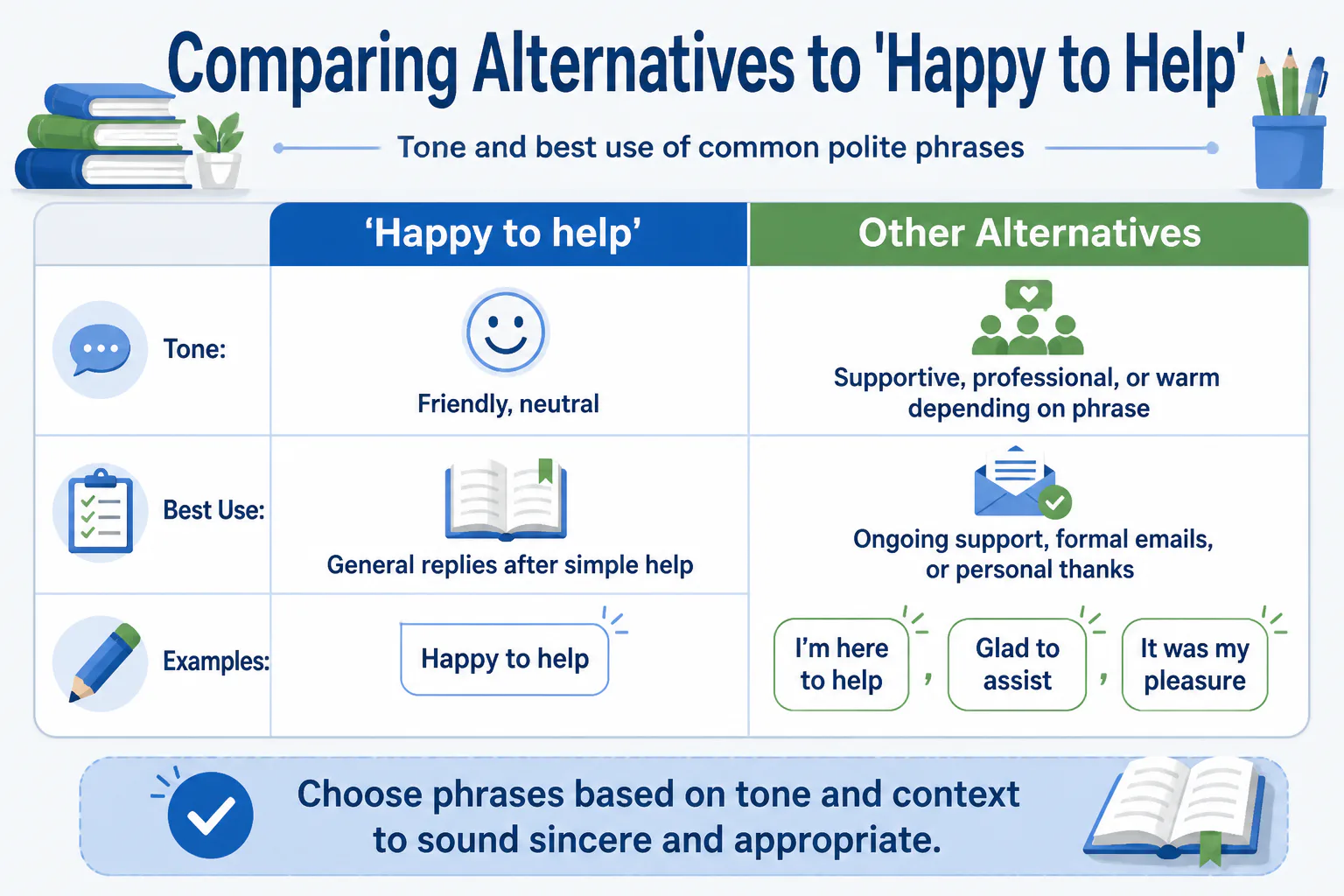
If you want a similar meaning with a slightly different tone, good options include I’m here to help, glad to assist, and it was my pleasure. “I’m here to help” sounds supportive and present. “Glad to assist” feels polished and professional. “It was my pleasure” sounds warmer and more personal.
Here are quick comparisons:
| Phrase | Tone | Best use |
|---|---|---|
| Happy to help | Friendly, neutral | General replies |
| I’m here to help | Supportive, reassuring | Ongoing assistance |
| Glad to assist | Professional, polished | Formal email or service |
| It was my pleasure | Warm, personal | Thoughtful thanks |
Common Situations to Use ‘Happy to Help’
Customer service replies
- After resolving a problem for a customer
- After answering a product or policy question
- After sending instructions or next steps
- As a polite closing after a customer says thank you
Professional emails
- When a coworker thanks you for information
- After reviewing a document or giving feedback
- When replying to a client with a brief, courteous close
- After helping someone schedule, confirm, or understand something
Casual conversations
- When a friend thanks you for a recommendation
- After helping someone carry, find, or fix something
- When a classmate or neighbor appreciates your advice
- As a light, friendly alternative to “no problem”
In all of these situations, the phrase tells the other person that helping them was not a burden. Some replies have a similar function but a different tone. For example, if you are acknowledging new information rather than expressing thanks, a phrase like thank you for letting me know fits better than “happy to help.”
Examples of ‘Happy to Help’ in Sentences
Email examples
- Happy to help. Let me know if you need anything else.
- I was happy to help with the report, and I can review the final version too.
- Happy to help clarify the timeline before the meeting.
Customer service examples
- Happy to help. Your issue has now been resolved.
- I’m happy to help with your account question today.
- We’re happy to help if you need more details about the next step.
Casual examples
- Happy to help. I know that form can be confusing.
- No worries, happy to help with the move.
- I’m always happy to help when you need a second opinion.
What to notice
These examples show that the phrase can stand alone or be followed by more detail. Adding a second sentence often makes it sound more human. In work settings, that extra line can soften a standard reply and make it feel less scripted.
You can also compare it with other short workplace formulas. For instance, some closings feel polished but distant, while others feel collaborative, much like the difference in phrasing behind looking forward to working with you when tone matters in professional writing.
Tone Considerations
Sincerity matters
“Happy to help” is polite because it expresses willingness and good intent. It tells the listener or reader that their request was welcome. That makes it a useful phrase in both service language and everyday conversation.
Still, politeness depends on more than the words themselves. If the situation is stressful, emotional, or complicated, a generic reply may feel flat. Customers and colleagues usually notice when language sounds copied from a script rather than chosen for the moment.
Avoid sounding robotic
In customer communication, repeating the same phrase too often can weaken trust. If every reply ends with “happy to help,” the message may feel impersonal. Varying your wording makes your communication sound more attentive and genuine.
That is especially important in service teams focused on better resolutions across channels. Clear language, empathy, and consistency support stronger customer experiences, whether replies come from people directly or are shaped within systems such as AI agents, Reporting and analytics, the Knowledge base, Workforce Management, and the Contact Center.
Match the moment
Use the phrase for ordinary, positive interactions. Choose something more personal when someone has been inconvenienced, disappointed, or upset. In those moments, specific empathy usually works better than a standard closing.
- Use “happy to help” for simple thanks and routine support.
- Use a warmer phrase when the person needs reassurance.
- Add context if you want to sound less formulaic.
Alternatives to ‘Happy to Help’
Professional alternatives
- I’m here to help.
- Glad to assist.
- Always glad to help.
- Please let me know if you need anything else.
Warmer alternatives
- It was my pleasure.
- I’m glad I could help.
- Of course.
- No problem at all.
How to choose
- Use “I’m here to help” when support is ongoing.
- Use “glad to assist” in formal or polished writing.
- Use “it was my pleasure” when you want to sound more personal.
- Use “of course” in relaxed, natural conversation.
FAQs
Is “happy to help” polite?
Yes. It is a polite phrase that shows willingness and friendliness. It works well when someone thanks you or when you want to close a helpful exchange positively.
Is “happy to help” too formal?
No. It is usually neutral rather than strongly formal. It fits professional emails, customer service replies, and many casual conversations.
Can “happy to help” sound insincere?
Yes, if it is overused or used in the wrong situation. In sensitive moments, a more specific and empathetic reply often sounds better.
What can I say instead of “happy to help”?
You can say “I’m here to help,” “glad to assist,” “I’m glad I could help,” or “it was my pleasure.” The best choice depends on how formal or personal you want to sound.
Conclusion
“Happy to help” works best when you use it in the right setting and match it to the tone of the moment. A small adjustment in wording can make the phrase sound more natural, sincere, and effective.