
All the Best Synonyms: Better Words for Everyday Writing
If you want all the best synonyms in one place, start with the words you use every day and learn how each alternative changes tone, meaning, and clarity. A synonym is a word with a similar meaning, but not always the exact same feeling or use. That small difference matters in emails, essays, stories, and even casual messages. Thesaurus.com makes that process easier by helping you search a word, compare choices, and find a better fit without repeating yourself.
Good synonym choices make writing sound more precise, more natural, and less repetitive. Instead of using the same word again and again, you can swap in a stronger option that better matches your purpose.
Understanding Synonyms
Synonyms are words that share a similar meaning, such as good and excellent, or happy and cheerful. They are useful because they help you say nearly the same thing in a more exact or more interesting way. Thesaurus.com covers synonyms and antonyms across nouns, verbs, adjectives, adverbs, and prepositions, so it works for much more than just descriptive words.
- Absolute synonyms are extremely close in meaning, but not every synonym is interchangeable.
- Partial synonyms overlap in some contexts.
- Near-synonyms share a general idea but carry different tone or emphasis.
Search for a Word
Go to the Homepage search bar and enter the word you want synonyms for. Then press Enter or click the search icon. This is the fastest way to move from a vague word like good, bad, or important to a fuller list of options that fit different situations.
View Synonyms and Antonyms
On the Search results page, scroll through the list of synonyms and antonyms and click on any synonym to explore further. This step matters because the best choice depends on context. For example, good can shift toward excellent, kind, suitable, or effective depending on what you are describing, and the same habit helps when picking a no worries synonym that sounds casual, polite, or reassuring.
Explore Word of the Day
From the Homepage sidebar, click on Word of the Day to see its definition and usage. This feature is a simple way to build vocabulary steadily. Learning one fresh word at a time makes it easier to remember shades of meaning and use them naturally in your own writing.
Play 4Words Game
In the Homepage featured game section, click Play Now on the 4Words Game and follow the on-screen instructions to combine words. Word games reinforce patterns you miss when you only memorize lists. They also help you notice connections between familiar words and stronger alternatives.
Read Featured Articles
Open the Articles section or use the homepage links to click article titles about word origins and language tips. Featured Articles help with common confusions, usage questions, and trending words, which is useful when two synonyms look similar but do not sound right in the same sentence.
Common words worth upgrading
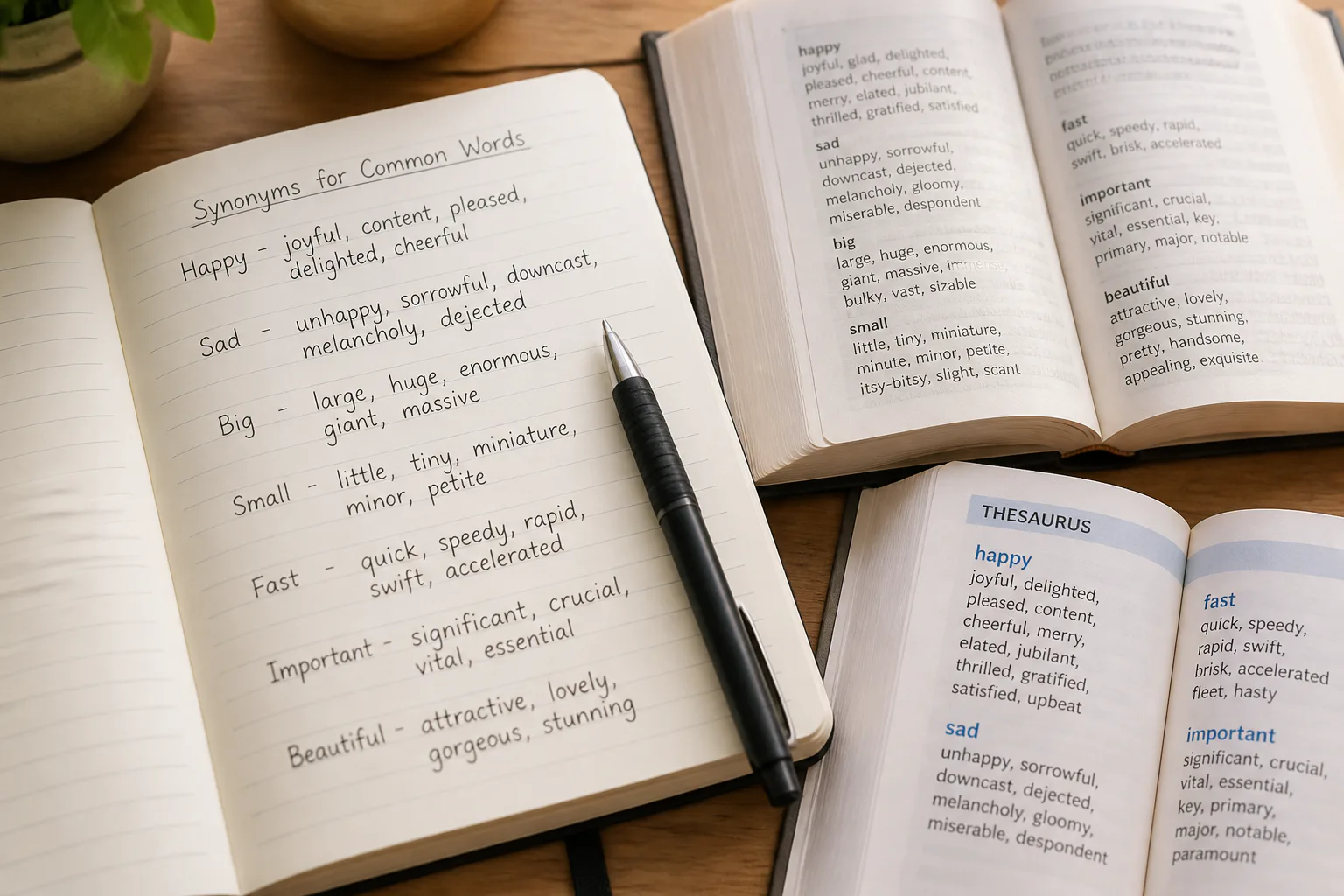
Some words appear so often that replacing them can instantly improve your writing. Here are practical examples of all the best synonyms for common choices, along with a quick note on when to use them:
- Good: excellent, fine, positive, favorable, strong, skilled
- Bad: poor, harmful, weak, unpleasant, severe
- Happy: cheerful, glad, delighted, pleased, joyful
- Sad: unhappy, downcast, sorrowful, gloomy, disappointed
- Important: essential, significant, key, major, valuable
- Beautiful: lovely, striking, elegant, stunning, attractive
- Big: large, huge, vast, major, enormous
- Small: little, tiny, compact, slight, modest
- Fast: quick, rapid, swift, speedy, brisk
- Smart: clever, bright, sharp, intelligent, insightful
The goal is not to choose the fanciest word. The goal is to choose the most precise one. In many cases, simple alternatives improve clarity more than unusual vocabulary does.
Top Synonyms for Common Words
Everyday replacements
- Good: excellent for high praise, fine for neutral approval, suitable for fit or appropriateness
- Happy: pleased for mild satisfaction, delighted for stronger emotion, cheerful for upbeat mood
- Important: essential for necessity, significant for meaning or impact, key for central ideas
- Beautiful: lovely for warmth, elegant for refined style, stunning for dramatic effect
- Said: stated, explained, replied, noted, asked
- Help: assist, support, aid, guide, encourage
- Show: display, reveal, present, demonstrate, highlight
- Think: believe, consider, suppose, reflect, conclude
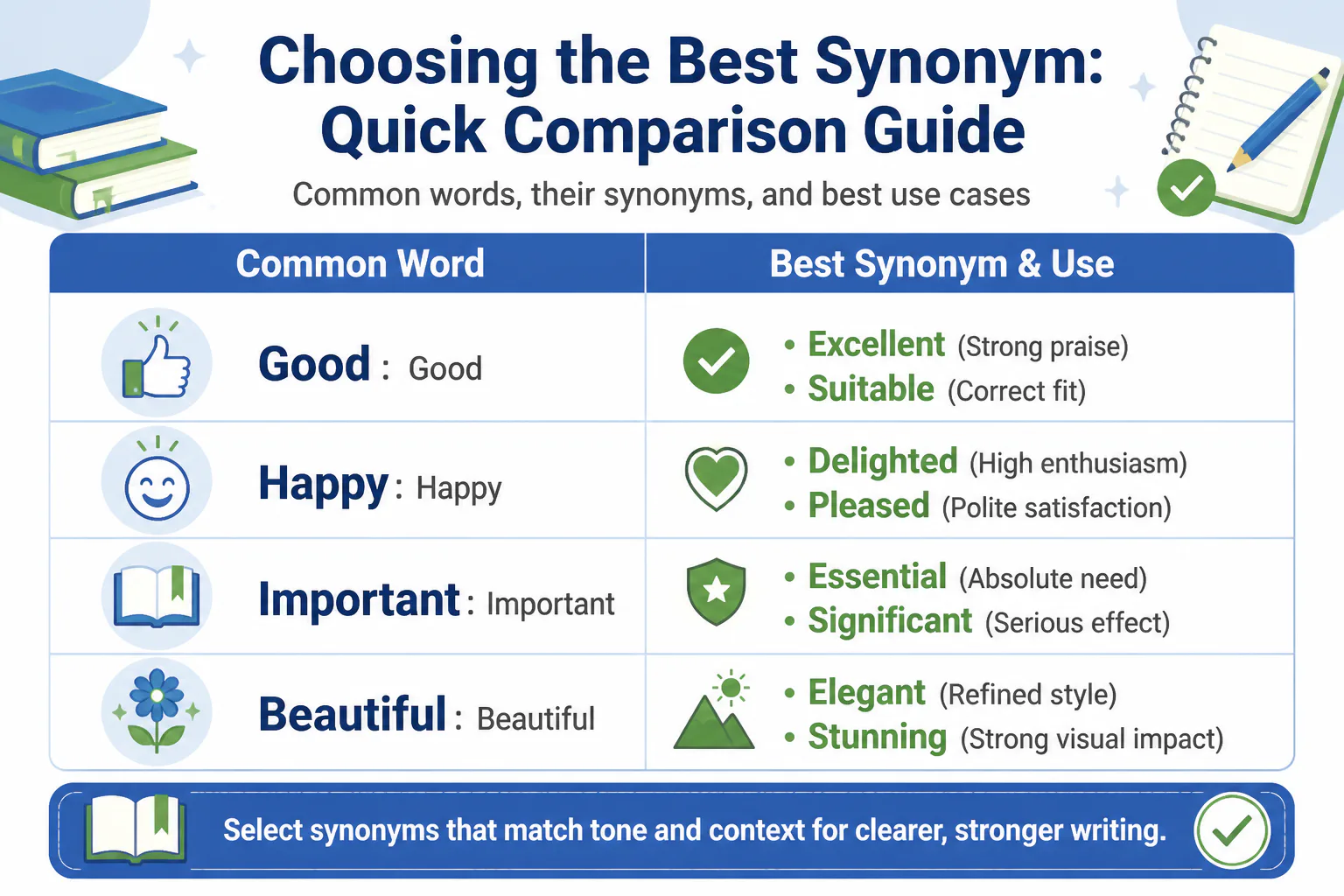
Quick comparison table
| Common Word | Synonym | Best Use |
|---|---|---|
| Good | Excellent | Strong praise |
| Good | Suitable | Correct fit |
| Happy | Delighted | High enthusiasm |
| Happy | Pleased | Polite satisfaction |
| Important | Essential | Absolute need |
| Important | Significant | Serious effect |
| Beautiful | Elegant | Refined style |
| Beautiful | Stunning | Strong visual impact |
These lists are a starting point, not a script. Even a strong synonym can sound wrong if the tone does not match the sentence.
Contextual Tips for Choosing Synonyms
Match tone
Choose words that fit the mood of your sentence. Cheerful sounds warm and light, while joyful feels stronger and more expressive. In the same way, birthday messages often change depending on tone, which is why phrases related to happy birthday can range from playful to heartfelt.
Match formality
Some synonyms sound casual, and others sound more polished. Help is everyday language, while assist often sounds more formal. If you are writing an academic paper, business email, or cover letter, this difference matters.
Match exact meaning
Near-synonyms can point in slightly different directions. Slim and skinny both relate to thinness, but they do not carry the same tone. The strongest writing comes from choosing the word that says exactly what you mean, not almost what you mean.
Read the sentence aloud
If a synonym looks right but sounds stiff, replace it. Reading aloud catches awkward rhythm and unnatural word choice quickly. That same test works for practical phrases too, especially when deciding between plain wording and a warmer option like let me know alternatives in polite communication.
Tools and Resources for Finding Synonyms
Use Synonym and Antonym Search
The most direct tool on Thesaurus.com is Synonym and Antonym Search. Enter a word in the main search bar on the homepage or elsewhere on the site, then review related choices. This is best when you already know the word you want to replace.
Use Word of the Day
Word of the Day builds vocabulary through short, daily learning. It is especially helpful if you want to improve writing over time instead of only searching when you are stuck.
Use Featured Articles
Featured Articles give extra support on word origins, common confusions, and language usage. If two synonyms seem close, an article can make the difference clearer than a quick list alone.
Use 4Words Game
The 4Words Game adds practice. By combining words and spotting patterns, you reinforce what you learn through search and reading.
- Use search when revising a draft
- Use Word of the Day for daily learning
- Use articles when meanings feel close
- Use 4Words Game for memory and recall
FAQs
What are the best synonyms for common words?
The best synonyms are the ones that fit your exact sentence. For example, good could become excellent, suitable, kind, or effective depending on meaning and tone.
Are all synonyms exact matches?
No. Some are very close, while others are partial or near-synonyms with different tone, strength, or context.
How can I improve writing with synonyms?
Replace repeated words, but keep the sentence natural. Search the word, compare options, and choose the one that matches your audience and purpose.
What can I use besides a thesaurus list?
You can use Word of the Day, Featured Articles, and word games like 4Words to build a stronger vocabulary and understand usage more clearly.
Conclusion
Finding all the best synonyms starts with common words and better choices, and Thesaurus.com helps you compare options so your writing stays clear, varied, and precise.

Related Posts
30 Other Ways to Say “Thank You” (With Examples)
ONG Meaning in Text: What Does ONG Stand For?