
YOU as Well Meaning: Definition & Usage
You as well meaning is simple: it is a polite way to return a wish, greeting, or feeling to another person. If someone says, “Have a nice day,” replying with “You as well” means “I hope you have a nice day too.” It is common in everyday English, especially in quick spoken or written replies.
The phrase sounds neutral, courteous, and easy to use. English learners often meet it in conversations, emails, and short messages because it works in many situations without sounding too casual or too stiff. It is very close in meaning to “you too,” though “you as well” often sounds slightly more formal.
What Does ‘You As Well’ Mean?
Basic meaning
“You as well” means “the same to you” or “you too”. It reflects the other person’s words back to them. When a speaker gives you a good wish, greeting, or kind sentiment, this phrase lets you return that same feeling in a short and polite way.
For example, if someone says, “Nice to meet you,” you can answer, “You as well.” The meaning is “It is nice to meet you too.” If someone says, “Have a great weekend,” the reply means “I hope you have a great weekend too.”
How it works in conversation
The phrase usually appears after another person says something positive. It is most often used to reciprocate a wish or greeting. In plain English, it helps you mirror the other person’s message without repeating the whole sentence.
- “Have a good day.” → “You as well.”
- “Good luck with your interview.” → “You as well.”
- “It was nice talking to you.” → “You as well.”
- “Enjoy your trip.” → “You as well.”
Tone and level of formality
“You as well” has a neutral and polite tone. It fits casual conversations, workplace exchanges, meetings, emails, and social media replies. It is not highly formal, but it is slightly more polished than “you too,” which is why some speakers choose it in semi-formal settings.
Regional habit also matters. In American English, people often say “you too” in relaxed conversation. In British English, “you as well” is heard more often, and phrases like “Cheers, you too” are also common.
Examples with similar phrases
The closest match is “you too.” In most everyday situations, the two phrases mean the same thing. Other alternatives include “same to you,” “likewise,” and “right back at you,” but each has a slightly different tone.
| Phrase | Meaning | Typical tone |
|---|---|---|
| You as well | You too | Polite, neutral |
| You too | The same to you | Casual, common |
| Same to you | I return that wish | Friendly, direct |
| Likewise | The same applies to me | Slightly formal |
| Right back at you | I send that same feeling back | Playful, warm |
Special uses
Although it usually returns a good wish, “you as well” can do a little more. It can include another person in a comment, as in “And you as well, Cindy!” In that case, the meaning is “this also applies to you.”
It can also be used sarcastically in playful situations. If a friend jokingly says, “Be weird somewhere else,” someone might answer, “You as well.” That use depends on tone, relationship, and context, so it is best used carefully.
When not to use it
“You as well” is useful, but it is not perfect for every moment. In highly formal writing, legal communication, or emotionally sensitive situations, a more personal response is better. If someone shares serious news, a quick mirrored reply can sound distant or robotic.
- Use it for short, polite exchanges.
- Avoid it when a personalized response matters more.
- Do not overuse it in every email or conversation.
- Choose warmer wording in emotional situations.
Common Situations to Use ‘You As Well’
Everyday replies
- After good wishes: “Have a nice evening.”
- After greetings: “Nice to meet you.”
- After parting comments: “Take care.”
- After kind remarks: “Enjoy the rest of your day.”
Work and semi-formal settings
- At the end of emails
- In meetings
- During customer or colleague conversations
- When you want to sound polite but brief
It works especially well in short professional exchanges. For example, if a coworker writes, “Looking forward to working with you,” a warm reply can be more specific, but in brief conversations people still use polite return phrases; this is similar to how people phrase working with you in professional English.
Examples of ‘You As Well’ in Conversation
Natural dialogue examples
A few common examples are simple exchanges such as “Have a great day” followed by “You as well” and “Nice to meet you” followed by “You as well.” Another example is “Enjoy your vacation” with the reply “You as well.”
These exchanges sound natural because the second speaker is returning the same sentiment.
It also fits written English. In an email, someone might write, “Hope you are doing well,” and you may answer politely before moving into the main message; that opening often appears beside other standard phrases like you are doing well in everyday correspondence.
A few less common uses
You can use it to include someone else: “Everyone should bring a notebook, and you as well, Marcus.” You can also use it playfully: “Stop being dramatic.” “You as well.” In both cases, the phrase still points back to the other person.
The key is to match the mood. In a friendly chat, it sounds smooth and natural. In a heartfelt message, a fuller reply often sounds better than a quick echo.
Difference Between ‘You As Well’ and ‘You Too’
Main difference
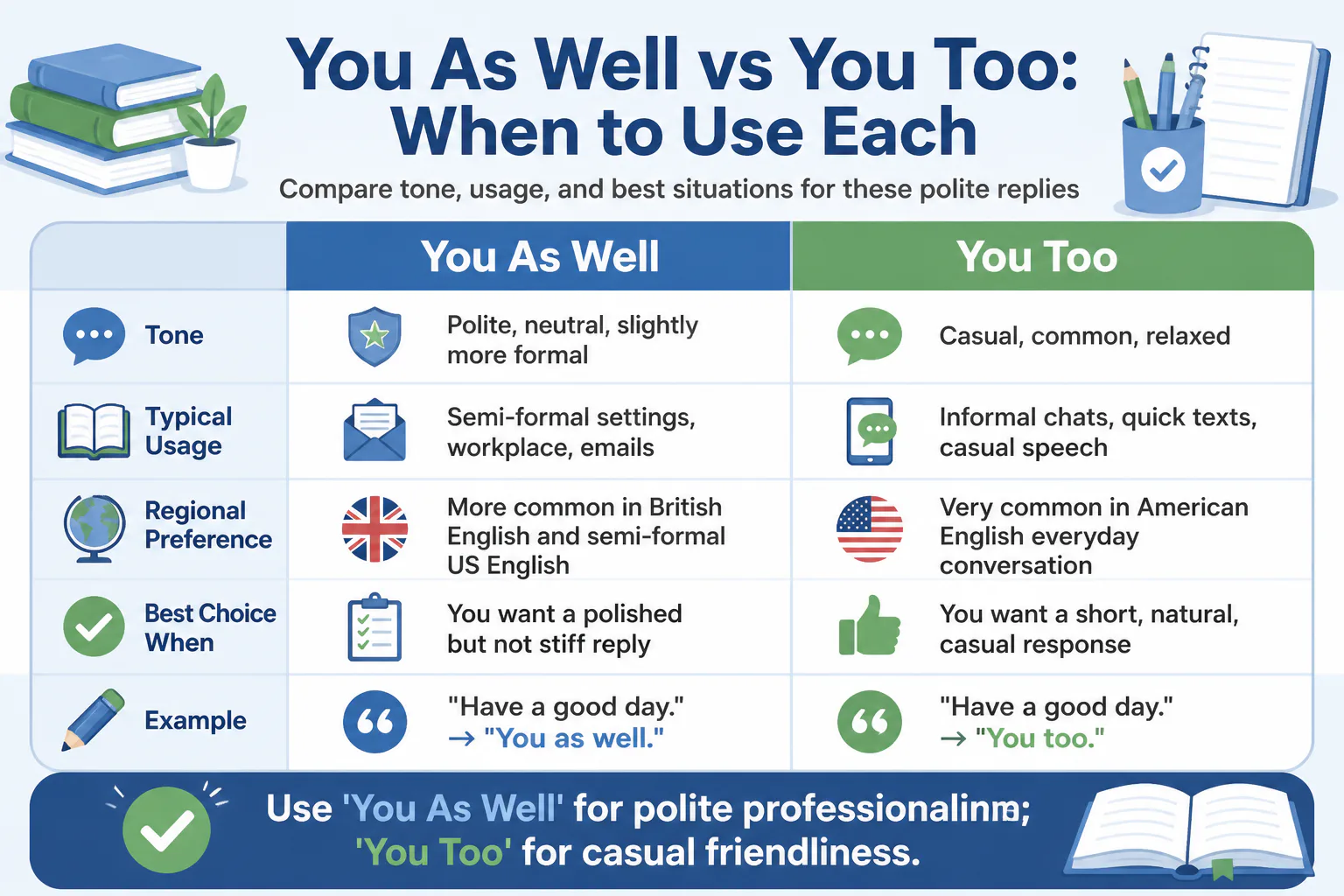
The meaning is almost the same. Both phrases return a wish, greeting, or sentiment to the speaker. In most conversations, choosing one over the other does not change the message.
The real difference is tone. “You too” sounds more casual and is especially common in everyday American speech. “You as well” sounds a little more formal and a little more neutral, so it often fits semi-formal situations better.
Which one should you choose?
Choose “you too” when the moment is relaxed and informal. Choose “you as well” when you want a slightly more polished tone without becoming stiff. If someone says, “Have a good rest of your day,” either answer works, much like the phrasing choices people make with rest of your day wishes.
| Situation | Better choice | Reason |
|---|---|---|
| Talking to a friend | You too | More casual |
| Replying to a coworker | You as well | Slightly more polished |
| Quick text message | You too | Short and natural |
| Brief professional email | You as well | Neutral and courteous |
FAQs
Is “you as well” grammatically correct?
Yes. It is a correct English phrase used in conversation and writing to mean “you too” or “the same to you.”
Is “you as well” more formal than “you too”?
Yes. Both are correct, but “you as well” usually sounds slightly more formal and more neutral.
Can “you as well” sound rude?
Not by itself. It sounds polite in normal use, but it can feel cold if used in an emotional or sensitive moment where a more personal response is expected.
Should I write “aswell” or “as well”?
Always write “as well” as two words. “Aswell” is incorrect.
Usage Tips
Quick reminders
- Use “you as well” to return a wish, greeting, or kind remark.
- Think of it as a polite version of “you too.”
- Use it in casual and semi-formal situations.
- Avoid overusing it in emotional or highly formal writing.
- Write “as well,” not “aswell.”
If you want to sound natural, pay attention to tone and setting. “You as well” is a strong choice when you need a short, respectful reply. If the moment feels personal, add a fuller sentence instead of relying on a quick mirrored phrase.
Conclusion
“You as well” is a useful phrase for returning good wishes politely and naturally. It fits everyday conversation, emails, and semi-formal situations when you want a short reply that still sounds courteous.