
Have a Good Rest of Your Day: Meaning and Proper Use
“Have a good rest of your day” means enjoy the remaining part of your day. People use it as a polite closing when they are speaking to someone in the afternoon or later, especially when part of the day has already passed. It sounds warm, considerate, and slightly more personal than a simple “goodbye.”
The phrase works well in everyday communication, including customer service, work emails, casual conversations, and short chats with neighbors or classmates. It tells the other person you are not just ending the conversation, but also wishing them well for the hours ahead. If you want to sound friendly without being too informal, it is a strong choice.
Meaning
Literal meaning
Literally, the phrase refers to the rest of your day, meaning the part of the day that has not happened yet. So if you say it at 2 p.m., you are wishing someone a pleasant afternoon and evening. That is why the expression usually appears after the day has already started and some activities are already behind you.
It is different from “have a good day,” which can be said at almost any point, especially in the morning. “Have a good rest of your day” is more specific because it recognizes that the person has already spent part of the day doing something. That small detail makes it feel thoughtful.
Implied social meaning
Beyond the literal meaning, the phrase signals politeness, goodwill, and a smooth ending to an interaction. It can sound a little more attentive than shorter closings because it acknowledges the person’s schedule and mood in the moment. In many settings, that makes it feel sincere rather than automatic.
It is especially common after a useful or pleasant exchange. For example, after answering a coworker’s question, helping a customer, or finishing a phone call, this phrase leaves the conversation on a positive note. If you already know the person is busy, it can also suggest respect for their time.
Common examples
Here are a few natural ways people use it:
- “Thanks for stopping by. Have a good rest of your day.”
- “I appreciate your help today. Have a good rest of your day.”
- “It was nice talking with you. Have a good rest of your day.”
- “If you need anything else, let me know. Have a good rest of your day.”
It also fits both speech and writing. In an email, for example, it can appear as a closing line after the main message. If you already use phrases like hope you are doing well at the start of messages, this phrase makes a natural ending that feels equally polite.
When it sounds best
This expression sounds best from late morning onward, though it is most common in the afternoon. Saying it at 8 a.m. can sound slightly odd because very little of the day has passed. In that case, “have a good day” is usually more natural.
It also works best when the conversation is ending. You would not usually say it in the middle of a discussion unless you are clearly signing off from a call, chat, or meeting. Think of it as a closing wish, not a general comment.
Polite alternatives
If you want a similar tone, several alternatives work well depending on the setting and the time of day. Some are shorter and more neutral, while others sound warmer or more casual.
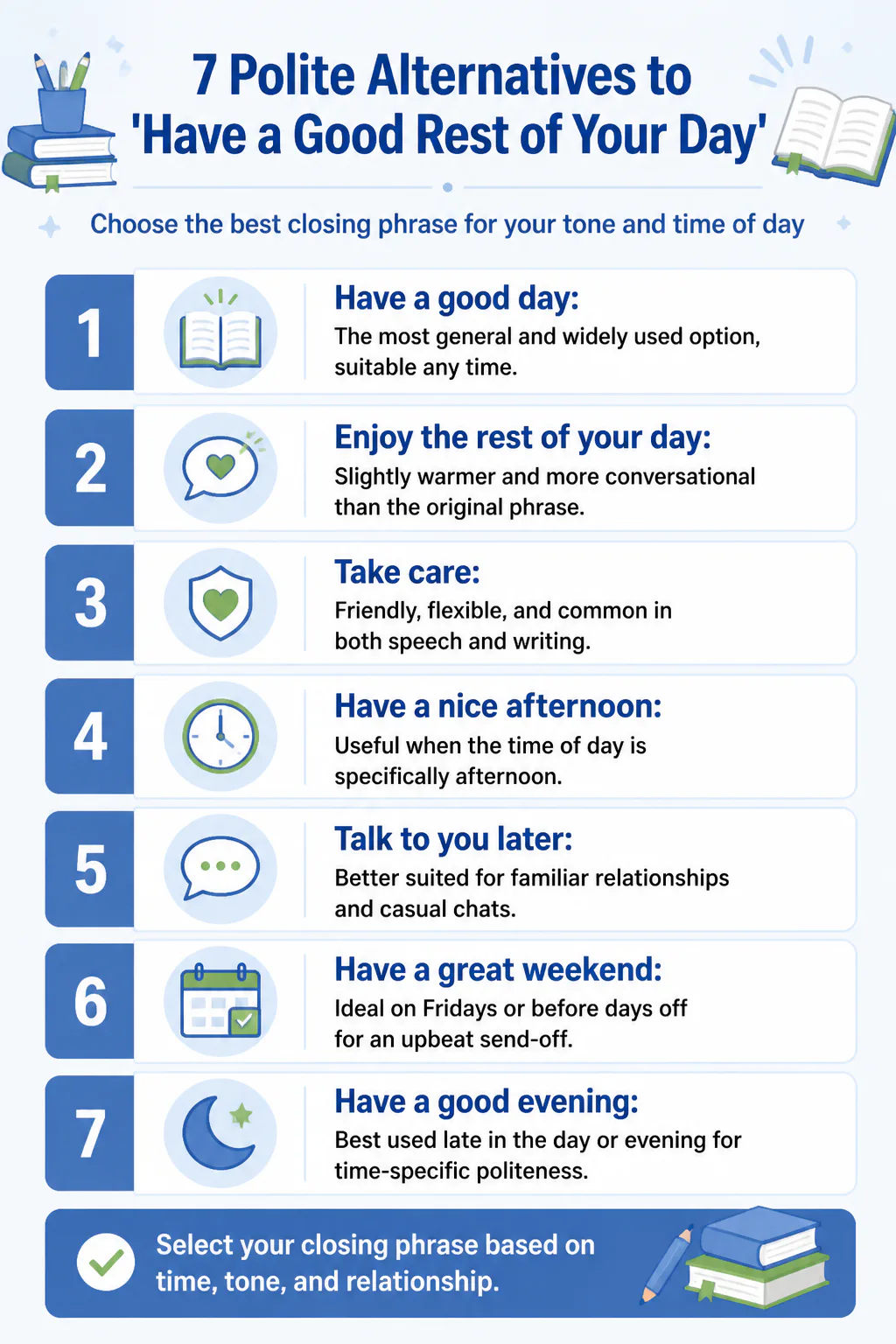
- Have a good day – the most general and widely used option
- Enjoy the rest of your day – slightly warmer and more conversational
- Take care – friendly, flexible, and common in speech and writing
- Have a nice afternoon – useful when the time of day is specific
- Talk to you later – better for familiar relationships
- Have a great weekend – ideal on Fridays or before days off
When and How to Use This Phrase
Best situations
Use the phrase when ending a brief interaction in a polite, friendly way. It fits professional and casual situations where you want to sound considerate but not overly emotional. Reception desks, emails, phone calls, online chats, and everyday small talk are all common places for it.
You can also match it to the context. After a check-in question like how is your day going, this closing sounds especially natural because the conversation is already focused on the person’s day.
Professional and casual tone
In professional settings, the phrase sounds polished without being stiff. It works well with clients, coworkers, teachers, and service staff because it stays respectful. In casual settings, it can sound kind and relaxed, especially if your tone is warm.
What matters most is timing and delivery. If you say it too early in the morning or in a rushed tone, it can feel slightly unnatural. If you use it at the end of a real exchange, it usually lands well.
Simple etiquette tips
- Use it after part of the day has passed.
- Say it at the end of a conversation, email, or call.
- Choose it when you want to sound polite and friendly.
- Switch to “have a good evening” if the day is almost over.
- Avoid forcing it into very formal writing where a shorter closing fits better.
Alternatives
Close substitutes
- Have a good day: The safest all-purpose option. It works earlier in the day and in almost every setting.
- Enjoy the rest of your day: Very close in meaning, but a bit more conversational.
- Have a nice rest of your day: Polite and natural, though slightly less common than “good.”
- Take care: A good choice when you want warmth without mentioning time of day.
More specific choices
- Have a nice afternoon: Best in the afternoon when you want to be precise.
- Have a good evening: Better than “rest of your day” when the evening has begun.
- Have a great weekend: Useful near the end of the workweek; some people prefer a more upbeat send-off such as have a great weekend.
- See you tomorrow: Best when you know you will meet again soon.
Quick comparison
| Phrase | Best time | Tone |
|---|---|---|
| Have a good day | Any time, especially morning | Neutral and polite |
| Have a good rest of your day | Late morning to afternoon | Thoughtful and friendly |
| Enjoy the rest of your day | Afternoon | Warm and conversational |
| Have a good evening | Late day or evening | Natural and time-specific |
| Take care | Any time | Friendly and flexible |
Regional Context
Usage in different English-speaking places
In the United States, “have a good rest of your day” is common in customer service, offices, and casual conversation. It often appears in spoken English, emails, and phone calls because it sounds polite without being formal. Many Americans use it naturally after noon.
In other English-speaking regions, people may choose shorter closings more often, such as “have a good day,” “cheers,” or “take care.” The longer phrase is still understandable, but it can sound more American in tone and rhythm. That does not make it wrong; it just gives it a regional flavor.
Formality and tone differences
Some speakers hear the phrase as especially customer-service oriented because it is common in retail and support settings. Others simply hear it as friendly and considerate. Your tone, relationship, and setting shape how it is received more than the phrase itself.
If you are unsure, choose based on simplicity. In very formal communication, shorter closings often work better. In everyday speech and ordinary business writing, this phrase sounds natural and courteous.
FAQs
Is “have a good rest of your day” grammatically correct?
Yes. It is a standard and natural English expression. The phrase clearly means wishing someone well for the remaining part of the day.
Is it more polite than “have a good day”?
Not always more polite, but it can sound more thoughtful because it reflects the time of day. “Have a good day” is still perfectly polite and more general.
Can I use it in an email?
Yes. It works well as a closing line in professional and casual emails, especially after midday. It is friendly, respectful, and easy to understand.
When should I avoid using it?
Avoid it early in the morning or very late at night. Also skip it if the setting calls for a more formal closing or a more time-specific phrase like “have a good evening.”
Conclusion
“Have a good rest of your day” is a polite, natural closing for conversations, calls, and emails after part of the day has passed. It works best when you want to sound friendly and considerate without becoming too informal.

Related Posts

Best Fast Learner Synonyms for Resumes and Reviews

30 Ways to Say Bro: Casual Slang and Nicknames