THANKS for Your Concern Meaning: Definition & Usage
Thanks for your concern meaning is simple at its core: it is a way to acknowledge that someone has shown care, interest, or worry about you or your situation. In everyday English, the phrase can sound warm and sincere, but it can also sound cold or sarcastic if the speaker is annoyed or wants to dismiss unwanted attention. The exact meaning depends less on the words themselves and more on tone, context, and relationship.
If someone checks on your health, asks whether you are okay, or shows worry about a problem, saying “thanks for your concern” usually means “I appreciate that you care.” In a sharper tone, however, it can mean something closer to “I heard you, but I do not want your input.” That contrast is what makes this phrase worth understanding.
What Does ‘Thanks for Your Concern’ Mean?
Core meaning
The phrase means that you are recognizing another person’s care or worry about a situation. Here, concern refers to interest, regard, or apprehension. In plain English, it means someone is emotionally affected by what is happening to you or is paying close attention because they care.
The word concern has several related meanings. As a noun, it can mean marked interest or regard, an uneasy feeling of worry, or a matter that deserves attention. As a verb, it can mean to relate to something, to affect someone, or to trouble someone. In this phrase, the noun sense matters most: another person has shown care, worry, or personal interest, and you are responding to that.
What “concern” suggests here
In this expression, concern is not just casual awareness. It often implies a troubled state of mind because of personal interest or affection. If a friend says, “I was worried when you didn’t answer,” your reply “Thanks for your concern” acknowledges that their reaction came from care, not mere curiosity.
Related words include care, solicitude, anxiety, and worry. These are similar, but not identical. Care is broad and warm, worry is more emotional, and solicitude sounds more formal and attentive.
Sincere and sarcastic uses
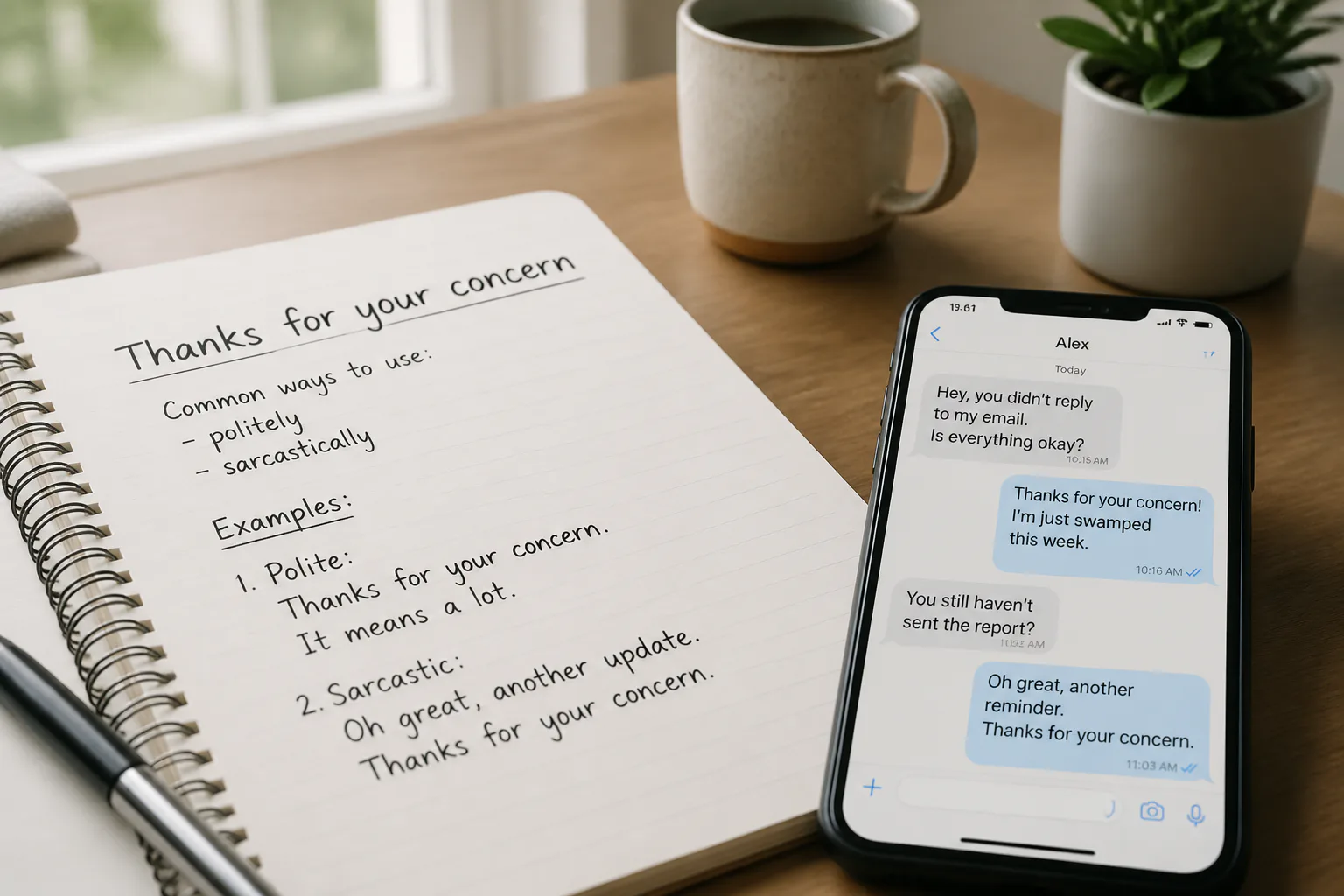
Used sincerely, the phrase is polite and appreciative. For example, “Thanks for your concern. I’m feeling much better today” shows that the speaker is genuinely thanking the other person for checking in.
Used sarcastically, the phrase can do the opposite. It can signal distance, irritation, or dismissal. For example, “Thanks for your concern, but I can handle it” may, depending on the voice and situation, sound less like gratitude and more like a warning to back off.
One useful way to hear the difference is to notice what comes next. A sincere speaker often adds reassurance or appreciation. A sarcastic speaker often adds a boundary, a contradiction, or a short ending that shuts down the conversation.
- Sincere: acknowledges real kindness or worry
- Neutral: polite but somewhat formal
- Sarcastic: dismisses attention, advice, or interference
How to respond
If the phrase sounds sincere, a simple reply such as “You’re welcome” or “Of course” works well. You can also say “I’m glad you’re okay” if the person has just reassured you. If the tone is neutral, “You’re welcome” is still appropriate and keeps the exchange calm.
If it sounds sarcastic, the safest response is usually not to push further. A short answer like “Okay” or no further comment may be better than continuing. That helps you avoid turning mild tension into an argument.
Polite Usage of the Phrase
When it sounds sincere
Most often, “thanks for your concern” is a respectful way to thank someone who has shown worry or compassion. It is common after illness, stress, bad news, or any situation where another person has checked on your wellbeing. In that sense, it is close to “I appreciate your concern.”
You will often hear it in slightly formal speech or writing. In casual conversation, many people choose shorter versions like “Thanks for checking on me” or “Thanks for caring.” If you want similar polite phrasing in everyday messages, compare how people use thanks for letting me know when they want to sound appreciative without sounding stiff.
Common sincere contexts
- After someone asks about your health
- After a friend checks on you during a hard time
- After a coworker expresses worry about a problem
- In a note or email acknowledging support
A sentence such as “I appreciate your concern, but there’s really nothing you can do to help” is still sincere, even though it sets a limit. The speaker is thankful, but also realistic about the situation.
Sarcastic or Ironic Usage
When the tone changes
The same phrase can sound sharp if the speaker feels judged, interrupted, or patronized. In that case, “thanks for your concern” does not function as real thanks. It becomes a polite-looking cover for annoyance.
This usually happens when someone offers unwanted advice, overreacts, or asks questions that feel intrusive. Tone matters a lot here. A flat voice, a pause, or an eye roll can completely change the meaning.
What sarcasm adds
In sarcastic use, the phrase often means one of these things:
- “I do not need your help.”
- “You are overstepping.”
- “Stop pretending to worry.”
- “This conversation is over.”
That is why context is everything. A phrase that looks polite on paper can sound hostile in speech. This is similar to how a brief acknowledgment like noted with thanks can sound either professional or abrupt depending on the setting.
Examples in Conversation
Sincere examples
- Friend: “I heard you were sick. Are you feeling better?”
Reply: “Thanks for your concern. I’m doing much better now.” - Coworker: “You seemed stressed yesterday, so I wanted to check in.”
Reply: “Thanks for your concern. I really appreciate it.” - Neighbor: “We saw the ambulance and got worried.”
Reply: “Thanks for your concern. Everything is under control.”
Sarcastic examples
- Person: “Are you sure you know what you’re doing?”
Reply: “Thanks for your concern, but I’ll manage.” - Person: “You always make things harder than they need to be.”
Reply: “Thanks for your concern.” - Person: “Maybe if you listened to me, this wouldn’t happen.”
Reply: “Right. Thanks for your concern.”
Quick comparison
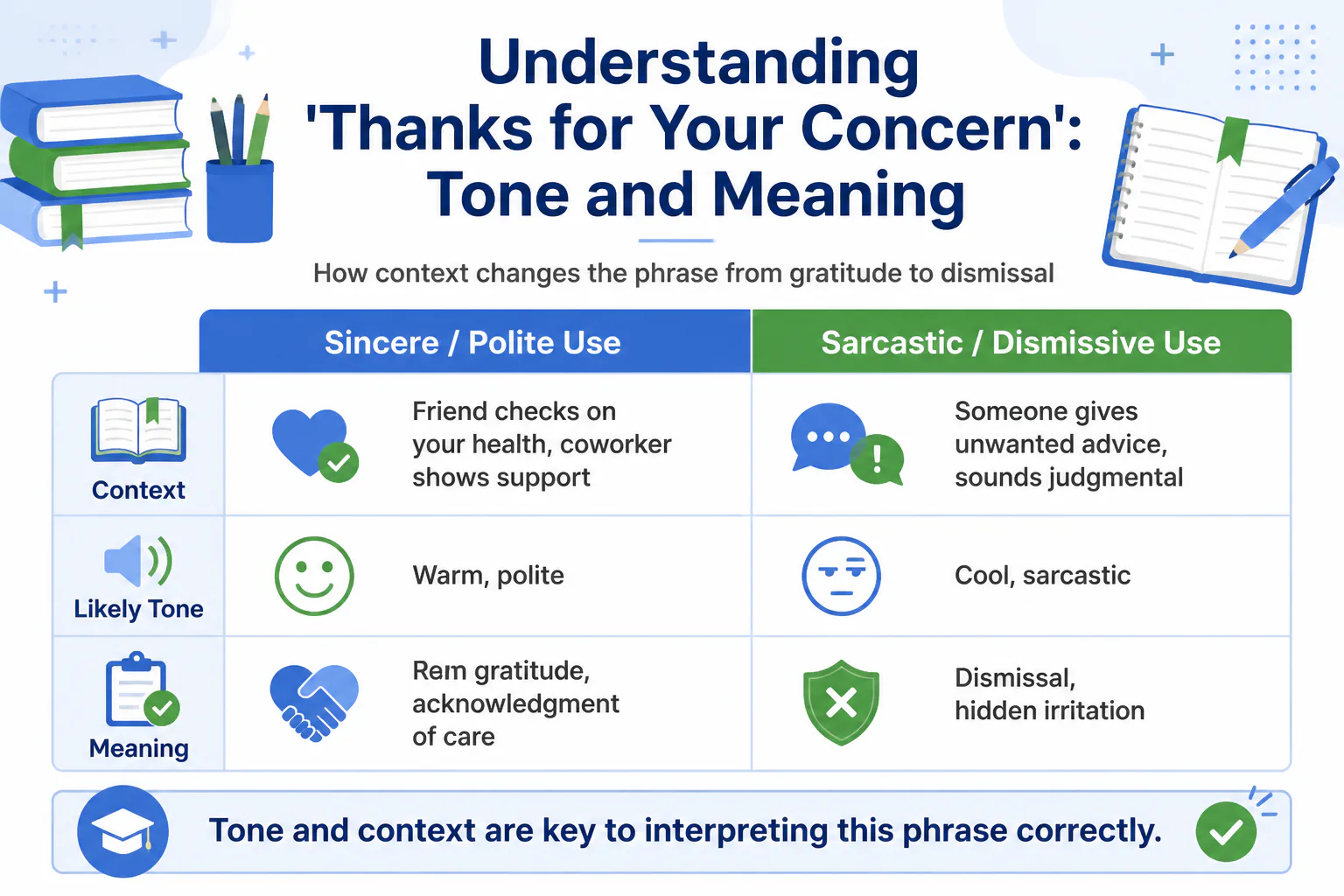
| Context | Likely tone | Meaning |
|---|---|---|
| Friend checks on your health | Warm | Real gratitude |
| Coworker shows support | Polite | Acknowledgment of care |
| Someone gives unwanted advice | Cool | Dismissal |
| Someone sounds judgmental | Sarcastic | Hidden irritation |
How to Respond
Best replies by tone
If the speaker sounds sincere, the best reply is simple: “You’re welcome,” “Of course,” or even “Thank you.” A neutral exchange can also end naturally with “You’re welcome.” The goal is to match the level of emotion without making the moment heavier than it needs to be.
If the phrase sounds guarded or sarcastic, do not force a warmer exchange. A short “Okay,” “Understood,” or silence is often better than defending yourself. In tense moments, people often switch to brief calming language much like no worries when they want to lower the temperature of a conversation.
Simple response guide
- If it sounds warm, reply warmly.
- If it sounds formal, reply briefly and politely.
- If it sounds sarcastic, do not argue over the wording.
- If you are unsure, choose a neutral response such as “You’re welcome.”
When in doubt, listen to tone and look at the situation that came before the phrase. The words themselves are polite, but the speaker’s intention decides whether they are offering gratitude or creating distance.
FAQs
Is “thanks for your concern” always polite?
No. The wording is polite, but the tone may be sincere, neutral, or sarcastic. Context tells you which meaning is intended.
What is the difference between “concern” and “consideration”?
Concern relates to care, worry, or personal interest. Consideration usually refers to thoughtful review or attention before making a decision. That is why “thank you for your concern” and “thank you for your consideration” are used in different situations.
Can I use this phrase in an email?
Yes, especially in polite or semi-formal messages about health, stress, or personal matters. In very casual emails, shorter alternatives may sound more natural.
Is “I appreciate your concern” different?
It is very similar, but it often sounds a little warmer and more direct. “Thanks for your concern” can sound slightly more formal or, in the wrong tone, more distant.
Conclusion
“Thanks for your concern” can express real appreciation or quiet dismissal, so the safest way to use and understand it is to pay attention to tone, context, and the relationship between the speakers.