
How Was Your Day Today? Meaning, Grammar, and Better Ways to Ask
You have probably asked someone “how was your day today” without thinking twice. Then later, maybe while texting, talking to a coworker, or writing dialogue, you paused and wondered: Is that actually right? The short answer is yes. How was your day today is grammatically correct, natural, and widely used in everyday English.
The more interesting question is not whether the phrase is allowed, but when it sounds best, how it compares with How was your day?, How is your day going?, and How has your day been?, and how to ask it in a way that creates better conversation. If you want to sound more natural, more polite, and more engaging in social or workplace conversations, this guide will help.
Is “How was your day today?” grammatically correct?
Yes, it is grammatically correct. It is also idiomatic, which means it fits the way real speakers naturally use English in everyday life.
Some learners worry that was sounds wrong if the day is not completely over yet. In strict timeline logic, that concern makes sense. But in actual conversation, a native speaker often treats the important part of the day, such as work or school, as finished. That is why informal English accepts questions like “How was your day today?” in the evening, after class, after work, or during a late check in.
For example, these all sound natural:
- After work: “Hey, how was your day today?”
- After school: “How was your day today at school?”
- At dinner: “So, how was your day today?”
- By text in the evening: “How was your day today?”
So if that is the phrase you already use, you do not need to “fix” it. It is normal, polite, and common.
What does “How was your day today?” really mean?
In most conversations, the phrase does not ask for a minute-by-minute report. It is usually a conversation starter, a friendly way to check in, and sometimes a sign of care for someone’s emotional well-being.
Depending on your tone and context, it can mean:
- “Did things go okay?”
- “What happened today?”
- “How are you feeling after work or school?”
- “Do you want to talk?”
That is why the same sentence can sound casual with friends, caring with a partner, or professional with coworkers you know well.
How was your day today vs. similar questions
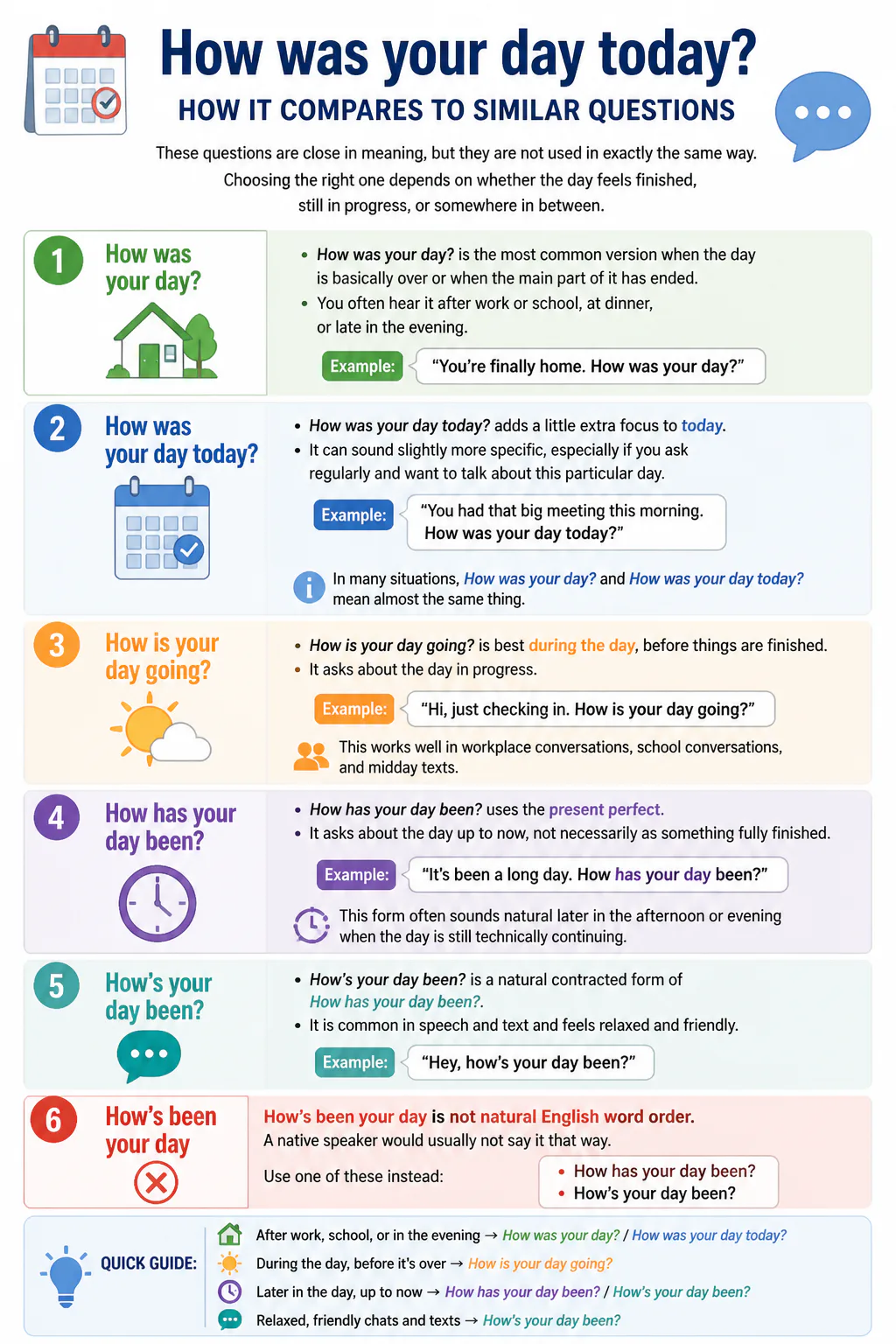
These questions are close in meaning, but they are not used in exactly the same way. Choosing the right one depends on whether the day feels finished, still in progress, or somewhere in between.
How was your day?
How was your day? is the most common version when the day is basically over or when the main part of it has ended. You often hear it after work or school, at dinner, or late in the evening.
Example:
- “You’re finally home. How was your day?”
How was your day today?
How was your day today? adds a little extra focus to today. It can sound slightly more specific, especially if you ask regularly and want to talk about this particular day.
Example:
- “You had that big meeting this morning. How was your day today?”
In many situations, How was your day? and How was your day today? mean almost the same thing.
How is your day going?
How is your day going? is best during the day, before things are finished. It asks about the day in progress.
Example:
- “Hi, just checking in. How is your day going?”
This works well in workplace conversations, school conversations, and midday texts.
How has your day been?
How has your day been? uses the present perfect. It asks about the day up to now, not necessarily as something fully finished.
Example:
- “It’s been a long day. How has your day been?”
This form often sounds natural later in the afternoon or evening when the day is still technically continuing.
How’s your day been?
How’s your day been? is a natural contracted form of How has your day been?. It is common in speech and text and feels relaxed and friendly.
Example:
- “Hey, how’s your day been?”
How’s been your day
How’s been your day is not natural English word order. A native speaker would usually not say it that way.
Use one of these instead:
- How has your day been?
- How’s your day been?
Quick comparison table
| Phrase | Natural English? | Best time to use it | Notes |
|---|---|---|---|
| How was your day? | Yes | After work or school, evening | Very common and natural |
| How was your day today? | Yes | Evening, after a finished activity | Specific but still idiomatic |
| How is your day going? | Yes | During the day | Focuses on the day in progress |
| How has your day been? | Yes | Later in the day, before it fully ends | Uses present perfect |
| How’s your day been? | Yes | Informal later-day conversation | Common contraction |
| How’s been your day? | No | Not recommended | Unnatural word order |
Why this question sometimes feels awkward
Even though how was your day today is correct, it often gets a short reply. That is not a grammar problem. It is a conversation design problem.
Many people answer with a one-word answer:
- “Fine.”
- “Good.”
- “Great.”
- “Awful.”
- “Busy.”
That happens because the question is friendly but broad. It works well as a greeting or basic small talk, but by itself it does not always invite detail.
How to make “How was your day today?” a better conversation starter
If you want more than “fine,” ask a more focused open-ended question after it. This is especially helpful with partners, friends, children, and coworkers you know well.
Better follow-up questions
- “What was the best part of your day?”
- “What was the most interesting thing you did today?”
- “What was the highlight of your day?”
- “Did today treat you well?”
- “What took up most of your energy today?”
- “Was anything stressful?”
- “Did anything make you laugh today?”
These are stronger because they guide the other person toward a real answer.
A simple 2-step approach
- Start with the familiar question: “How was your day today?”
- Add a specific follow-up question.
Example:
“How was your day today? What was the best part?”
That feels natural and creates space for a fuller response.
When to use it in different relationships
With coworkers
In casual workplace conversations, the phrase is usually polite and can be professional, especially with coworkers you know reasonably well.
Good examples:
- “How was your day today?”
- “How is your day going?”
- “How has your day been so far?”
If the workplace is very formal, you may choose something slightly more neutral, like:
- “How has your day been?”
- “How are things going today?”
With partners
With a partner, the phrase often does more than start casual conversation. It can show care, attention, and support. The most important part is not the sentence itself but whether you genuinely listen.
Better partner versions include:
- “How was your day today, really?”
- “What was the hardest part of your day?”
- “What was the highlight of your day?”
With friends
With friends, you can be more relaxed and playful. The wording depends on your shared style.
Natural options:
- “How was your day?”
- “How’s your day been?”
- “Did today treat you well?”
With children
Kids often give the shortest answers of all. “How was school?” may get you only “fine.” A more specific prompt usually works better.
Try:
- “What was the best part of your day?”
- “What was the funniest thing that happened today?”
- “What was easy today, and what was hard?”
A popular family version is Roses and Thorns: asking for the best and worst parts of the day. It turns a routine check in into a more meaningful conversation.
Common mistakes learners make
1. Using past tense too early in the day
If it is only 11 a.m., How was your day? can sound odd unless the relevant event is already over.
Better choice:
- How is your day going?
2. Confusing “How has your day been?” with “How was your day?”
Both are correct, but they frame time differently. How has your day been? sounds more like “up to this point.” How was your day? sounds more complete and finished.
3. Saying “How’s been your day”
This is one of the most common word-order mistakes. It is not natural.
Use:
- How has your day been?
- How’s your day been?
4. Asking the question with no real interest
People can hear the difference. If your tone is flat or distracted, the question becomes empty small talk. If you want a real answer, pause, listen, and ask a follow-up question.
Natural examples in real-life situations
After work
“Welcome home. How was your day today?”
“Pretty good, actually. The meeting went better than I expected.”
During the afternoon
“Hey, how is your day going?”
“Busy, but manageable.”
Evening text
“How’s your day been?”
“Long, but I’m finally relaxing.”
School conversation
“How was your day today?”
“Good. We did a science experiment.”
Travel companions meeting at night
Imagine two friends spend the day separately. One goes shopping, the other visits the Tower of London. When they meet back at the hotel late at night, How was your day? sounds completely natural because each person’s day activity is clearly finished.
Best alternatives to “How was your day today?”
You do not need to avoid the original phrase, but variety can make conversation feel fresher and more personal.
Casual alternatives
- How was your day?
- How’s your day been?
- Did today treat you well?
- How did things go today?
More open-ended alternatives
- What was the best part of your day?
- What was the most interesting thing you did today?
- What was your biggest win today?
- What was the highlight of your day?
Supportive alternatives
- How are you feeling after today?
- Was today rough, or did it go okay?
- Anything you want to talk about from today?
Professional alternatives
- How has your day been?
- How are things going today?
- How did everything go today?
So which version should you choose?
Use this quick guide:
- Choose How is your day going? if the day is still happening.
- Choose How has your day been? if you mean “so far,” especially later in the day.
- Choose How was your day? if the important part of the day is over.
- Choose How was your day today? if you want the same meaning with a little extra focus on today.
All of these can be correct. What matters most is the timing, the relationship, and the purpose of the question.
FAQ
Is it okay to say “How was your day today?”
Yes. It is grammatically correct, natural, and idiomatic in everyday English. People often use it in the evening or after work or school.
Is “How was your day today?” redundant because of “day” and “today”?
No. It can sound slightly repetitive in a literal sense, but it is still a normal and natural expression. In real conversation, speakers often add today for emphasis or specificity.
What is the difference between “How was your day?” and “How was your day today?”
The difference is small. How was your day? is more general. How was your day today? puts a bit more focus on this particular day, especially if you ask the question often.
When should I use “How is your day going?”
Use How is your day going? during the day, before the day feels finished. It is the best choice for midday check-ins and ongoing situations.
When should I use “How has your day been?”
Use How has your day been? when you are asking about the day up to now. It is common later in the afternoon or evening and uses the present perfect.
Is “How’s your day been?” correct?
Yes. How’s your day been? is a normal informal contraction of How has your day been?. It is very common in speech and messages.
Is “How’s been your day?” correct?
No. How’s been your day is not natural English word order. Say How has your day been? or How’s your day been? instead.
Why do people answer “How was your day?” with just one word?
Because it is a broad question and often functions as small talk or a simple greeting. If you want a longer answer, add an open-ended question such as “What was the best part of your day?”
Is “How was your day today?” polite in workplace conversations?
Yes, usually. It is polite and can be professional in casual workplace settings, especially with coworkers you know well. In more formal contexts, “How has your day been?” may sound slightly smoother.
What is a better question than “How was your day today?”
If you want richer conversation, try:
- What was the best part of your day?
- What was the most interesting thing you did today?
- What was the highlight of your day?
- Did today treat you well?
Conclusion
How was your day today is a perfectly natural question in English. It is grammatically correct, widely used in informal English, and works well as a polite conversation starter after work, after school, or during an evening check in.
The key is choosing the version that matches the moment. Use How is your day going? while the day is still unfolding. Use How has your day been? when you mean “so far.” Use How was your day? or How was your day today? when the day or its main activities feel complete.
If you want better conversations, do not stop at the first question. Add a thoughtful follow-up question, ask about the best part of your day, or try a simple Roses and Thorns check-in. Small changes like that can turn routine small talk into real connection.
If you are exploring everyday English questions like this one, keep going. Learning how timing, tone, and context affect simple phrases is one of the fastest ways to sound more natural and confident.

Related Posts
35 Other Ways to Say “However” (With Examples)

35 Other Ways to Say “You’re Welcome” (With Examples)
2 thoughts on “How Was Your Day Today? Meaning, Grammar, and Better Ways to Ask”