
TYSM Meaning: What It Stands For and How to Use It
If you have ever seen tysm in a text, comment, or DM and wondered what it means, you are not alone. It looks small, but it carries a lot of warmth. In everyday digital communication, tysm is a quick, friendly way to say “thank you so much” without typing the full phrase.
This little abbreviation shows up everywhere now, from text messaging and social media to online chat, gaming servers, and even some workplace chats. In this article, you’ll learn exactly what TYSM means, how people use it, where it came from, when it sounds appropriate, and when you should probably spell out your thank you instead.
What Does TYSM Mean?
TYSM stands for “thank you so much.” It is an initialism, which means each letter represents the first letter of a word in the full phrase.
People use tysm to express gratitude quickly in text messaging, social media, and other forms of casual communication. You may see it written in lowercase as tysm or in uppercase as TYSM. Both mean the same thing.
- tysm = thank you so much
- TY = thank you
- TYVM = thank you very much
- TUVM = thank you very much
- TVM = thanks very much
- TQ = thank you
- 10Q = thank you
- thanx = thanks
Is TYSM an Acronym or an Initialism?
Strictly speaking, tysm is an initialism, not a true acronym. That is because people usually say the full phrase “thank you so much” rather than pronounce tysm as a word.
In everyday conversation, though, many people casually call it an abbreviation or even an acronym. If you are being precise, initialism is the best term.
How TYSM Is Used in Text Messaging and Social Media
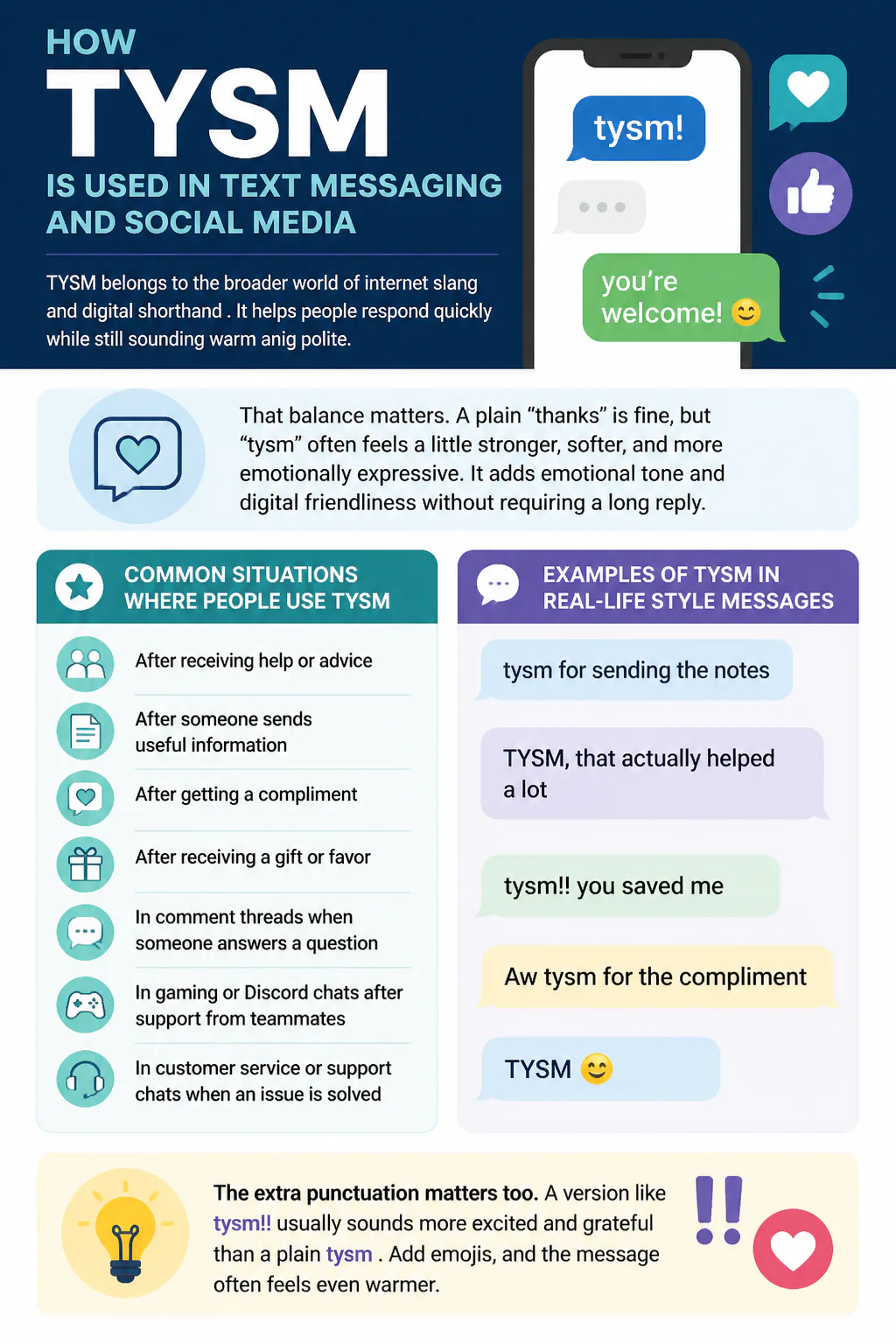
TYSM belongs to the broader world of internet slang and digital shorthand. It helps people respond quickly while still sounding warm and polite.
That balance matters. A plain “thanks” is fine, but “tysm” often feels a little stronger, softer, and more emotionally expressive. It adds emotional tone and digital friendliness without requiring a long reply.
Common situations where people use tysm
- After receiving help or advice
- After someone sends useful information
- After getting a compliment
- After receiving a gift or favor
- In comment threads when someone answers a question
- In gaming or Discord chats after support from teammates
- In customer service or support chats when an issue is solved
Examples of tysm in real-life style messages
- tysm for sending the notes
- TYSM, that actually helped a lot
- tysm!! you saved me
- Aw tysm for the compliment
- TYSM 😊
The extra punctuation matters too. A version like tysm!! usually sounds more excited and grateful than a plain tysm. Add emojis, and the message often feels even warmer.
What Tone Does TYSM Convey?
Tone is a big part of why tysm stays popular. It does more than shorten a sentence. It signals warmth, politeness, and often a more personal kind of appreciation than a simple “thx” or “thanks.”
Here is how the tone usually works:
| Expression | Typical Tone | Common Use |
|---|---|---|
| TY | Brief, efficient | Quick replies |
| Thanks | Neutral, everyday | General use |
| TYSM | Warm, appreciative | Casual and semi-formal chats |
| TYVM | Slightly more emphatic | Casual digital shorthand |
| Thank you so much | Clear, sincere, fuller | Broader use, including more formal situations |
In most cases, tysm feels sincere. Still, context matters. If the conversation is tense, overly short, or clearly ironic, someone might read it as sarcastic. That does happen, but usually the surrounding message makes the meaning obvious.
Where You’ll See TYSM Online
TYSM is common across many kinds of online communities. It is not tied to one app or age group, although it is often associated with younger users and faster-paced digital spaces.
Popular platforms where tysm appears
- Instagram comments and DMs
- TikTok captions, replies, and comments
- Twitter/X posts and quick replies
- Discord servers and direct messages
- Snapchat chats
- Reddit comment threads
- Text messaging and SMS
It also appears in chatrooms, gaming communities, fan spaces, and casual support conversations. In 2026, it is still widely understood and still feels current, especially in short-form digital interactions.
The Origin of TYSM in SMS Culture and Early Internet Slang
TYSM grew out of early SMS culture and internet messaging habits from the late 1990s and early 2000s. At the time, people often had character limits, slower typing, and tiny phone keypads. Shortened expressions became practical.
That era helped normalize a whole family of texting abbreviations such as:
- BRB
- LOL
- TY
- TYSM
Over time, these forms moved from text messaging into forums, social media, and modern messaging apps. What started as efficiency became part of the style of digital communication itself.
Is TYSM Informal or Formal?
TYSM is generally considered informal. It works best in casual communication and can sometimes fit semi-formal settings, depending on the relationship and platform.
Think of it this way: tysm is great for friendly speed, but not every setting rewards speed over clarity.
When tysm is usually appropriate
- Texting friends or family
- Replying in social media comments
- Thanking someone in a Discord or gaming chat
- Casual internal team chats
- Fast-moving workplace chats with people you know well
When you should avoid tysm
- Formal emails
- Job applications
- Academic writing
- Business proposals
- Official documents
- Serious customer-facing messages where tone must be polished
In those cases, writing out thank you or thank you so much is the safer choice.
TYSM in Work Chats: Acceptable or Too Casual?
This is where context really matters. In modern workplace chats, especially internal ones, tysm may be perfectly acceptable if the culture is relaxed and the message is brief.
For example, in Slack-style team communication or quick internal support threads, “tysm for the update” may sound efficient and polite. But in a formal email to a client, manager, or external partner, spelling it out is usually better.
A simple rule for work chats
- If the space is fast, internal, and conversational, tysm may work.
- If the message is external, formal, or high-stakes, write the full phrase.
- If you are unsure, choose “thank you so much” instead of the abbreviation.
TYSM vs TY, TYVM, and Other Thank-You Abbreviations
Not all gratitude abbreviations feel the same. Some are shorter and flatter, while others feel more expressive.
| Abbreviation | Meaning | Typical Feel |
|---|---|---|
| TY | Thank you | Very quick and basic |
| TYSM | Thank you so much | Warm and appreciative |
| TYVM | Thank you very much | Emphatic, slightly more old-school |
| TUVM | Thank you very much | Variant form |
| TVM | Thanks very much | Short and casual |
| TQ | Thank you | Regional and platform-specific |
| 10Q | Thank you | Playful, stylized shorthand |
| thanx | Thanks | Casual, older digital shorthand |
If your goal is to sound grateful but still natural, tysm is one of the strongest options in informal writing.
Can TYSM Be Misunderstood?
Yes, but usually only a little. Most people read tysm as sincere appreciation. That said, text-based messages lack voice and facial expression, so tone can sometimes get lost.
Someone may misread tysm if:
- The conversation is already tense
- The reply is extremely short
- The writer is known for sarcasm
- The message clashes with the rest of the context
If you want to make sincerity extra clear, you can expand it slightly:
- tysm, I really appreciate it
- TYSM for helping me out
- tysm!! that means a lot
These longer versions make the gratitude harder to misread.
How to Use TYSM Naturally
If you are new to internet slang, the easiest mistake is overthinking it. TYSM works best when it feels spontaneous.
Good ways to use tysm
- Use it after genuine help, kindness, or useful information
- Pair it with emojis if you want a softer tone
- Use lowercase for a relaxed feel
- Use uppercase for more visible emphasis
Examples by context
Friend: tysm for picking me up
Social media: aw tysm for the support
Gaming chat: TYSM for the revive
Work chat: tysm for turning that around so quickly
Customer support chat: TYSM, that fixed it
Digital Etiquette: When to Spell Out “Thank You So Much” Instead
Good digital etiquette is really about reading the room. TYSM is efficient, but full phrases still matter in situations where clarity, professionalism, or emotional depth count more.
Spell out the full phrase when:
- You are writing to someone older or less familiar with internet slang
- You want to sound polished and professional
- You are thanking someone for something serious or meaningful
- You are communicating across cultures or language backgrounds
There is nothing wrong with shorthand, but not every conversation benefits from it.
Why TYSM Remains Popular in 2026
Even though digital language changes fast, tysm has stayed relevant because it solves a simple communication need. People want quick replies, but they also want to sound human.
That is exactly where tysm fits. It combines speed with appreciation, and it works naturally on platforms built around short messages. In a world of fast replies, it still manages to carry real gratitude.
Quick Takeaways About TYSM
- TYSM means thank you so much.
- It is an initialism used in internet slang.
- It is common in text messaging, social media, and online chat.
- It sounds more grateful and warm than a simple “thanks.”
- It is mostly informal, though sometimes okay in semi-formal workplace chats.
- It became popular through early SMS culture and chatrooms.
- Context matters if you want to avoid sounding sarcastic or too casual.
FAQs About TYSM
What does tysm mean in texting?
In texting, tysm means thank you so much. It is a quick and friendly way to show appreciation.
Is tysm rude or polite?
TYSM is generally polite. It usually conveys warmth, gratitude, and digital friendliness, especially in casual conversation.
Is tysm formal?
No, tysm is usually informal. It can work in some semi-formal internal chats, but it is not ideal for formal writing or official emails.
What is the difference between TY and TYSM?
TY means thank you, while TYSM means thank you so much. TYSM sounds stronger, warmer, and more appreciative.
Can adults use tysm?
Yes. Although it is often associated with younger users, tysm is widely understood across age groups in digital communication.
Why do people write tysm in lowercase?
Lowercase often feels more relaxed and conversational online. Uppercase TYSM usually adds emphasis, but the meaning stays the same.
Is tysm the same as tyvm?
They are similar, but not identical. TYSM means thank you so much, while TYVM means thank you very much. Both express strong gratitude, though tysm often feels a bit softer and more current in casual messaging.
Where did tysm come from?
TYSM developed from early internet slang, chatrooms, and SMS culture in the late 1990s and early 2000s, when shorter messages were more practical.
Can tysm sound sarcastic?
It can, but usually only if the context suggests sarcasm. In most cases, tysm is read as sincere.
Should I use tysm in an email?
For casual internal emails, maybe. For formal or professional emails, it is better to write thank you or thank you so much in full.
Conclusion
TYSM may be short, but its meaning is simple and clear: thank you so much. As an abbreviation and initialism used in internet slang, it has become a reliable part of modern digital shorthand across text messaging, social media, and online chat.
The key is knowing when it fits. In casual communication, tysm sounds warm, polite, and natural. In formal writing, it is usually better to spell things out. If you want to communicate appreciation quickly without losing that human touch, tysm is one of the easiest and most effective tools in modern digital communication.
If you found this helpful, you may want to explore related language topics like texting abbreviations, digital etiquette, and how emotional tone works in online communities.