Safe Trip Meaning: Definition & Usage
Safe trip meaning is simple: it is a friendly farewell phrase used to wish someone a safe, pleasant journey. People say it when someone is leaving for travel by car, plane, train, bus, or even a short local trip. In everyday English, it shows care, warmth, and concern without sounding too formal.
The phrase is common in speech, texts, cards, and travel goodbyes. If you want to sound natural, the main point is this: use it just before someone leaves or when referring to their journey. In learner dictionaries, phrases like this are easiest to understand through clear definitions, audio pronunciation, and real examples, which is why Cambridge English Dictionary entries are especially useful for studying everyday expressions.
Definition of ‘Safe Trip’
Core meaning
- Safe trip is a common expression that conveys the hope that someone will have a safe, secure, and enjoyable journey.
- It is used as a farewell wish for a person who is traveling.
- The focus is mainly on safety, but the phrase also carries kindness and good intention.
In natural English, you usually hear it in sentences such as “Have a safe trip” or “I hope you have a safe trip.” On its own, “safe trip” can appear in a message or note, but in full conversation the complete wish sounds more natural. That is why “Have a safe trip” is more common than simply saying “safe trip” by itself.
How the phrase works
This expression functions as a farewell, not as a description of a trip that already happened. You say it before or at the start of travel, not after the person arrives. For example, you would say it at the airport, at the train station, in a text before departure, or as someone gets into a car.
The phrase is also slightly different from “have a nice trip.” “Nice trip” emphasizes enjoyment, while “safe trip” emphasizes protection and well-being. Many speakers combine both ideas by saying something like, “Have a safe trip and enjoy your vacation.”
Tone and etiquette
The tone is warm, polite, and caring. It works well in both personal and professional settings because it is friendly without being too casual. You can say it to family, friends, coworkers, clients, classmates, or neighbors.
Because it is short and clear, the phrase fits many situations:
- in person during a goodbye
- in a text message before departure
- in an email to a colleague traveling for work
- in a card or note for someone going on holiday
Natural forms to use
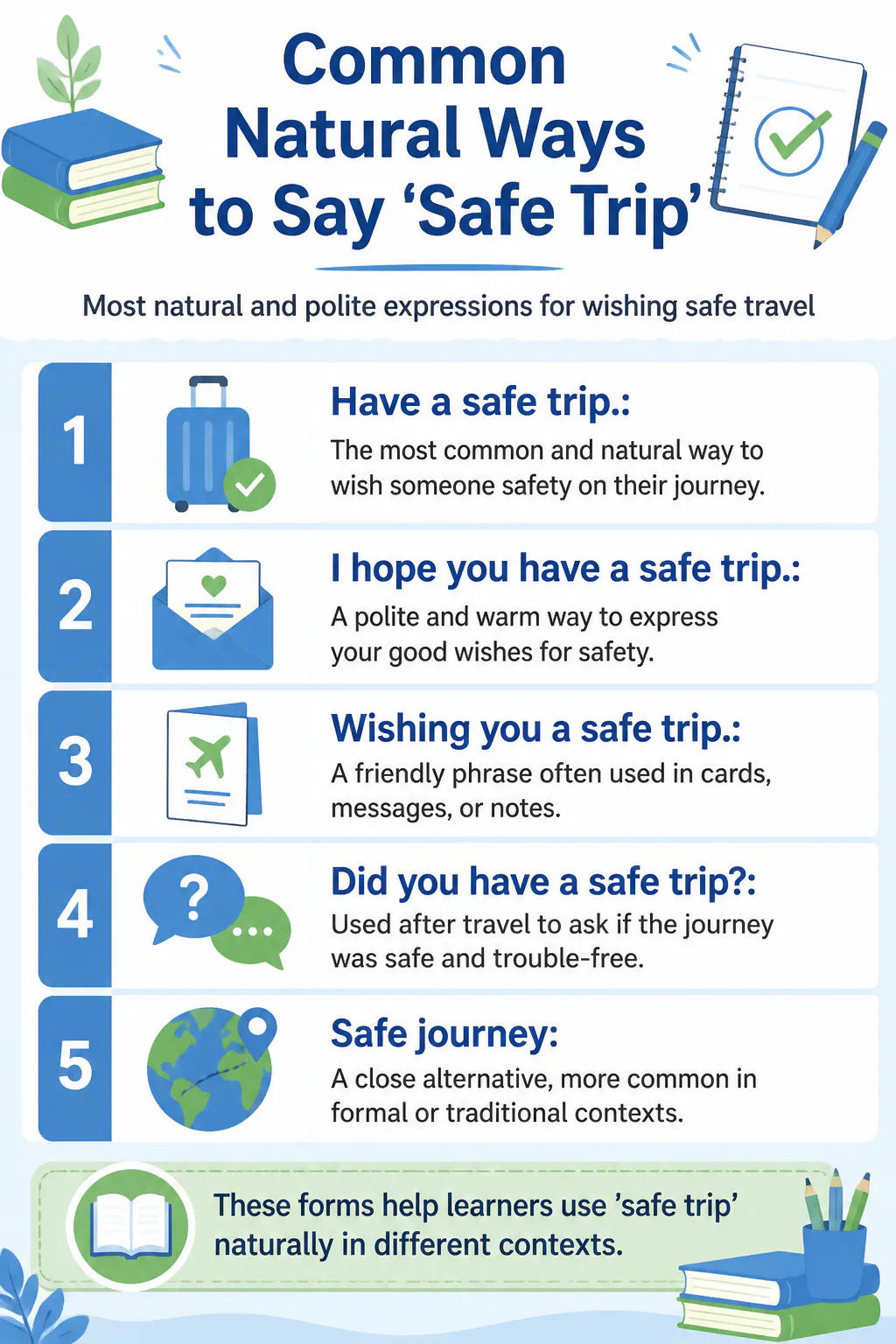
Some forms sound more natural than others. In standard English, these are the most common ways to use the phrase:
- Have a safe trip.
- I hope you have a safe trip.
- Wishing you a safe trip.
- Did you have a safe trip?
The last example is used after the journey, when you are asking whether the person arrived without trouble. If you want a close alternative, many speakers use safe journey in exactly the same way, especially in more formal or slightly more traditional wording.
How Cambridge helps learners
For learners, Cambridge English Dictionary is useful because it gives clear definitions and audio pronunciations in both British and American English. It also includes guidewords that help users find the right meaning quickly, plus thousands of real examples that show how words and phrases are used in context.
That matters with a phrase like this because learners often know the individual words but still need help with tone, timing, and natural patterns. Cambridge entries draw on the Cambridge English Corpus, a database of over 2 billion words, so example usage reflects real English rather than invented textbook language. The dictionary also supports learners from CEFR levels A1 to C2, which makes it practical for both intermediate and advanced study.
Common Usage
When people say it
People usually say “have a safe trip” when someone is about to leave. It is common for holidays, business travel, school trips, family visits, and weekend travel. The phrase works whether the journey is long or short.
In conversation, context matters. If the trip seems stressful, long, or weather-related, “safe trip” can sound more thoughtful than “have fun.” A related farewell, safe travels, often sounds a little broader because it can refer to a whole period of travel with several stops, not just one journey.
Where it fits best
You can use the phrase in these common contexts:
- airport, station, or roadside goodbyes
- texting a friend before a flight
- emailing a coworker who is traveling
- saying goodbye before a holiday or family visit
- welcoming someone later with “Did you have a safe trip?”
Examples in Sentences
Everyday examples
- Have a safe trip, and call me when you arrive.
- I hope you have a safe trip to Chicago tomorrow.
- Wishing you a safe trip home after the conference.
- They left early this morning, so I sent a message saying, “Have a safe trip.”
- Did you have a safe trip back from New York?
- Thanks for visiting us. Have a safe trip home.
- My boss wrote, “Have a safe trip and good luck with the meeting.”
- We stood at the door and waved goodbye, telling them to have a safe trip.
Common mistakes
- Saying it after arrival instead of before departure.
- Using only “safe trip” in formal writing when “Have a safe trip” is clearer.
- Confusing it with “nice trip,” which stresses enjoyment more than safety.
- Using it in situations that do not involve travel.
If you are comparing similar phrases, safe journey meaning is almost the same, but the choice often depends on habit, region, and personal style.
Regional Nuances
British and American use
Both British and American English understand and use the phrase easily. In the US, “Have a safe trip” is very common and sounds natural in daily speech. In the UK, people also use it, though “safe journey” may sound slightly more familiar in some contexts.
These differences are small, not strict rules. Most English speakers will understand “safe trip,” “safe journey,” and “safe travels” without confusion. Cambridge English Dictionary helps learners hear these differences through audio pronunciations in both British and American English, and its examples make the tone clearer.
Social meaning
Culturally, the phrase shows care rather than strong emotion. It is warmer than a plain goodbye but less personal than a long emotional message. That makes it useful in workplaces, schools, and everyday social life.
It is also common in text messages and online chat because it is short, polite, and easy to understand. Even when written briefly, it still carries the idea that the speaker wants the traveler to arrive safely.
FAQs
Does “safe trip” mean “have a good trip”?
Not exactly. “Have a good trip” focuses on enjoyment, while “have a safe trip” focuses on safety. People often use both together when they want to express both ideas.
Is it correct to say just “safe trip”?
It is understandable, especially in a quick message, but “Have a safe trip” sounds more complete and natural in standard English.
Can I use “safe trip” in professional situations?
Yes. It is polite, neutral, and appropriate for colleagues, clients, teachers, and other professional contacts.
What is the difference between “safe trip” and “safe travels”?
“Safe trip” usually refers to one journey, while “safe travels” can suggest a longer travel period or multiple parts of a journey. In casual use, many speakers treat them as close alternatives.
Conclusion
Safe trip is a simple, caring phrase to use just before someone travels, whether the situation is personal, casual, or professional.