

Safe Journey Meaning: Definition & Usage
Safe journey meaning is a polite farewell wish that expresses hope that someone travels safely and arrives well. People say it when a person is leaving for a trip, going home, or returning to another place. The phrase is simple, warm, and widely understood in English as a way to show care for another person’s well-being.
In everyday use, safe journey works both literally and socially. Literally, it refers to safety during travel. Socially, it functions as a kind and supportive goodbye, much like saying you hope everything goes smoothly on the way.
Definition of ‘Safe Journey’
Core meaning
Safe journey means a wish for someone’s safe travel. It is usually said to a person who is about to leave, and it expresses hope that the trip will be free from harm or trouble. In natural English, it often appears as part of a longer goodbye, such as “Have a safe journey” or “Wishing you a safe journey.”
The word safe shows protection and well-being, while journey refers to travel from one place to another. Together, the phrase carries a clear message of care. It is not just about transport or distance; it is also a warm human gesture.
How the phrase works
As a farewell phrase, safe journey is more common in speech and messages than as a standalone dictionary-style expression. Most speakers use it in a complete sentence. For example, “Have a safe journey home” sounds more natural than simply saying “Safe journey,” although the shorter form is still understood.
This is why learners often see several related forms in real usage. Common patterns include:
- Have a safe journey.
- Wishing you a safe journey.
- Hope you have a safe journey home.
- Have a safe journey back.
Tone and etiquette
- The tone of the phrase is kind, polite, and caring.
- It is suitable in both personal and professional situations.
- You can say it to family, friends, colleagues, guests, or anyone who is about to travel.
It is especially common when the speaker wants to sound thoughtful without being too emotional. In that way, it works much like other everyday good wishes, such as have a great day, which also combine politeness with warmth.
Examples in natural use
These short examples show how English speakers normally use the phrase:
- Have a safe journey to London.
- Wishing you a safe journey home after the conference.
- Thanks for visiting us. Safe journey back.
- I hope you have a safe journey and arrive on time.
Cultural note
The phrase carries cultural weight because travel has long been linked with uncertainty, distance, and hope for safe return. For that reason, wishing someone a safe journey has a long history as a positive expression of concern and goodwill. In older usage and many traditions, people prayed or gave thanks for a safe journey, which helps explain why the phrase still feels sincere today.
Dictionary treatment of phrases like this is especially useful because meaning depends on context, tone, and pattern. In Cambridge English Dictionary, learners can use clear definitions, British and American audio pronunciations, guidewords, and example sentences to understand how farewell wishes like this work in real English. Its examples are drawn from the Cambridge English Corpus, a database of over 2 billion words, so the phrase is shown in authentic use rather than invented textbook lines.
Common Usage
When people say it
People usually say safe journey when someone is leaving for a trip of any length. The trip may be long or short, formal or casual. What matters is that the speaker wants to wish the traveler well.
Typical situations include:
- Someone leaving for a holiday
- A friend driving home late
- A guest returning after a visit
- A colleague traveling for work
- A family member going abroad
Common sentence patterns
The phrase is often expanded with extra detail, especially the destination or direction. You may hear “Have a safe journey home,” “Have a safe journey back,” or “Wishing you a safe journey tomorrow.” If the focus is a shorter trip, some speakers prefer safe trip because it sounds slightly more conversational in modern English.
In formal writing, messages, and cards, “Wishing you a safe journey” sounds polished and courteous. In everyday conversation, “Have a safe journey” is usually the most natural choice.
Regional Variations
Similar phrases in English
English speakers use several close alternatives, and the choice often depends on region, style, and habit rather than a major difference in meaning. All of the following are natural:
- safe travels
- travel safe
- have a safe trip
- wishing you a safe journey
- have a great trip
- have a pleasant trip
- have a good journey
British and American preferences
Both British and American English understand safe journey, but some alternatives are more common in certain places or settings. Safe travels is especially common in American English and can sound slightly more modern or idiomatic. Have a good journey and safe journey can sound a little more traditional or formal.
Some farewell phrases also shift by context rather than region. For example, a host saying goodbye to a guest may choose “Have a safe journey home,” while a short text message may simply say “Travel safe.” If you want another close form, have a safe journey is the most complete and widely acceptable version.
Meaning versus feeling
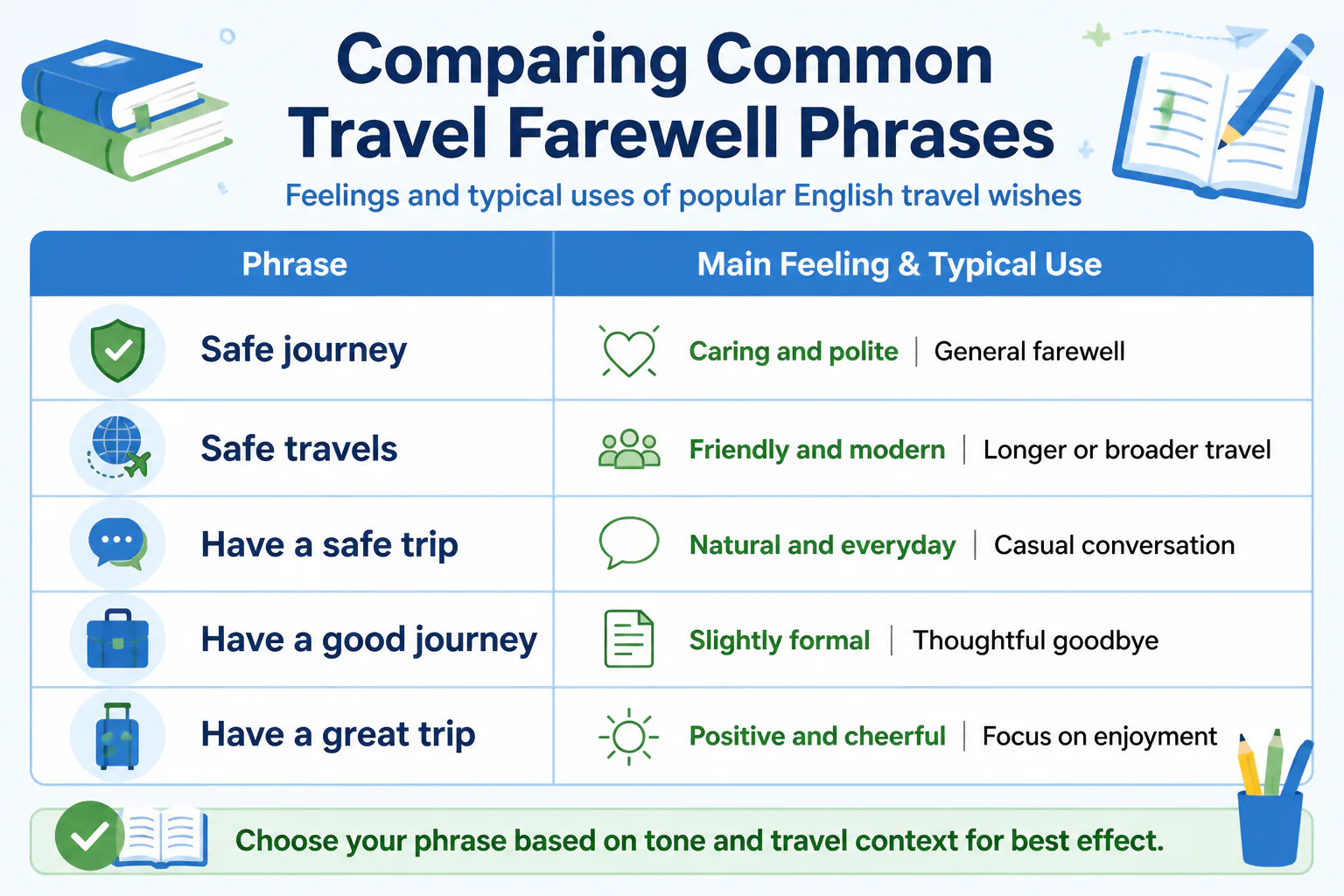
These variations all express care, but they do not feel exactly the same. Safe journey sounds warm and steady. Safe travels feels broad and flexible, especially for longer or multi-stop travel. Have a great trip focuses more on enjoyment than safety.
| Phrase | Main feeling | Typical use |
|---|---|---|
| Safe journey | Caring and polite | General farewell |
| Safe travels | Friendly and modern | Longer or broader travel |
| Have a safe trip | Natural and everyday | Casual conversation |
| Have a good journey | Slightly formal | Thoughtful goodbye |
| Have a great trip | Positive and cheerful | Focus on enjoyment |
Examples of ‘Safe Journey’ in Sentences
Everyday examples
- Have a safe journey home after the party.
- We loved having you here. Wishing you a safe journey back.
- Call me when you arrive, and have a safe journey.
- Our team wishes you a safe journey to New York.
- Thanks for coming to visit us. Safe journey home.
More formal examples
- On behalf of the company, I wish you a safe journey and a successful visit.
- Please accept our best wishes for a safe journey home.
- We hope you have a safe journey and a pleasant stay.
- Thank you for attending the event, and have a safe journey back.
What to avoid
- Use safe, not save.
- Do not force the phrase into every goodbye; use it when travel is actually involved.
- If you want a full sentence, say “Have a safe journey,” not only “Safe journey,” in more formal contexts.
FAQs
Is “safe journey” correct English?
Yes. It is a correct and widely understood English expression used to wish someone safety while traveling. The fuller form “Have a safe journey” is often the most natural.
Is “safe journey” formal or informal?
It can be both. The phrase itself is neutral, so it works in casual speech, polite emails, and professional goodbyes.
What is the difference between “safe journey” and “safe travels”?
Both express the same basic wish. “Safe travels” often sounds slightly more modern and flexible, while “safe journey” can sound a bit more traditional or formal.
Can I say “safe journey home”?
Yes. That is a very natural variation and is common when someone is returning from a visit, event, or meeting.
Conclusion
Safe journey is a warm and useful phrase for wishing someone well before travel, whether the setting is personal, professional, formal, or casual.