

Other Words for Rest in Peace: Respectful Phrases for Memorials
If you are looking for other words for rest in peace, the best alternatives depend on where the message will appear and what feels respectful to the person or family being remembered. Some phrases are simple and universal, while others are spiritual, poetic, or deeply personal. Choosing carefully helps your words feel sincere in sympathy cards, obituaries, memorial posts, engravings, and private messages.
A thoughtful expression can do more than replace a familiar phrase. It can reflect the family’s beliefs, honor the person’s memory, and fit the tone of the moment. In many cases, a short line works best for keepsakes, while a fuller expression suits a longer tribute.
Common Alternatives to ‘Rest in Peace’
Widely used phrases
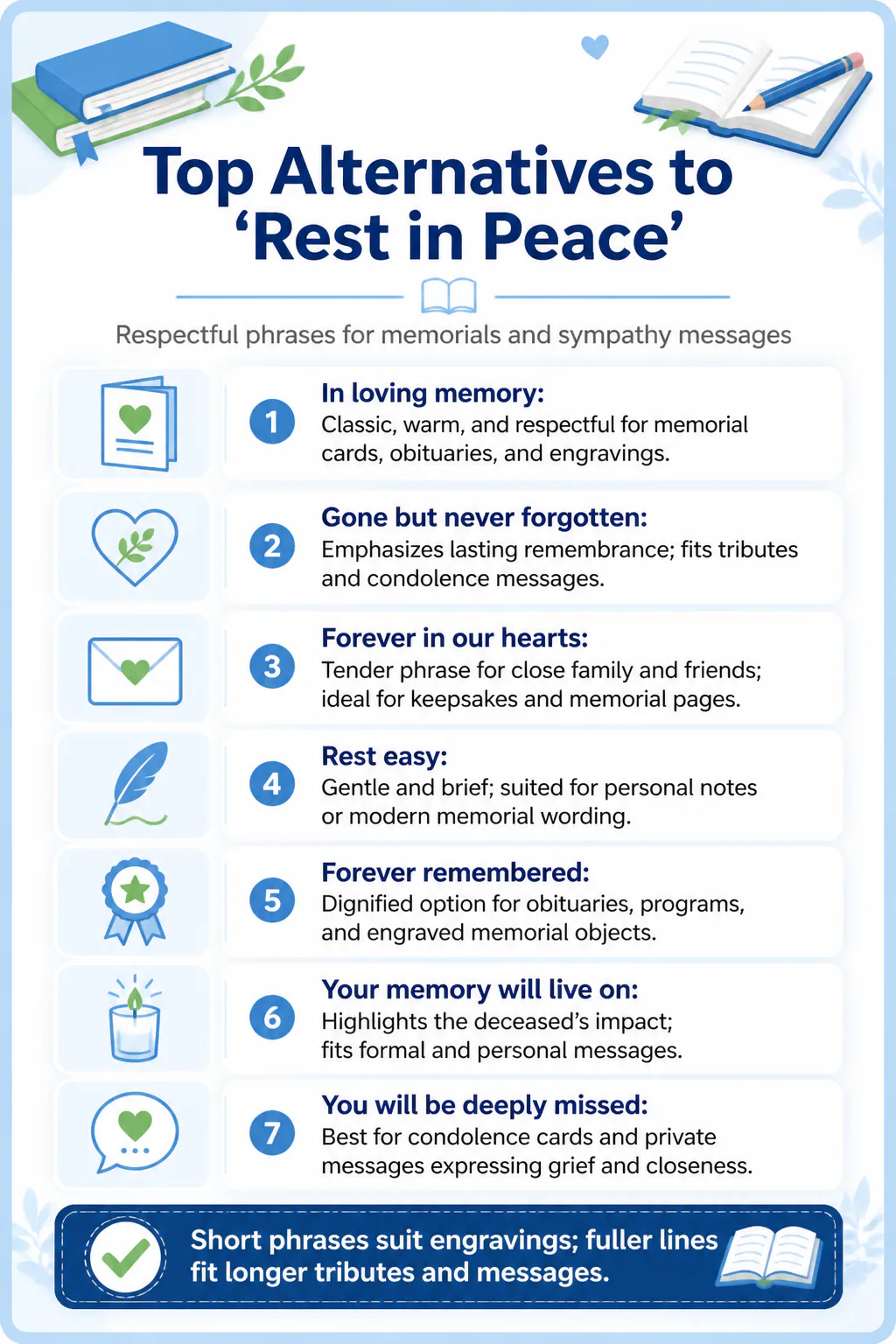
- In loving memory, a classic choice for memorial cards, obituaries, and engraved items. It is warm, respectful, and suitable across many beliefs.
- Gone but never forgotten, appropriate when you want to emphasize lasting remembrance. It works well in tributes and condolence messages.
- Forever in our hearts, a tender phrase for close family members, partners, or dear friends. It is often used on keepsakes and memorial pages.
- Rest easy, gentle and brief, often chosen for personal notes or modern memorial wording. Use it when the tone is intimate but still respectful.
- Forever remembered, a dignified option for obituaries, programs, and engraved memorial objects.
- Your memory will live on, suitable when highlighting the impact a person had on others. It fits both formal and personal messages.
- You will be deeply missed, best for condolence cards and private messages where grief and closeness are central.
- A life well lived, fitting for memorial services and obituary wording, especially when honoring a full and meaningful life.
When each phrase fits best
Short alternatives usually work best on engravings, urn plaques, and keepsakes. Phrases like “In loving memory,” “Rest easy,” and “Forever remembered” are concise enough to feel elegant without losing meaning.
For longer memorial writing, you can choose fuller lines that express remembrance more directly. Obituaries and memorial pages often carry phrases such as “Your memory will live on” or “You will be deeply missed,” since they leave room for more emotion and detail.
If you want more options beyond the most familiar wording, this roundup of rest in peace synonyms can help you compare tone before choosing one for a card or tribute.
How to make them personal
Even a familiar phrase feels more sincere when you adapt it. Adding the person’s name, dates, a shared memory, or a brief note of love can turn a standard line into something much more meaningful.
- “Forever in our hearts, Daniel.”
- “In loving memory of Maria, whose kindness touched everyone she met.”
- “You will be deeply missed by all who knew you.”
- “A life well lived, a love well shared.”
This is especially helpful when the phrase appears in a sympathy card or private message. The wording stays respectful, but the added detail makes it feel real rather than formulaic.
Spiritual Alternatives
Faith-centered expressions
- May you find eternal peace, suitable when the deceased or family holds spiritual beliefs about the afterlife.
- May your soul be at peace, appropriate in a spiritual context and often used in prayers or formal condolences.
- At peace with the Lord, fitting in Christian settings where faith language is welcome.
- May perpetual light shine upon you, a reverent choice for religious memorial wording.
When to use spiritual wording
Religious or spiritual phrases can bring comfort when they match the beliefs of the deceased and the bereaved family. They are often used in memorial services, faith-based obituaries, and condolence notes shared within a religious community.
If you are unsure about the family’s beliefs, it is safer to choose neutral language. Many people prefer a respectful expression of remembrance over a spiritual message that feels out of place. If you need a broader set of ideas, this guide on what to say instead offers phrasing that stays considerate across different contexts.
Secular Alternatives
Neutral memorial phrases
- Forever in our hearts, affectionate and non-religious, ideal for families and close friends.
- Gone but never forgotten, one of the strongest secular alternatives because it centers memory rather than belief.
- You will be deeply missed, direct and heartfelt for cards, messages, and memorial remarks.
- Your memory will live on, fitting when honoring influence, legacy, or public service.
- Gone but not forgotten, simple and traditional, with a slightly more understated tone.
- Forever remembered, good for formal tributes and engraved wording.
- A life well lived, especially appropriate when celebrating the person’s character and accomplishments.
Best uses for secular wording
These phrases are useful when you want to avoid spiritual assumptions. They fit well in workplace condolences, public statements, memorial programs, and messages to families whose beliefs you do not know well.
Secular wording can still feel deeply warm. In practice, many people choosing a rest in peace other term want language that honors the person without referring to heaven, prayer, or eternal rest.
| Phrase | Tone | Best Context |
|---|---|---|
| Forever in our hearts | Warm and personal | Keepsakes, family tributes |
| Gone but never forgotten | Classic and enduring | Cards, obituaries, memorial posts |
| You will be deeply missed | Direct and emotional | Private messages, sympathy cards |
| A life well lived | Dignified and reflective | Obituaries, services, memorial pages |
Culturally Sensitive Expressions
Respecting background and tradition
- Choose phrases that match the family’s customs rather than defaulting to the most common wording.
- Use simple remembrance language if you are unfamiliar with the person’s religious or cultural tradition.
- Keep engraved or public wording especially careful, since it will be seen by many people over time.
- When in doubt, let remembrance lead and belief-specific language step back.
Safer cross-cultural choices
Expressions such as “In loving memory,” “Forever remembered,” and “You will be deeply missed” are often safer across different cultural backgrounds because they focus on love and remembrance. They avoid assumptions while still sounding sincere and compassionate.
In multicultural settings, that balance matters. A respectful phrase should support the grieving family, not draw attention to a difference in beliefs or customs.
How to Choose the Right Phrase
Match the setting
Start with the context. For engravings and keepsakes, choose short lines such as “In loving memory” or “Forever remembered.” For obituaries, memorial pages, and service programs, longer expressions such as “Your memory will live on” or “A life well lived” often feel more complete.
Consider your relationship
Your closeness to the person matters too. A deeply personal phrase like “Forever in our hearts” suits family and close friends, while “You will be deeply missed” can work well in both personal and professional condolences.
Respect beliefs first
If you know the family is religious, a spiritual phrase can offer comfort. If you are unsure, choose neutral wording and personalize it with the person’s name, dates, or a short memory. That keeps the message respectful, sincere, and appropriate.
FAQs
What can I say instead of rest in peace?
You can say “In loving memory,” “Gone but never forgotten,” “Forever in our hearts,” “Rest easy,” or “You will be deeply missed.” The best choice depends on the setting and the family’s beliefs.
What is a non-religious alternative to rest in peace?
Good secular options include “Forever remembered,” “Your memory will live on,” “Gone but not forgotten,” and “A life well lived.” These avoid spiritual language while remaining respectful.
Which phrases work best for engravings?
Short phrases are usually best for engravings and keepsakes. “In loving memory,” “Forever remembered,” and “Forever in our hearts” are clear, elegant, and fitting for limited space.
Should I avoid spiritual phrases?
Avoid them if you do not know the family’s beliefs. Neutral remembrance phrases are the safer and more considerate option when belief or cultural background is uncertain.
Conclusion
The best other words for rest in peace are the ones that fit the person, the family, and the moment with care. Whether you choose a spiritual, secular, or simple remembrance phrase, thoughtful wording helps your message feel genuine and kind.

Related Posts

30 Other Ways to Say “Thank You” (With Examples)
ONG Meaning in Text: What Does ONG Stand For?