

What Can I Say Instead of Rest in Peace: Meaningful Alternatives for Condolences
If you are wondering what can i say instead of rest in peace, the short answer is this: choose words that feel sincere, respectful, and suited to the person, family, and setting. “Rest in peace” is familiar and comforting, but it does not always feel personal enough for every condolence message, obituary, engraving, or memorial post. A thoughtful alternative can better reflect shared beliefs, a close relationship, or the tone of the tribute you want to give.
There are many respectful options, from simple phrases like “Rest easy” to warmer tributes such as “Forever in our hearts” and faith-based expressions that honor specific traditions. The best choice depends on where you are writing it, how well you knew the person, and what the family would find comforting.
Why Say Something Different Than ‘Rest in Peace’?
Make the message more personal
People often look for a different phrase because grief is personal, and a standard expression can feel too distant. If the deceased was a close friend, parent, spouse, or mentor, a more specific tribute often sounds warmer and more heartfelt. Adding a name, a memory, or a gentle line of affection can make your condolences feel more genuine.
Respect beliefs and traditions
Not every family uses the same religious or cultural language around death. Some prefer spiritual phrases, while others want something simple and nonreligious. Choosing words that match the family’s beliefs shows care, especially in memorial settings where language carries lasting meaning.
Match the context
The right wording also depends on where it will appear. Short phrases work well for engravings on urns or memorial jewelry, while sympathy cards and obituaries leave more room for fuller, gentler wording. If you need more beautiful ways to express remembrance, softer alternatives often fit formal and personal tributes better than a single standard phrase.
Choose by tone and setting
Here is a simple way to think about alternatives:
- Simple and universal: In loving memory, Gone but never forgotten, Forever in our hearts
- Gentle and comforting: Rest easy, Sleep peacefully, May you find eternal peace
- Poetic and reflective: Your memory lives on, Till we meet again, May your soul be at peace
- Personal and warm: You will always be loved, Your kindness will be remembered, We carry you with us
- Faith-based: Grant them eternal rest, Om Shanti, Inna lillahi wa inna ilayhi raji’un
The safest approach is to choose language that sounds natural coming from you. A short, sincere line is almost always better than a dramatic phrase that does not reflect your relationship with the deceased or the family’s values.
Common Alternatives to ‘Rest in Peace’
Widely accepted phrases
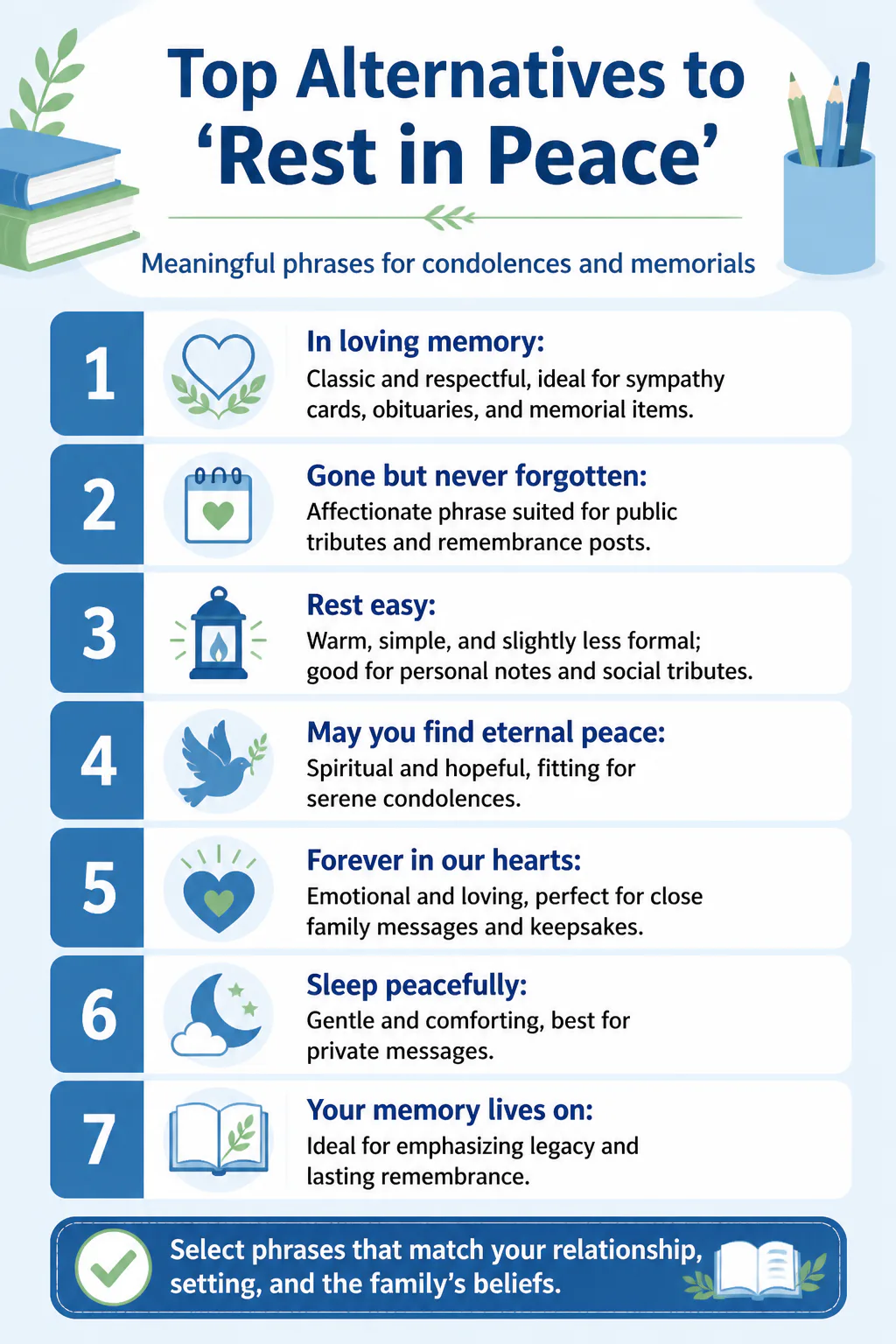
- In loving memory – suitable for sympathy cards, obituaries, and memorial items
- Gone but never forgotten – good for public tributes and remembrance posts
- Rest easy – warm, simple, and slightly less formal
- May you find eternal peace – spiritual without being too narrow
- Forever in our hearts – fitting for close family and personal remembrance
- Sleep peacefully – gentle and comforting in private messages
- Your memory lives on – ideal when emphasizing legacy
- Till we meet again – comforting for those who believe in reunion after death
How these phrases differ
Some alternatives are formal, while others feel intimate. “In loving memory” works almost anywhere, but “Rest easy” feels more conversational and personal. If you are choosing wording for a card or tribute note, it helps to compare a rest in peace other term by tone rather than by popularity alone.
| Phrase | Best Use | Tone |
|---|---|---|
| In loving memory | Obituaries, engravings, cards | Classic and respectful |
| Rest easy | Personal notes, social tributes | Warm and gentle |
| Forever in our hearts | Family messages, memorial keepsakes | Emotional and loving |
| Gone but never forgotten | Public remembrance posts | Affectionate and familiar |
| May you find eternal peace | Spiritual condolences | Hopeful and serene |
Religious Variations
Christian expressions
- Grant them eternal rest
- Eternal rest grant unto them, O Lord
These phrases are especially appropriate in Christian condolences, funeral programs, and prayer-based memorials. They carry a reverent tone and are best used when you know the family is comfortable with explicitly Christian language.
Hindu expressions
- Om Shanti
- Sadgati prapt ho
These are suitable in Hindu contexts and express peace for the departed soul. If you are not familiar with the family’s customs, keep the wording simple and respectful rather than adding extra religious language you do not fully understand.
Islamic expressions
- Inna lillahi wa inna ilayhi raji’un
- May Allah grant them Jannah
These phrases are appropriate in Islamic condolences and are often used after hearing of a death. Public messages need extra care, and the same caution applies whenever people share grief online: just as wording matters in sensitive situations like what to say instead of a private family matter, memorial posts should avoid personal details unless the family has already made them public.
Personal Expressions
Short personal tributes
- Forever loved, never forgotten
- You will always be with us
- Your love remains with us
- Your kindness will be remembered
- We will cherish your memory
Ways to make them more meaningful
A personalized line often means more than a stock phrase. You can adapt an expression with the person’s name, important dates, or a brief memory that captures who they were. For example, “Forever in our hearts, Maria” feels more intimate than the phrase alone.
These kinds of tributes work especially well on sympathy cards, memorial jewelry, and remembrance pages. For engravings, keep it brief and clear. For cards or obituary notes, you have more room to pair the phrase with a sentence about the person’s character, love, or lasting impact.
When and How to Use These Alternatives
Choose by format
Use shorter phrases for urn engravings, memorial jewelry, and keepsakes, where space is limited and every word needs weight. “In loving memory” and “Forever in our hearts” are strong choices because they are concise and timeless. Obituaries and sympathy cards allow fuller wording, so you can add a personal sentence after the phrase.
Choose by relationship
If you were close to the deceased, warmer wording often feels more natural. “Rest easy” or “You will always be loved” can sound tender and authentic in a message from a friend or family member. If your connection was more formal, choose respectful lines such as “In loving memory” or “May you find eternal peace.”
Choose by audience
Think about who will read the message. A private note can be more emotional, while a public tribute should stay respectful and careful. Avoid sharing private circumstances, family details, or sensitive information unless the family has already made those details public.
- Pick a phrase that matches the family’s beliefs.
- Match the tone to the setting, such as a card, obituary, engraving, or public post.
- Add a personal touch only if it feels natural and appropriate.
- Keep the message simple rather than trying to sound poetic for its own sake.
FAQs
What is the best nonreligious alternative?
“In loving memory,” “Gone but never forgotten,” and “Forever in our hearts” are among the best nonreligious options. They are respectful, widely understood, and suitable for many settings.
Can I say “rest easy” instead?
Yes. “Rest easy” is a gentle and accepted alternative that feels slightly more personal and less formal than “rest in peace.” It works especially well in sympathy cards and personal tributes.
What should I use for an engraving?
Choose a short phrase with lasting meaning, such as “In loving memory” or “Forever in our hearts.” Engravings usually work best when the wording is brief, clear, and timeless.
Should I use religious phrases if I am unsure?
Only if you know the family’s beliefs and are confident the phrase is appropriate. If you are unsure, a simple and respectful nonreligious expression is the safer choice.
Conclusion
The best alternative to “rest in peace” depends on the tone, relationship, and setting, so sincere wording that fits the tribute will usually feel most comforting.

Related Posts

30 Other Ways to Say “Thank You” (With Examples)
ONG Meaning in Text: What Does ONG Stand For?