

Another Word for Rest in Peace: Respectful Alternatives and Meanings
Another word for rest in peace can be a simple, personal, or spiritual phrase that honors the deceased with warmth and respect. Common choices include In loving memory, Gone but never forgotten, Rest easy, May you find eternal peace, and Forever in our hearts. The best option depends on where you are using it, your relationship to the person, and the family’s beliefs.
Some phrases work well in sympathy cards, while others fit obituaries, memorial pages, engravings, or private messages better. Choosing carefully matters because words of condolence are deeply personal. A respectful phrase should offer comfort without assuming beliefs the family does not share.
Understanding ‘Rest in Peace’
Origin and meaning
“Rest in peace” comes from the Latin requiescat in pace, a blessing meaning “may he begin to rest in peace.” It has long been used in traditional Christian prayers and funeral services, especially in Catholic contexts. That history gives the phrase a solemn and comforting tone, which is why it remains widely recognized today.
Why people seek alternatives
Even though “rest in peace” is familiar, it does not always feel personal enough. Some people want wording that sounds warmer, more poetic, or more closely matched to the person being remembered. Others prefer language that feels less religious, more intimate, or better suited to a specific setting.
A phrase for a headstone, for example, usually needs to be brief. A memorial post or obituary allows more space for emotion and detail, which is why many readers look for other words for rest in peace that sound thoughtful without being stiff.
Respectful alternatives and meanings
These alternatives are widely used because they are gentle, sincere, and suitable for many kinds of remembrance:
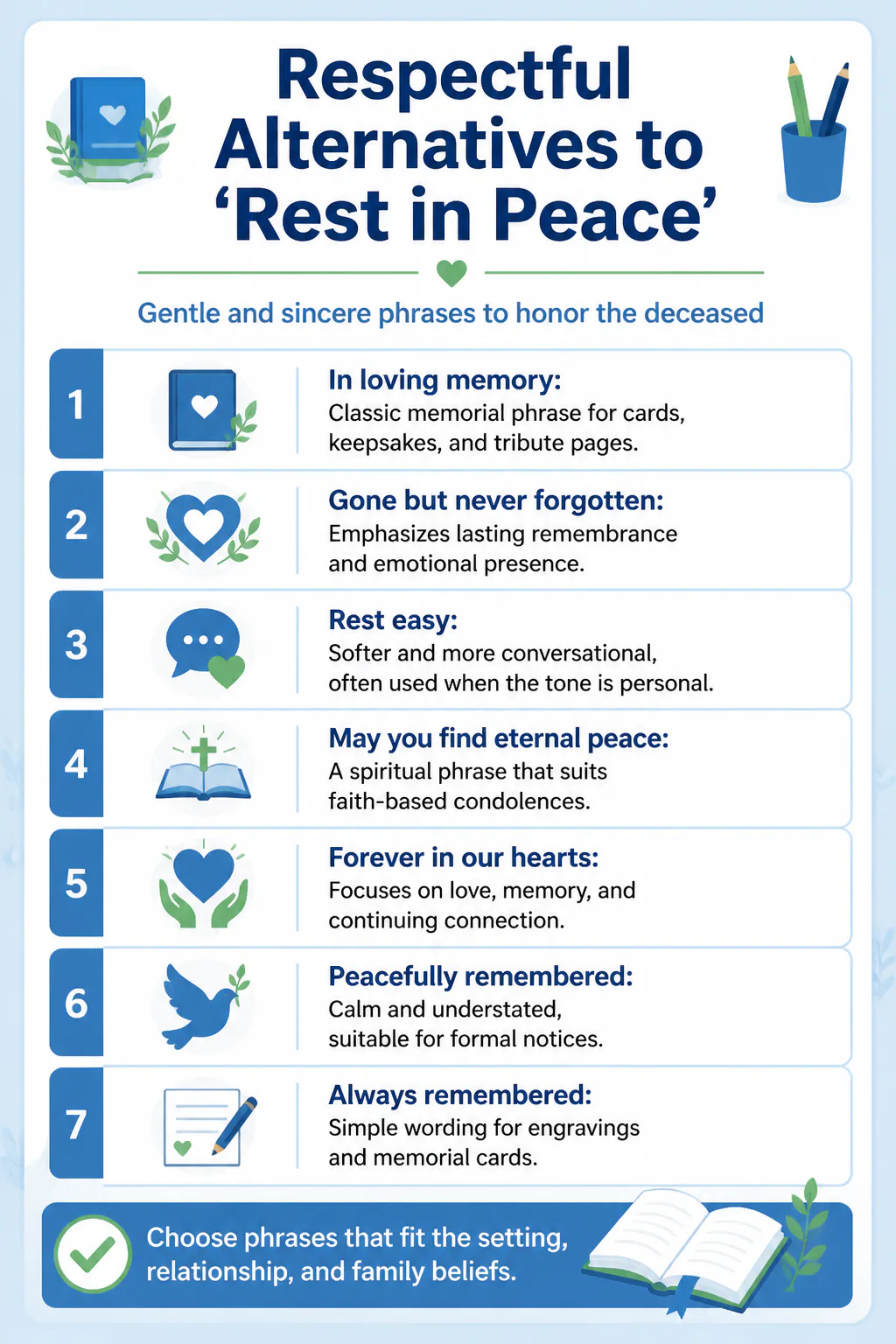
- In loving memory – A classic memorial phrase for cards, keepsakes, and tribute pages.
- Gone but never forgotten – Emphasizes lasting remembrance and emotional presence.
- Rest easy – Softer and more conversational, often used when the tone is personal.
- May you find eternal peace – A spiritual phrase that suits faith-based condolences.
- Forever in our hearts – Focuses on love, memory, and continuing connection.
- Peacefully remembered – Calm and understated, suitable for formal notices.
- Always remembered – Simple wording for engravings and memorial cards.
- With love and remembrance – Appropriate for private messages and sympathy notes.
- May your soul be at peace – Best used when spiritual language is welcome.
- Cherished in memory – A dignified option for obituaries and printed memorials.
Choosing by context
Context matters as much as wording. Short phrases are often best for engravings and keepsakes because space is limited and the message needs to stay clear. Longer, more expressive lines usually fit memorial pages, obituaries, and social posts better, where there is room for a fuller tribute.
| Context | Best phrase style | Examples |
|---|---|---|
| Sympathy card | Warm and personal | With love and remembrance, Forever in our hearts |
| Obituary | Formal and dignified | In loving memory, Cherished in memory |
| Engraving | Short and clear | Always remembered, Rest easy |
| Memorial post | Expressive and heartfelt | Gone but never forgotten, Forever in our hearts |
| Private message | Gentle and sincere | Rest easy, With love and remembrance |
Common Alternatives to ‘Rest in Peace’
Simple phrases
- Rest easy
- Always remembered
- Peacefully remembered
- With love and remembrance
Poetic phrases
- Gone but never forgotten
- Forever in our hearts
- Cherished in memory
- In loving memory
Spiritual phrases
- May you find eternal peace
- May your soul be at peace
- Rest in eternal light
- Peace to your soul
Some families prefer language that stays neutral and comforting rather than openly religious. If you want a broader list of a rest in peace synonym, focus on phrases that express remembrance, peace, and love without sounding casual.
Cultural Variations
Beliefs shape the wording
Condolence language differs across families, cultures, and faith traditions. In some settings, spiritual phrases feel deeply appropriate and comforting. In others, a neutral line such as “Forever in our hearts” or “In loving memory” is more respectful because it avoids assumptions about the afterlife.
Use spiritual language carefully
Religious or spiritual phrases should be used thoughtfully, especially if you are not sure what the family believes. A phrase like “May you find eternal peace” can be beautiful, but only when it aligns with the family’s wishes. If you are uncertain, simpler memorial wording is usually the safest and kindest choice.
That same sensitivity applies when deciding what can I say instead of rest in a public tribute, where many readers from different backgrounds may see the message.
When and How to Use Alternative Phrases
Match the phrase to the setting
Choose short wording for engraved items, urn plaques, keepsakes, and floral ribbons. Use fuller and more expressive language for obituaries, memorial services, and online tributes. In a private message, warmth matters more than formality, so a brief heartfelt line often works best.
Match the phrase to the relationship
If the person was a close relative or friend, more personal wording can feel right. If you are writing on behalf of a workplace, community group, or formal organization, a restrained phrase usually reads better. The closer and more personal the relationship, the more natural it is to choose language rooted in memory and affection.
- For a card: choose warm, gentle wording.
- For an obituary: choose dignified, polished wording.
- For an engraving: keep it short and timeless.
- For a memorial service: consider the family’s tone and beliefs.
- For a public post: stay respectful and widely appropriate.
Avoid common mistakes
Do not choose wording that feels overly casual or clever. Avoid technical religious language if you are unsure of its meaning or relevance. Most importantly, do not make the phrase about your own discomfort; the goal is to honor the person who died and support those who are grieving.
FAQs
What is another word for rest in peace?
Common alternatives include “In loving memory,” “Rest easy,” “Gone but never forgotten,” and “Forever in our hearts.” The best choice depends on tone, setting, and the family’s beliefs.
Is it okay to use a non-religious alternative?
Yes. Neutral phrases are often the most respectful choice when you do not know the family’s faith or when you want wording that feels broadly appropriate.
What phrase works best for an engraving?
Short phrases usually work best for engravings and keepsakes. Good examples include “In loving memory,” “Always remembered,” and “Rest easy.”
Should I use spiritual phrases in a condolence message?
Use spiritual wording only if it matches the beliefs of the deceased or their family. If you are unsure, choose a simple expression of remembrance and peace instead.
Conclusion
Finding another word for rest in peace comes down to choosing a phrase that fits the setting, respects the family’s beliefs, and honors the person being remembered.

Related Posts

30 Other Ways to Say “Thank You” (With Examples)
ONG Meaning in Text: What Does ONG Stand For?