
I Hope Everything Is Going Well with You: Meaning and Proper Use
“I hope everything is going well with you” is a polite English phrase used to show care and ask, in a gentle way, how someone’s life or situation is going. You will often see it in emails, messages, and conversations because it sounds warm, respectful, and neutral. It works in both professional and personal settings, especially when you want to begin communication on a friendly note. If you want simpler alternatives, you can also say “I hope you’re doing well” or “I hope things are going smoothly.”
Although the phrase is common, using it well matters. The context, the relationship, and the tone of your message all affect whether it sounds thoughtful or too routine. The phrase is often used to open emails and messages because it expresses goodwill while keeping the tone natural and professional.
Meaning of the Phrase
What it means
At its core, the phrase expresses care and goodwill. When you say, “I hope everything is going well with you,” you are telling the other person that you want their life, work, health, or current situation to be positive. It is not a direct question like “How are you?” but it still invites a response if the other person wants to share one.
The word “hope” carries the idea of a desire joined with expectation or belief that something good is happening. In this phrase, “everything is going well” refers to ongoing parts of a person’s life, not just one small moment. That is why it feels broader than a quick greeting.
How English speakers use it
English speakers often use this expression as an opening line before the main reason for writing or speaking. In an email, for example, it creates a polite bridge before a request, update, or question. In conversation, it can work as a friendly check-in, especially if you have not spoken to someone recently.
Because it refers to an ongoing situation, it sounds natural when you want to acknowledge the other person as a person, not only as someone you need something from. That is one reason it appears so often in workplace communication.
Why it sounds polite
- The phrase is polite because it shows attention to the other person’s well-being before moving to your main point.
- It is friendly without being too personal, which makes it useful in many situations.
- If you are learning email etiquette, it belongs to the same family of greetings as hope you are doing well, but this version sounds slightly broader because it refers to “everything,” not just the person’s immediate mood.
It also avoids pressure. Instead of demanding details, it leaves space for the other person to respond briefly or not at all. That balance makes it especially effective in professional writing.
When it works best
This phrase is most useful when you are reconnecting, beginning an email, or softening the start of a message. It fits situations such as writing to a colleague, contacting a client, checking in with a friend, or following up after some time has passed. It works in both formal and informal communication because its tone is neutral.
Still, it should not be your only opening line every time. If you repeat it too often, it can start to sound generic. In that case, using a variation can make your communication feel fresher and more natural.
Quick comparison
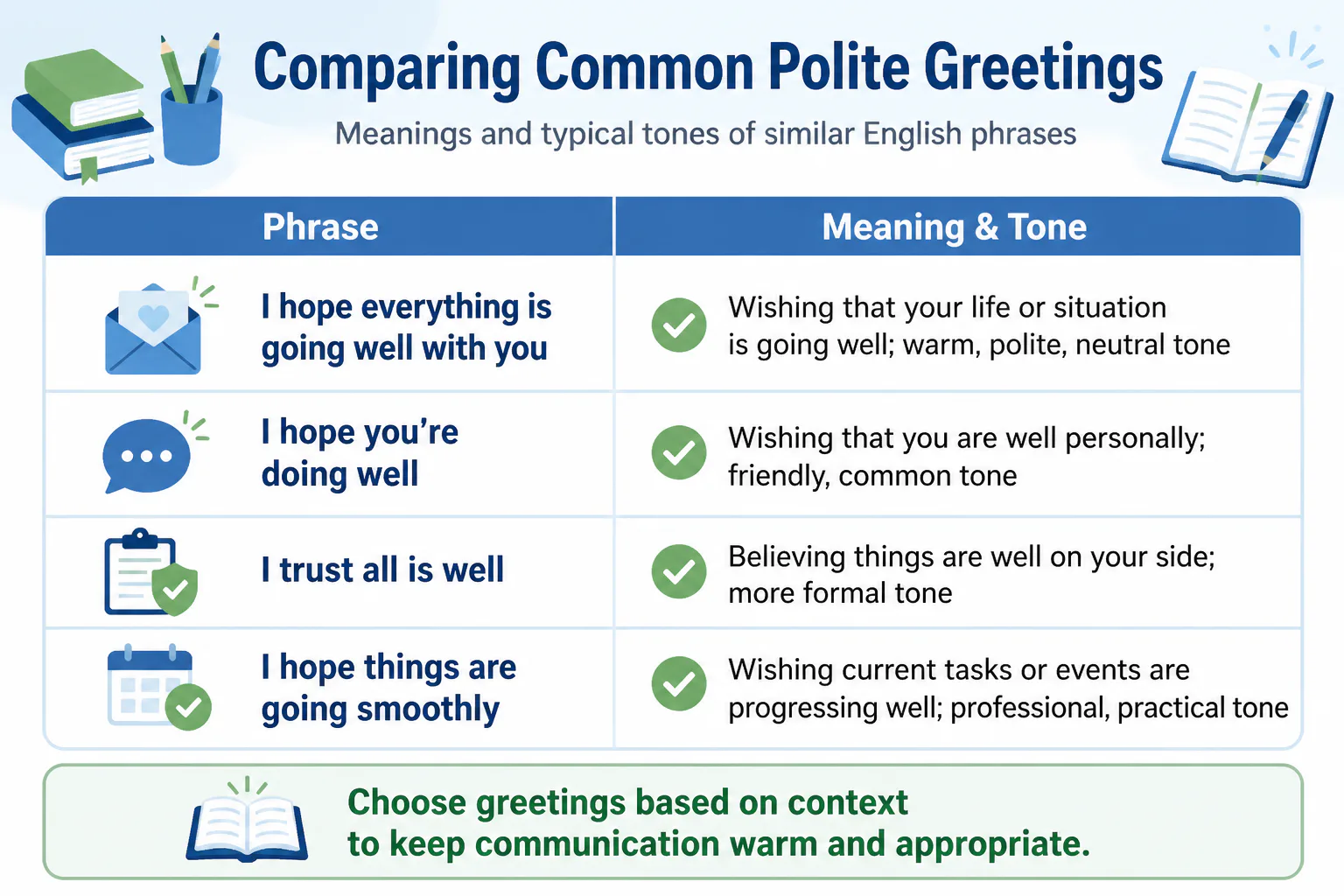
| Phrase | Meaning | Typical tone |
|---|---|---|
| I hope everything is going well with you | I wish that your life or situation is going well | Warm, polite, neutral |
| I hope you’re doing well | I wish that you are well personally | Friendly, common |
| I trust all is well | I believe things are well on your side | More formal |
| I hope things are going smoothly | I wish that current tasks or events are progressing well | Professional, practical |
Politeness
What tone it gives
- The tone is neutral, friendly, and considerate.
- It is not overly emotional, and it is not cold.
- That middle ground is what makes it so useful across many types of communication.
It also shows emotional awareness. Even if your main purpose is practical, opening this way signals that you recognize the other person as more than a task or transaction. In English-speaking settings, that small touch often improves the feel of a message.
When it can sound weak
The phrase can lose strength if you use it too often or in a copy-and-paste way. Readers quickly notice when a greeting feels automatic. In some cases, a more specific line sounds better, especially if you already know what is happening in the person’s life or work.
For example, if you know someone has been busy with a project, a more tailored sentence may feel more genuine than a standard greeting. This is similar to how phrases like looking forward to working with you sound best when they match a real context rather than serving as filler.
Common mistakes
- Using a very casual alternative in a formal business email.
- Starting with the phrase but giving no meaningful follow-up.
- Repeating the same greeting in every message.
- Using it in situations where a more specific comment would sound more sincere.
Alternative Phrases
Formal alternatives
- I trust all is well.
- I hope things are going smoothly.
- I hope all is going well on your end.
- I trust life is treating you well.
Neutral alternatives
- I hope you’re doing well.
- I hope all is well with you.
- I hope you’ve been well.
- I hope things are going well for you.
Warmer alternatives
- I hope you and your family are well.
- I wish you well on all your endeavors.
- I hope your week is going well.
- I hope your day is going smoothly.
Examples in Sentences
Email examples
- I hope everything is going well with you. I’m writing to follow up on our meeting from last week.
- I hope everything is going well with you and your team. Please find the updated document attached.
- I trust all is well. I wanted to confirm the timeline for the project.
Message examples
- Hi Maria, I hope everything is going well with you. It’s been a while since we last talked.
- I hope you’re doing well. Just checking in to see how things have been.
- I hope things are going smoothly for you this week.
Conversation examples
- I hope everything is going well with you at work.
- I hope everything is going well with you since the move.
- I hope all is well with you these days.
FAQs
Is this phrase formal or informal?
It can be both. The phrase is neutral, so it fits professional emails and personal messages as long as the rest of the communication matches the setting.
Is it the same as “I hope you’re doing well”?
They are very close in meaning, but not identical. “I hope everything is going well with you” sounds broader because it refers to the person’s overall situation, not only their personal state.
Can I use it in every email?
No. If you use it in every message, it can sound repetitive or automatic. Rotate it with other polite openings or write something more specific when possible.
Do I need a reply to it?
No. It is often used as a courteous opening rather than a direct request for details. The other person can reply briefly, fully, or simply move on to the main topic.
Conclusion
“I hope everything is going well with you” works best when you want to sound warm, polite, and natural at the start of a message. Use it with the right context and vary it when needed to keep your communication fresh.