Hope Everything Is Going Well: Meaning and Proper Usage
“Hope everything is going well” is a polite English phrase used to show care and friendly interest in someone’s current situation. People often use it in emails, messages, and conversations as a warm opening before moving to the main point. Its tone is neutral, so it works in both professional and personal communication when you want to sound courteous without becoming too personal.
It does not ask for detailed information. Instead, it gently expresses goodwill and suggests that you want the other person to be doing fine. Because it refers to an ongoing situation, it points to how life, work, or a specific matter is progressing right now.
Meaning of ‘Hope Everything Is Going Well’
The phrase means, in simple terms, “I hope your life, work, or current situation is going smoothly.” It is a polite way to acknowledge the other person before discussing your main reason for writing or speaking. Rather than making a direct request for an update, it expresses care in a soft, socially comfortable way.
What the phrase conveys
When you say this, you are communicating two things at once: kindness and distance. The kindness comes from showing concern for the other person’s well-being. The distance comes from the fact that you are not asking a deeply personal question, which is why the phrase feels safe in many contexts.
That balance makes it common in workplace emails, check-ins, and everyday messages. If you are writing to a colleague, client, teacher, or acquaintance, the phrase helps set a respectful tone before the main message begins.
Why it sounds polite
“Hope everything is going well” has a positive and hopeful tone. It suggests confidence that things are fine, but it does not claim certainty. That matters because it sounds considerate rather than intrusive.
It is also neutral enough to fit different relationships. In a business email, it sounds professional. In a message to a friend you do not speak with often, it sounds warm without feeling stiff.
How grammar affects meaning
The phrase uses the present continuous idea of “going well” to refer to an ongoing situation. In other words, it is about how things are progressing now, not only how they were in the past. That is why it feels natural in follow-up emails, project updates, and general check-ins.
For example, if you contact someone during a busy week, this phrase suggests you are thinking about how that week is unfolding for them. That ongoing sense is one reason the expression feels smooth and conversational.
Where people commonly use it
You will often see the phrase at the beginning of an email or message. It works especially well when the main purpose of the message is practical, because it softens the transition into the real topic. If you often write openers such as hope you are doing well, this version feels slightly broader because it refers to everything, not only the person directly.
- Professional emails to coworkers, clients, or supervisors
- Friendly messages to acquaintances
- Follow-up notes after a meeting or event
- General check-ins when you have not spoken recently
When the phrase works best
Use it when you want to be polite, calm, and respectful. It is especially effective when you need a brief opening line before asking a question, sharing an update, or making a request. It works best when followed by something meaningful, not when it stands alone as empty politeness.
For instance, “Hope everything is going well. I wanted to follow up on the report” sounds natural. By contrast, using the phrase with no real follow-up can feel generic.
When and How to Use This Phrase
Use this phrase when the relationship calls for warmth but not deep familiarity. In formal and semi-formal communication, it helps create a courteous opening. In casual communication, it still works, though shorter versions may sound more natural.
Professional settings
In work emails, this phrase is useful when writing to someone you know but do not interact with closely every day. It sounds respectful and steady, which is why many people use it in introductions, follow-ups, and requests. If your next line is task-focused, pairing it with clear purpose keeps the message from sounding routine.
Personal settings
With friends, relatives, or familiar contacts, the phrase can still sound nice, but it may feel slightly formal depending on the relationship. In relaxed conversation, people often switch to more direct lines such as asking how is your day going or saying they hope you are doing great.
Best practice
A good rule is simple: use it as an opening, then quickly add context. Mention the reason for your message, refer to a recent event, or personalize the note. That small step makes the phrase feel intentional rather than copied.
Examples
Professional examples
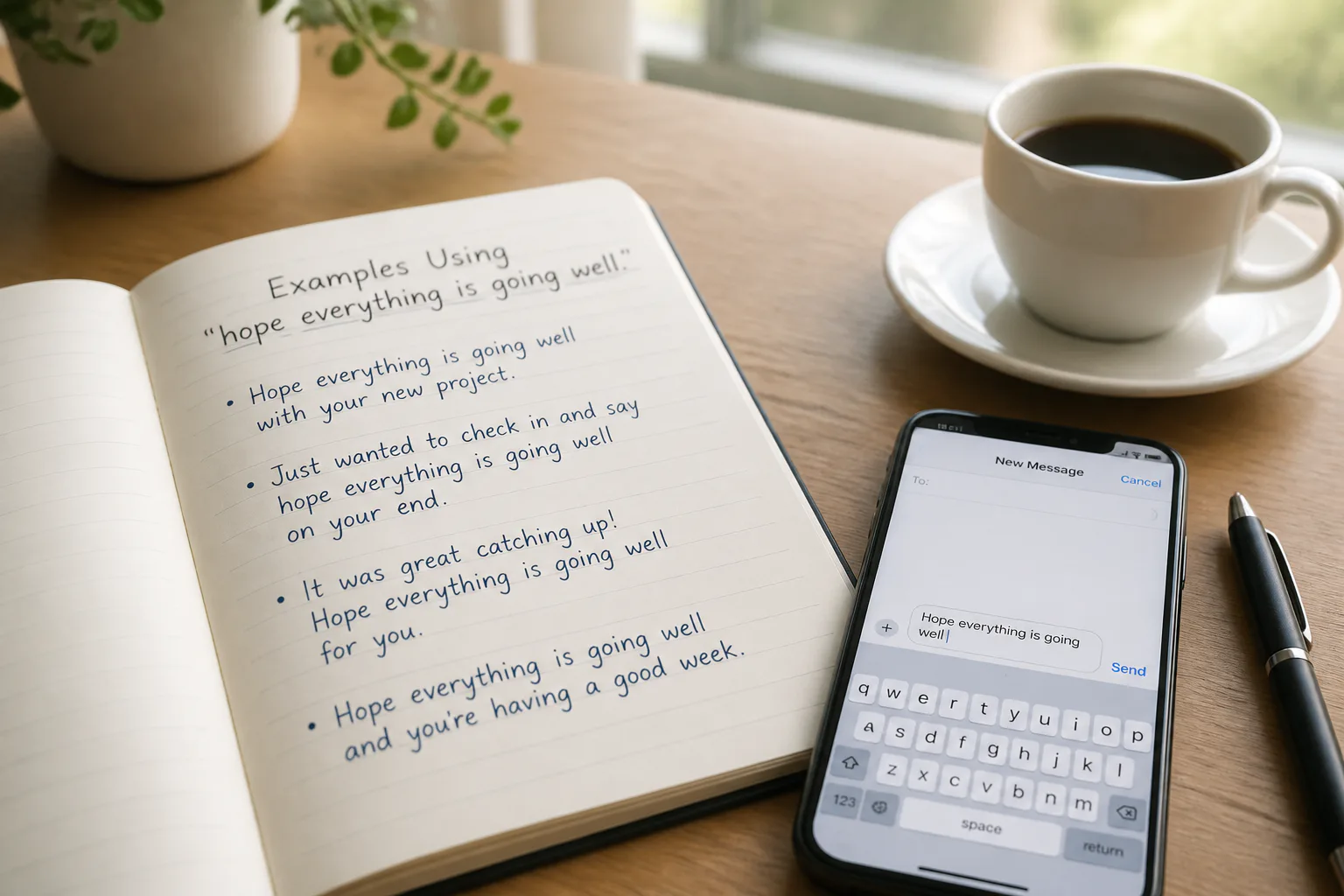
- Hope everything is going well. I wanted to follow up on our meeting from Tuesday.
- I hope everything is going well with you. I am writing to confirm the deadline for the project.
- I hope you’re doing well. Thank you for your earlier response.
- I hope you’re having a good week. I wanted to check whether the documents were received.
- I trust all is well. I am reaching out regarding next month’s schedule.
Personal examples
- Hope everything is going well with you and your family.
- Hope everything is going well. It has been a while since we last talked.
- Hope you’re doing great and enjoying your new job.
- How are you doing? I was thinking about you today.
Email opening patterns
- Hope everything is going well. I’m writing to ask about…
- I hope everything is going well with you. Just a quick note to…
- I hope you’re doing well. I wanted to share…
- I hope you’re having a good week. I’m following up on…
These openings work best when the second sentence gets to the point. In the same way, clear closings matter too, especially if your message includes a file and phrases like please see attached need to sound natural and professional.
Alternatives
Formal alternatives
- I hope you’re doing well.
- I trust all is well.
- I hope things are going smoothly.
- I hope you’re having a good week.
Casual alternatives
- Hope you’re doing great.
- How are you doing?
- Hope things are going well.
- Hope your week is going smoothly.
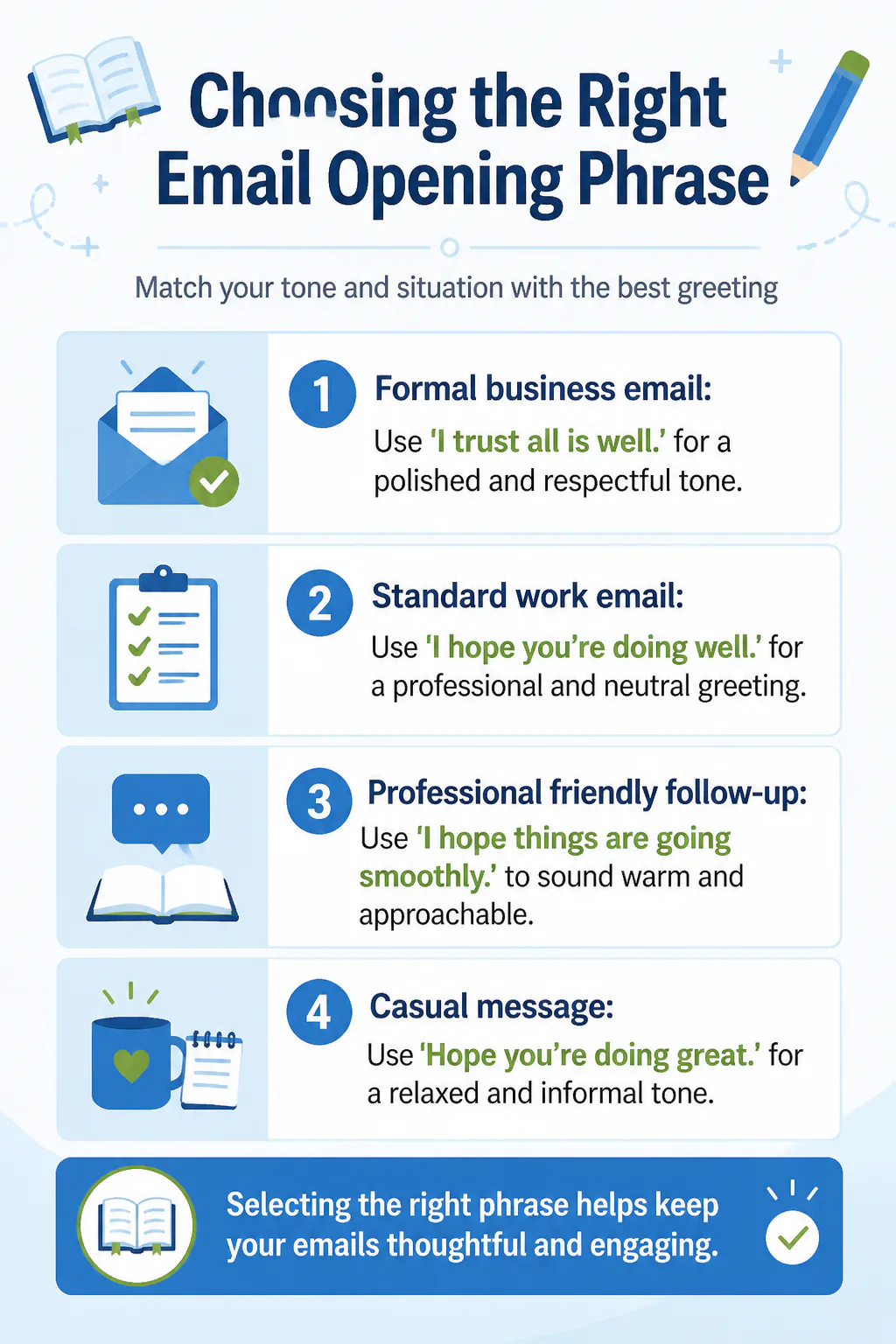
How to choose the right one
| Situation | Better choice | Tone |
|---|---|---|
| Formal business email | I trust all is well. | Polished |
| Standard work email | I hope you’re doing well. | Professional |
| Friendly follow-up | I hope things are going smoothly. | Warm |
| Casual message | Hope you’re doing great. | Relaxed |
Using alternatives helps you avoid repetition. If you begin every email with the same line, your writing can sound automatic rather than thoughtful.
Tone Considerations
This phrase is polite and effective, but only when it matches the situation. In professional communication, it works well because it shows respect without sounding too personal. In more serious situations, though, a generic line can feel out of place, especially if the person is dealing with difficulty and you know it.
When to use it
Use it when you need a neutral, friendly opening and do not want to overstep. It fits especially well in routine emails, check-ins, and first messages after some time apart. It also works when you want to soften a request or transition into business.
When to avoid it
Avoid it if you already know that things are not going well for the other person. In that case, a more direct and sensitive line is better. Also avoid using it in every message, because overuse can make your writing feel generic and less engaging.
How to make it better
The easiest way to improve the phrase is to add specifics. Mention a recent event, shared project, or reason for writing. For example, “Hope everything is going well. I enjoyed our conversation last week and wanted to follow up” feels more personal than a standard opening alone.
FAQs
Is “hope everything is going well” formal?
It is neutral rather than highly formal. That makes it suitable for many professional emails, while still sounding natural in personal messages.
Can I use it in an email?
Yes. It is one of the most common email openers in English because it is polite, brief, and easy to pair with the main purpose of the message.
Is it overused?
Yes, it can be. If you use it too often, your messages may sound repetitive, so alternatives and added context help keep your writing fresh.
What is a better alternative in business writing?
“I trust all is well” is a stronger formal option. “I hope you’re doing well” is another safe and widely accepted choice.
Conclusion
“Hope everything is going well” works best as a polite opener when you match it to the relationship, tone, and purpose of your message.