
I Hope You’re Doing Well Meaning: Definition & Usage
“I hope you’re doing well” means I wish you well or I care about how you are. It is a polite, friendly phrase people often use at the beginning of an email or message, especially in professional communication. The line is grammatically correct, easy to understand, and generally warm in tone, but it can also feel routine if it is used too often.
If you searched for i hope you’re doing well meaning, the short answer is simple: it is a greeting that shows concern for the other person’s well-being before moving into the main message. You will see it in emails to coworkers, clients, teachers, and acquaintances. In casual situations, people may shorten it to “Hope you’re doing well,” which is widely accepted even though it leaves out the subject “I.”
Meaning of ‘I hope you’re doing well’
Literal meaning
Literally, the phrase expresses a hope that the other person is healthy, comfortable, or in a good state. It is not asking for detailed personal news. Instead, it works as a brief sign of kindness before the writer gets to the purpose of the message.
Implied meaning
In real use, the phrase does more than state hope. It signals respect, friendliness, and social awareness. In many emails, it functions as a soft opening that makes the message feel less abrupt.
That is why it appears so often in workplace writing. A direct message such as “Please send the report by noon” can sound cold on its own, while “I hope you’re doing well. Please send the report by noon” sounds more considerate.
How it appears in writing
You will usually find the phrase near the start of an email, right after the greeting. For example:
- Hi Maria, I hope you’re doing well.
- Hello Mr. Chen, I hope you’re doing well and having a productive week.
- I hope you’re doing well. I’m writing to follow up on our meeting.
Writers also use close variations. If you want a full breakdown of another common version, see I hope you are doing well, which uses the same basic meaning in a slightly more complete form.
Why it can sound overused
The phrase is clear and correct, but it has become a standard opener in business email. Because so many people use it, some readers skim past it without noticing. In that sense, it can sound polite yet generic rather than personal.
That does not mean you should never use it. It simply means the phrase works best when the situation calls for a neutral, respectful opening, not when you want to sound especially memorable or personal.
Useful alternatives
If you want the same basic idea with a different feel, you can choose a close alternative. “I hope this email finds you well” sounds more formal and traditional. “Hope all is well” is shorter and more conversational. “I hope you’re having a good week” feels a little more specific, while “How are you doing?” invites an actual response.
Usage
Email openings
This phrase is most common in email communication. People use it when writing to colleagues, clients, professors, supervisors, or someone they do not contact often. It creates a courteous opening before a request, update, question, or follow-up.
Formal and informal situations
You can use the phrase in both formal and informal writing, but it appears most often in professional settings. In a message to a friend, it may sound slightly stiff unless the rest of the note is also calm and thoughtful. In a work email, that same wording usually sounds natural.
Some similar greetings, such as hope you are doing well messages, are especially useful when you need a polite opener without sounding too personal.
Using Grammarly tools
If you are unsure whether this opener fits your message, Grammarly can help you shape it. You can use the AI email writer to draft an email, choose an opener such as “I hope you’re doing well” or an alternative, use Reader Reactions to preview how it may be received, adjust the tone, and then send the email.
Tone
Polite and friendly
The usual tone of this phrase is polite, friendly, and professional. It shows that the writer is not jumping straight into business. That small moment of warmth can make a message feel more human.
Neutral rather than emotional
At the same time, the phrase is fairly neutral. It does not show strong emotion, deep familiarity, or urgency. That is why it works well with acquaintances and professional contacts but may feel distant in very close relationships.
Small changes can shift the tone. For example, “I hope you’re having a good week” sounds more current and personal, while everything is going well with you can feel a bit warmer and more conversational.
When it sounds insincere
The phrase can sound insincere when it is clearly just filler. If the message is blunt, demanding, or copied into dozens of emails, the opener may not feel genuine. Readers notice when a warm greeting is followed by a cold or abrupt tone.
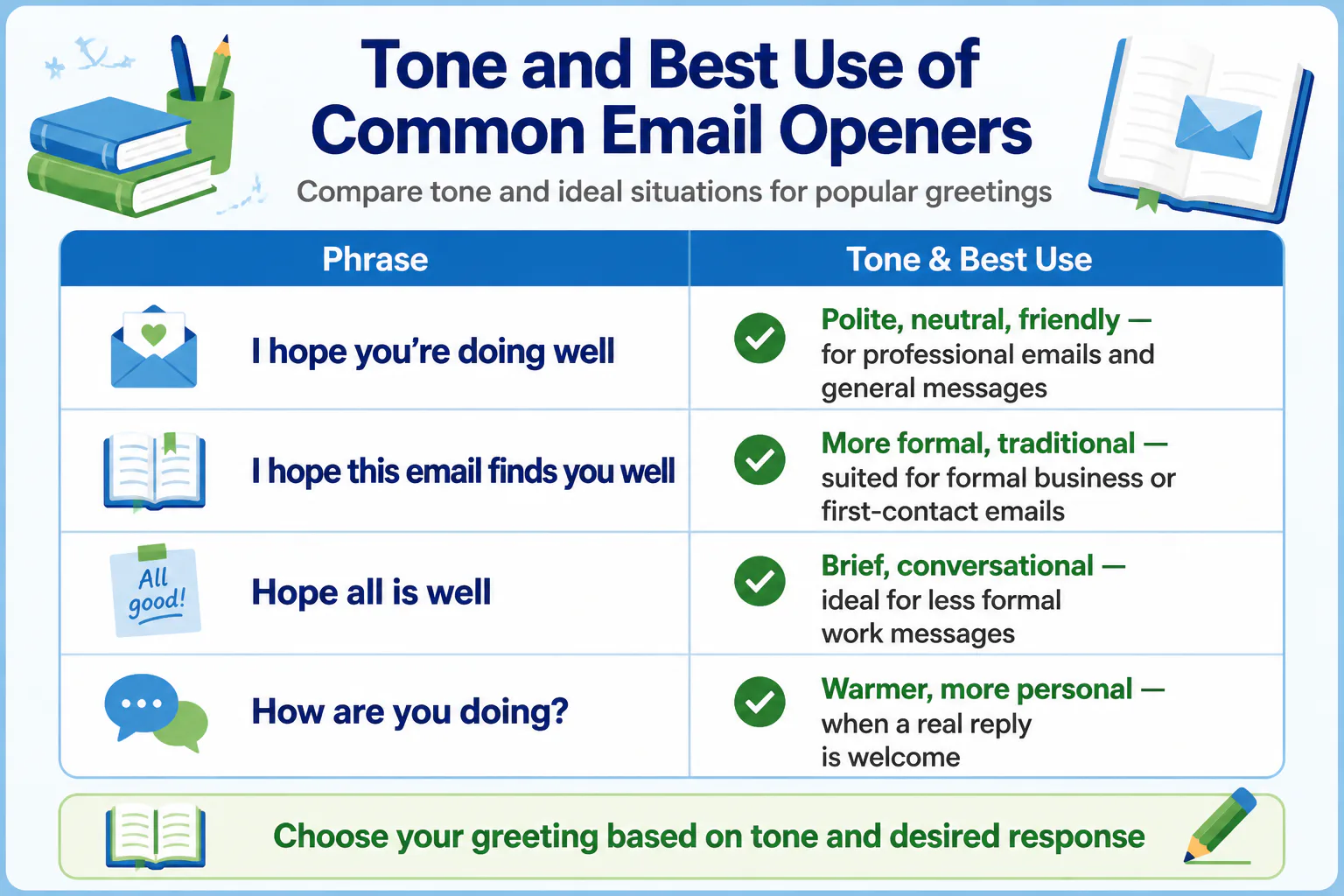
| Phrase | Tone | Best use |
|---|---|---|
| I hope you’re doing well | Polite, neutral, friendly | Professional emails and general messages |
| I hope this email finds you well | More formal, traditional | Formal business or first-contact emails |
| Hope all is well | Brief, conversational | Less formal work messages |
| How are you doing? | Warmer, more personal | Messages where a real reply is welcome |
Alternatives to ‘I hope you’re doing well’
Try these options
- I hope this email finds you well.
- Hope all is well.
- I hope you’re having a good week.
- How are you doing?
- I hope things are going smoothly for you.
- I hope your week is off to a good start.
Choose by situation
- Use “I hope this email finds you well” when you want a more formal tone.
- Use “Hope all is well” when you want something shorter and lighter.
- Use “I hope you’re having a good week” when you want to sound more specific.
- Use “How are you doing?” when you truly want the other person to answer.
Tips for using the phrase effectively
Keep it natural
- Use the phrase when you want a safe, polite opener.
- Avoid repeating it in every email, especially to the same person.
- Match the rest of the message to the friendly tone of the opening.
- Choose a more specific alternative if you know something about the person’s week, project, or situation.
- Do not force it into urgent messages where speed matters more than small talk.
Follow a simple process
- Use Grammarly’s AI email writer to draft your email.
- Choose an appropriate greeting or opener.
- Use Reader Reactions to preview how the greeting will be received.
- Adjust the greeting or tone based on that feedback.
- Send the email once the opening matches your purpose.
FAQs
Is “I hope you’re doing well” grammatically correct?
Yes. It is a grammatically correct sentence and a standard email opener.
Is “Hope you’re doing well” wrong?
No. It is technically incomplete because the subject “I” is omitted, but it is widely accepted in everyday writing and email.
Is the phrase formal or informal?
It can work in both, but it is most common in professional and business emails. Its tone is polite and neutral rather than casual.
Should I stop using it because it is cliché?
Not necessarily. It is still useful, but it works best when you use it selectively and vary your openings when you want to sound more personal.
Conclusion
“I hope you’re doing well” remains a useful, polite opener when you want a friendly but professional tone in emails and messages.